Visit PM Intelli Hub YouTube Channel

AI-Powered Skills for Project Managers

Guide to AI for Non-Technical Project Managers: Getting Started

Artificial Intelligence is no longer limited to data scientists or software engineers. AI for Non-Technical Project Managers is quickly becoming a practical advantage for professionals who manage scope, schedules, budgets, risks, and stakeholders — without writing a single line of code.

If you lead projects, run a PMO, build schedules, or manage engineering contracts, AI is not about replacing your expertise. It is about amplifying it. Used correctly, AI helps you think faster, analyze better, and communicate more clearly.

This guide explains AI from first principles and shows how non-technical project managers can start using it immediately in real-world projects.


What AI Actually Means for Project Managers

Before tools and trends, we need clarity.

At its core, AI is software that can:

  • Recognize patterns in data
  • Generate structured text or reports
  • Summarize complex information
  • Suggest options based on historical inputs
  • Automate repetitive analysis

For project managers, that translates into:

  • Faster risk identification
  • Automated schedule analysis
  • Smarter cost forecasting
  • Improved stakeholder communication
  • Better decision support

AI does not replace project judgment. Instead, it strengthens your ability to process information quickly.


Why AI for Non-Technical Project Managers Matters

Most project managers are domain experts — not programmers. Yet they deal with:

  • Massive schedules
  • Thousands of cost line items
  • Complex contracts
  • Frequent change orders
  • Multi-stakeholder communications

AI becomes powerful when applied to these daily realities.

For example:

Project AreaTraditional ApproachAI-Enhanced Approach
Risk RegisterManual brainstormingPattern-based risk suggestions
Schedule ReviewManual critical path checksAutomated delay impact simulation
Cost ForecastSpreadsheet extrapolationPredictive trend analysis
ReportingManually written summariesAI-drafted executive reports

The difference is not sophistication. It is speed and clarity.

For a deeper foundation on performance tracking, see:
Baseline vs Current Schedule: What Every Scheduler must Know


Understanding AI Without Technical Jargon

Let’s simplify AI into three practical categories relevant to project management.

1. Generative AI

This type creates content. Examples include:

  • Drafting risk descriptions
  • Writing meeting summaries
  • Creating executive updates
  • Generating project charters

It saves time on documentation-heavy work.


2. Predictive AI

This analyzes historical data to forecast outcomes.

Applications in projects:

  • Cost overrun prediction
  • Schedule slippage probability
  • Resource utilization forecasting

This type supports decision-making rather than documentation.


3. Analytical AI

This identifies trends, anomalies, or patterns.

Use cases:

  • Detecting unusual cost spikes
  • Identifying repetitive delay causes
  • Spotting risk clusters

For PMO leaders, this category can elevate portfolio oversight.


Step-by-Step: How to Get Started with AI for Non-Technical Project Managers

You do not need a digital transformation program to begin. Follow this structured approach.


Step 1: Identify Repetitive Mental Work

Start by asking:

  • What tasks consume mental energy every week?
  • What reports are manually recreated?
  • Where do I analyze patterns repeatedly?

Common candidates include:

  • Weekly status reports
  • Risk register updates
  • Lessons learned summaries
  • Change impact narratives

If the task involves text, patterns, or repetitive structure, AI can likely assist.


Step 2: Start with Low-Risk Applications

Avoid jumping into predictive modeling immediately.

Begin with:

  • Drafting executive summaries
  • Rewriting technical updates into plain language
  • Creating structured meeting minutes
  • Developing communication plans

Example:
An infrastructure PM managing a wastewater pump station project uses AI to convert field engineer notes into concise stakeholder-ready updates. The PM reviews and refines — but saves 45 minutes per report cycle.


Step 3: Use AI to Think, Not Just Write

Many PMs limit AI to drafting emails. That is a missed opportunity.

Try prompting AI to:

  • Identify potential risks in a scope description
  • Suggest failure points in a procurement strategy
  • Stress-test your schedule logic assumptions
  • Challenge your mitigation plan

AI becomes a thinking partner, not just a writing assistant.


Step 4: Integrate AI into Project Controls

For schedulers and cost engineers, AI can assist with:

  • Interpreting variance trends
  • Identifying likely root causes
  • Simulating “what-if” scenarios

If you work with earned value metrics, AI can help explain:

  • CPI/SPI trends
  • Forecast implications
  • Narrative explanations for leadership

For additional context, see:
Earned Value Explained for Engineering Projects


Step 5: Establish Boundaries and Governance

AI should never:

  • Approve change orders
  • Replace engineering validation
  • Make contractual decisions
  • Substitute professional judgment

Instead, use it to:

  • Generate options
  • Highlight blind spots
  • Accelerate preparation

PMOs should define:

  • Acceptable AI use cases
  • Data privacy guidelines
  • Human review requirements

Real-World Project Examples

Let’s make this practical.


Example 1: Highway Construction Project

Challenge: Repeated schedule delays due to utility relocation conflicts.

AI Use:

  • Analyze delay logs
  • Identify recurring root causes
  • Suggest preventive controls

Result:
The PM identifies a pattern: coordination gaps between utility providers and roadway crews. A structured pre-construction utility workshop is introduced, reducing recurring delays.


Example 2: IT System Implementation

Challenge: Executive stakeholders complain that status reports are too technical.

AI Use:

  • Convert detailed sprint updates into business-impact language
  • Summarize risks into three decision-oriented bullet points

Result:
Stakeholder clarity improves. Meeting time reduces by 20%.


Example 3: PMO Portfolio Oversight

Challenge: 40 active capital projects with inconsistent reporting.

AI Use:

  • Normalize risk language
  • Categorize issues by trend type
  • Highlight cross-project themes

Result:
The PMO shifts from reactive reporting to proactive intervention.


Common Mistakes Non-Technical PMs Make with AI

Understanding what not to do is critical.

1. Treating AI as an Authority

AI generates suggestions — not validated truths.

Always verify:

  • Contract clauses
  • Engineering specifications
  • Regulatory references

2. Over-Automating Decision-Making

AI should support decisions, not replace them.

Professional accountability remains with the project manager.


3. Feeding Sensitive Data Without Controls

Avoid uploading:

  • Confidential contract details
  • Proprietary engineering drawings
  • Personal employee data

Establish internal guidelines first.


4. Using Vague Prompts

Weak prompt:

“Analyze this project.”

Strong prompt:

“Identify potential cost overrun risks in this civil construction scope based on procurement sequencing and subcontractor dependencies.”

Specificity improves output quality.


Practical Tips You Can Apply This Week

Here are actionable ways to begin immediately.

Improve Weekly Reporting

Prompt AI to:

  • Draft a 5-bullet executive summary
  • Translate technical delays into business impact
  • Highlight top 3 decisions needed

Strengthen Risk Workshops

Before a risk session:

  • Ask AI to generate 15 potential risks for your project type
  • Use them to stimulate discussion
  • Filter with your team

Analyze Change Orders

Use AI to:

  • Categorize change drivers
  • Identify recurring scope gaps
  • Suggest prevention strategies

For deeper insights on scope control, see:
Scope Creep in Engineering Projects: Causes and Prevention


Enhance Lessons Learned

After project closeout:

  • Feed anonymized issue logs
  • Ask AI to group themes
  • Extract systemic improvement areas

This improves organizational learning without additional staff effort.


How AI Elevates Project Leadership

AI for Non-Technical Project Managers is not about technical transformation. It is about leadership leverage.

When used correctly, AI helps you:

  • Think more strategically
  • Focus on stakeholder alignment
  • Detect early warning signals
  • Communicate clearly under pressure

It shifts your role from document producer to decision facilitator.


The Strategic Advantage for PMOs

For PMO leaders, AI offers portfolio-level visibility.

With structured use:

  • Risk trends can be aggregated
  • Variance explanations standardized
  • Executive dashboards improved
  • Predictive signals identified earlier

This is not digital hype. It is structured information leverage.


Final Thoughts: Start Small, Think Big

AI for Non-Technical Project Managers is not about becoming technical. It is about becoming more effective.

Start with one use case:

  • Weekly reporting
  • Risk analysis
  • Change narrative drafting

Build comfort. Develop internal standards. Then scale thoughtfully.

The competitive advantage will not go to the PM who uses AI the most.
It will go to the PM who uses AI with discipline, judgment, and strategic intent.

AI is a tool.
Project leadership remains human.


Frequently Asked Questions

Do I need to learn how to code to use AI as a project manager?

No. AI is now a practical tool for professionals who manage scope, schedules, and budgets without writing any code. The value of AI for a non-technical PM lies in using existing software and platforms to automate repetitive analysis, recognize data patterns, and summarize complex information, rather than building the underlying algorithms themselves.

How does AI actually differ from traditional project management methods?

Traditional approaches often rely on manual brainstorming for risk registers and manual critical path checks for schedule reviews. AI enhances these areas by providing pattern-based risk suggestions and automated simulations of delay impacts. Essentially, it moves project management from reactive, manual reporting to proactive, predictive analysis.

What are some "low-risk" ways to start using AI in my daily workflow?

If you are just starting, focus on documentation-heavy tasks that consume high mental energy. AI can be used to:
Draft executive summaries and weekly status reports.
Rewrite technical updates into plain language for stakeholders.
Summarize "lessons learned" from anonymized issue logs.
Create structured meeting minutes and communication plans.

How can AI be used as a "thinking partner" instead of just a writing assistant?

Beyond drafting emails, AI can be prompted to stress-test your project's logic. For example, you can ask AI to identify potential failure points in a procurement strategy, suggest hidden risks in a scope description, or challenge the assumptions in your schedule logic. This helps you identify blind spots you might have otherwise missed.

What are the major "dos and don'ts" when integrating AI into project management?

Do: Use AI to generate options, highlight trends, and accelerate preparation.
Don't: Treat AI as an absolute authority; always verify its outputs against contract clauses and engineering specs.
Don't: Feed sensitive or confidential contract data into public AI tools without internal governance.
Don't: Use AI to replace professional judgment or automate high-stakes decision-making like approving change orders.

Using AI to Improve Schedule Forecasting

Introduction: Why Schedule Forecasting Still Fails on Many Projects

Schedule forecasting sits at the heart of project control. Every major decision—funding, staffing, procurement, stakeholder commitments—depends on confidence in forecasted dates. Yet across engineering, infrastructure, IT, and capital programs, schedule forecasts are still frequently wrong.

The problem is not a lack of tools or effort. It is that traditional forecasting relies heavily on static logic, manual judgment, and backward-looking assumptions. This is where using AI to improve schedule forecasting becomes relevant—not as a replacement for schedulers, but as a way to strengthen forecasting accuracy, consistency, and early warning.

This article explains how AI can support better schedule forecasts from first principles, how PMs and PMOs can apply it responsibly, and where human judgment remains essential.


What Schedule Forecasting Really Means

Schedule forecasting is often misunderstood.

It is not simply recalculating a critical path or updating finish dates. At its core, schedule forecasting answers one question:

Based on current performance and known risks, how is the project likely to finish?

Good forecasting requires:

  • Reliable progress data
  • Logical schedules
  • Understanding of uncertainty
  • Recognition of behavioral patterns

AI helps by strengthening these inputs, not by guessing outcomes.


Why Traditional Schedule Forecasting Breaks Down

Before understanding AI’s role, it is important to understand why forecasting fails in the first place.

Common root causes include:

  • Over-optimistic remaining durations
  • Repeated manual adjustments without learning
  • Ignoring historical performance trends
  • Late recognition of emerging risks

Schedulers often “fix” forecasts to match expectations, which hides risk instead of managing it.


What AI Actually Does in Schedule Forecasting

AI does not magically predict the future. Instead, it identifies patterns and relationships that humans struggle to process consistently at scale.

When using AI to improve schedule forecasting, the technology typically supports four areas:

  • Pattern recognition across schedule updates
  • Probabilistic assessment of completion dates
  • Detection of abnormal schedule behavior
  • Learning from historical project performance

AI works best where large volumes of structured schedule data exist.


Step-by-Step: How AI Improves Schedule Forecasting

Step 1: Analyzing Historical Schedule Performance

AI systems can review past projects to identify:

  • Typical activity duration overruns
  • Common sequencing issues
  • Trade-specific productivity trends
  • Seasonal or contextual impacts

This historical lens improves the realism of future forecasts.


Step 2: Monitoring Schedule Update Behavior

AI can flag behaviors such as:

  • Repeated pushing of milestones
  • Artificial logic changes to preserve dates
  • Sudden float recovery without explanation

These signals often indicate forecast manipulation or hidden risk.


Step 3: Supporting Probabilistic Forecasting

Unlike deterministic schedules, AI-supported forecasting can:

  • Generate confidence ranges for finish dates
  • Highlight best-case and worst-case scenarios
  • Show likelihood distributions rather than single dates

This supports better executive decision-making.


Step 4: Identifying Early Risk Signals

AI excels at spotting subtle trends such as:

  • Gradual erosion of float
  • Increasing rework cycles
  • Slowing progress rates before delays are visible

This gives PMs time to intervene earlier.


AI vs Traditional CPM Forecasting

AspectTraditional CPMAI-Supported Forecasting
BasisLogic and durationsLogic, data patterns, trends
OutputSingle finish dateRange of probable outcomes
Risk detectionReactiveProactive
LearningManualContinuous

AI strengthens CPM; it does not replace it.


Real-World Example: Infrastructure Project

Scenario:
A highway expansion project with repeated utility conflicts.

Traditional Forecasting

  • Monthly updates push milestones forward
  • Recovery logic added late
  • Delays recognized after critical milestones slip

AI-Supported Forecasting

  • AI identifies utility-related delays across similar projects
  • Flags high-risk activities earlier
  • Forecast shows increasing probability of late completion

Outcome: leadership authorizes early mitigation funding, reducing overall delay.


Real-World Example: IT System Implementation

Scenario:
A multi-phase enterprise software rollout.

AI identifies:

  • Testing phases consistently underperform estimates
  • Dependencies between data migration and user acceptance testing

The forecast is adjusted early, allowing phased deployment rather than a failed big-bang launch.


How PMOs Use AI for Portfolio-Level Forecasting

At the portfolio level, AI supports:

  • Cross-project trend analysis
  • Early identification of systemic risks
  • Consistent forecasting assumptions

PMOs gain foresight instead of reacting to late surprises.

How PMOs Use Schedules for Portfolio Control


What AI Cannot Do (And Should Not Do)

AI should not:

  • Override professional judgment
  • Justify unrealistic commitments
  • Replace sound schedule logic
  • Be used to “defend” bad plans

Forecasting remains a leadership responsibility.


Common Mistakes When Using AI for Schedule Forecasting

1. Treating AI Outputs as Absolute Truth

AI provides insight, not certainty. Outputs must be interpreted, not accepted blindly.


2. Feeding Poor-Quality Schedules into AI

Bad logic, missing updates, and unreliable progress data produce misleading results—regardless of AI.


3. Ignoring Organizational Context

AI may flag risk, but only humans understand political, contractual, or regulatory constraints.


4. Using AI to Mask Accountability

AI should surface risk, not be used to shift blame.


Practical Tips PMs Can Apply Immediately

  • Use AI insights to challenge optimistic forecasts
  • Compare AI-generated ranges with team expectations
  • Focus AI analysis on high-risk milestones
  • Combine AI outputs with schedule reviews
  • Educate stakeholders on probabilistic forecasts

Start small. Value comes from disciplined use, not full automation.


How AI Improves Communication with Executives

Executives rarely want schedule detail. They want confidence.

AI-supported forecasting enables:

  • Clear confidence ranges
  • Visual risk trends
  • Early warning indicators

This improves trust and decision quality.


The Role of Governance When Using AI

Strong governance ensures AI supports, rather than undermines, control.

PMOs should define:

  • Where AI insights are used
  • How forecasts are approved
  • How conflicts between AI and human judgment are resolved

Governance keeps AI grounded in reality.

Baseline vs Current Schedule: What Every Scheduler Must Know


Strategic Takeaway: AI Makes Forecasting More Honest

The greatest value of using AI to improve schedule forecasting is not speed or automation—it is honesty.

AI exposes patterns humans tend to rationalize away. It highlights risk earlier, challenges optimism, and supports better decisions. Used responsibly, AI strengthens the scheduler’s role and improves leadership confidence.

Projects still succeed because of people. AI simply helps them see the future more clearly.


AI Prompt Engineering for Project Managers — Complete Guide

AI is no longer a novelty in project management—it is becoming a daily productivity partner. Yet the real differentiator is not which AI tool you use, but how well you communicate with it. This is where AI prompt engineering for project managers becomes a critical skill.

This pillar guide explains prompt engineering from a project management perspective, provides practical frameworks, real project examples, and links to deeper use cases across planning, cost, risk, and PMO functions.


What Is AI Prompt Engineering for Project Managers?

AI prompt engineering is the structured practice of designing clear, contextual, and goal-driven instructions that guide AI systems to produce reliable and useful outputs.

For project managers, prompt engineering is not about coding—it is about: - Translating project context into precise instructions - Defining constraints, assumptions, and outputs - Guiding AI to support decision-making

A well-written prompt can produce: - Accurate schedules - Reliable cost forecasts - Risk registers - Executive-ready reports

A poor prompt produces noise.

👉 Related article: What Is AI Prompt Engineering? A Non-Technical Guide for Project Managers


Why Prompt Engineering Matters in Project Management

Project environments are complex, regulated, and stakeholder-driven. Generic AI responses rarely meet professional PM standards.

Effective prompt engineering allows project managers to: - Improve output accuracy - Reduce rework - Standardize AI-assisted processes - Maintain governance and compliance - Scale productivity across teams

As AI becomes embedded in PM tools, prompt quality directly impacts project outcomes.

👉 Related article: Why Prompt Engineering Matters for Project Managers


How Project Managers Should Think About AI Prompts

Project managers should approach prompts the same way they approach: - Scope statements - Requirements definitions - Work packages

Every prompt should clearly define: - Role (Who the AI is acting as) - Objective (What problem is being solved) - Context (Project type, constraints, assumptions) - Output (Format, level of detail, audience)

Prompt engineering is structured communication—not experimentation.

👉 Related article: How Project Managers Should Think About AI Prompts


Core AI Prompt Frameworks for Project Managers

1. ROLE Framework

  • Role: Act as a project controls manager
  • Objective: Analyze cost performance
  • Limits: Use provided data only
  • Expectations: Executive-level summary

2. CRISP Framework

  • Context – Project background
  • Request – Specific task
  • Inputs – Data or assumptions
  • Structure – Output format
  • Perspective – PM, sponsor, or PMO

3. STAR Adapted for AI

  • Situation – Project scenario
  • Task – Required analysis
  • Action – Steps AI should follow
  • Result – Desired output

These frameworks dramatically improve consistency and reliability.

👉 Related article: Core Prompt Frameworks for Project Management


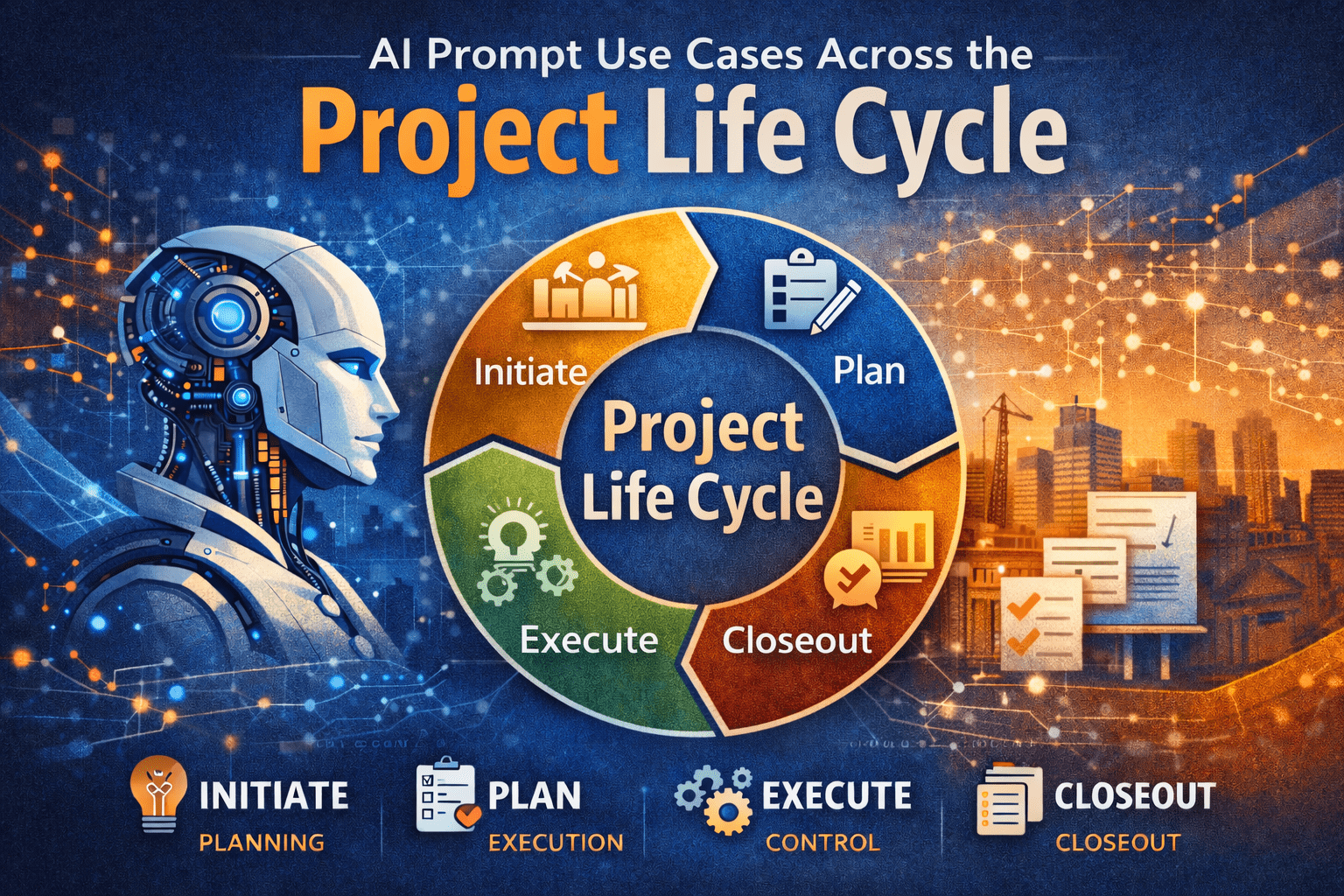
AI Prompt Use Cases Across the Project Life Cycle

Initiation & Planning

  • Drafting project charters
  • Creating WBS structures
  • Developing baseline schedules

Cost Management

  • Budget development
  • Forecasting EAC
  • Cost trend analysis

Risk & Issue Management

  • Risk identification
  • Qualitative and quantitative analysis
  • Mitigation strategy development

Stakeholder Communication

  • Status reports
  • Executive summaries
  • Meeting briefings

PMO & Portfolio Management

  • KPI development
  • Portfolio dashboards
  • Governance documentation

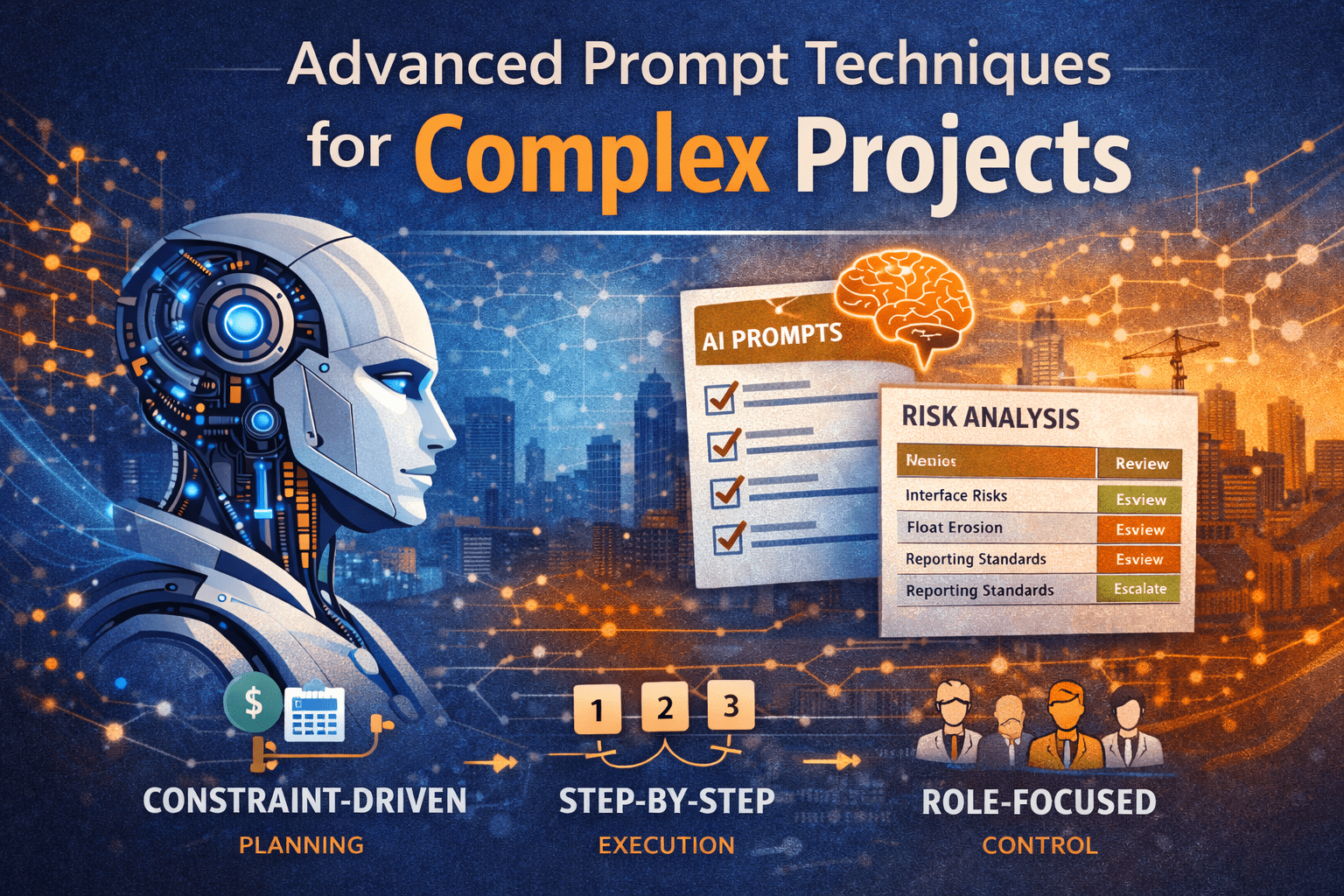
Advanced Prompt Techniques for Complex Projects

Advanced projects often require: - Multi-step reasoning - Scenario comparisons - Iterative refinement

Advanced techniques include: - Chain-of-thought prompting - Prompt stacking - Scenario-based prompting - Constraint-driven prompting

These methods allow AI to support complex decision-making, not just documentation.

👉 Related article: Advanced Prompt Techniques for Complex Projects


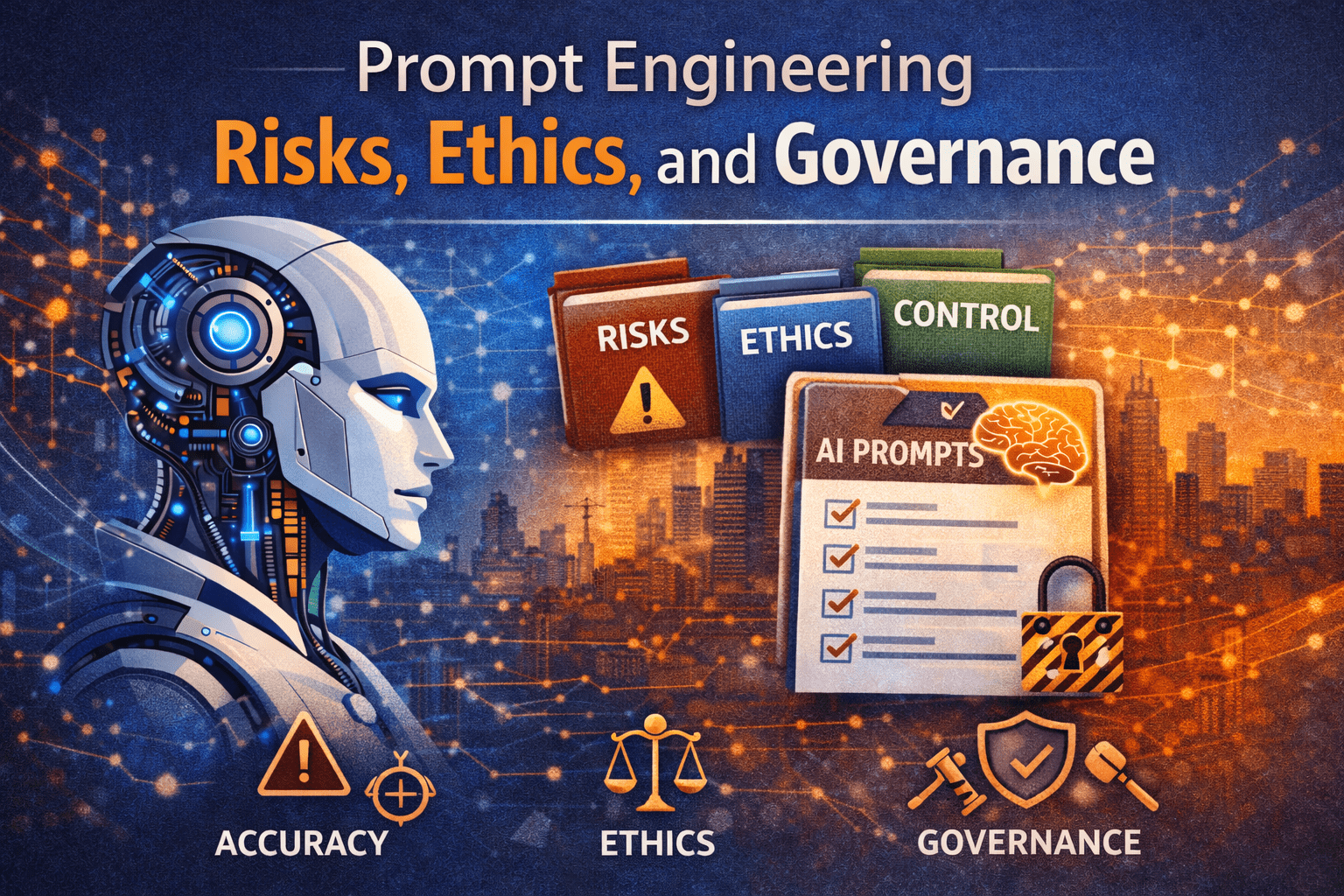
Risks, Ethics, and Governance in AI Prompt Engineering

Project managers must remain accountable for AI-assisted outputs.

Key risks include: - Data confidentiality - Bias in recommendations - Over-reliance on AI outputs - Regulatory non-compliance

Best practices: - Never upload confidential data - Validate AI outputs - Maintain human approval checkpoints - Align with organizational AI governance

👉 Related article: Prompt Engineering Risks, Ethics, and Governance


Tools That Support Prompt Engineering for Project Managers

Popular tools include: - ChatGPT - Microsoft Copilot - Notion AI - Jira and Asana AI features

The value lies not in the tool—but in the quality of prompts.

👉 Related article: Tools That Support Prompt Engineering


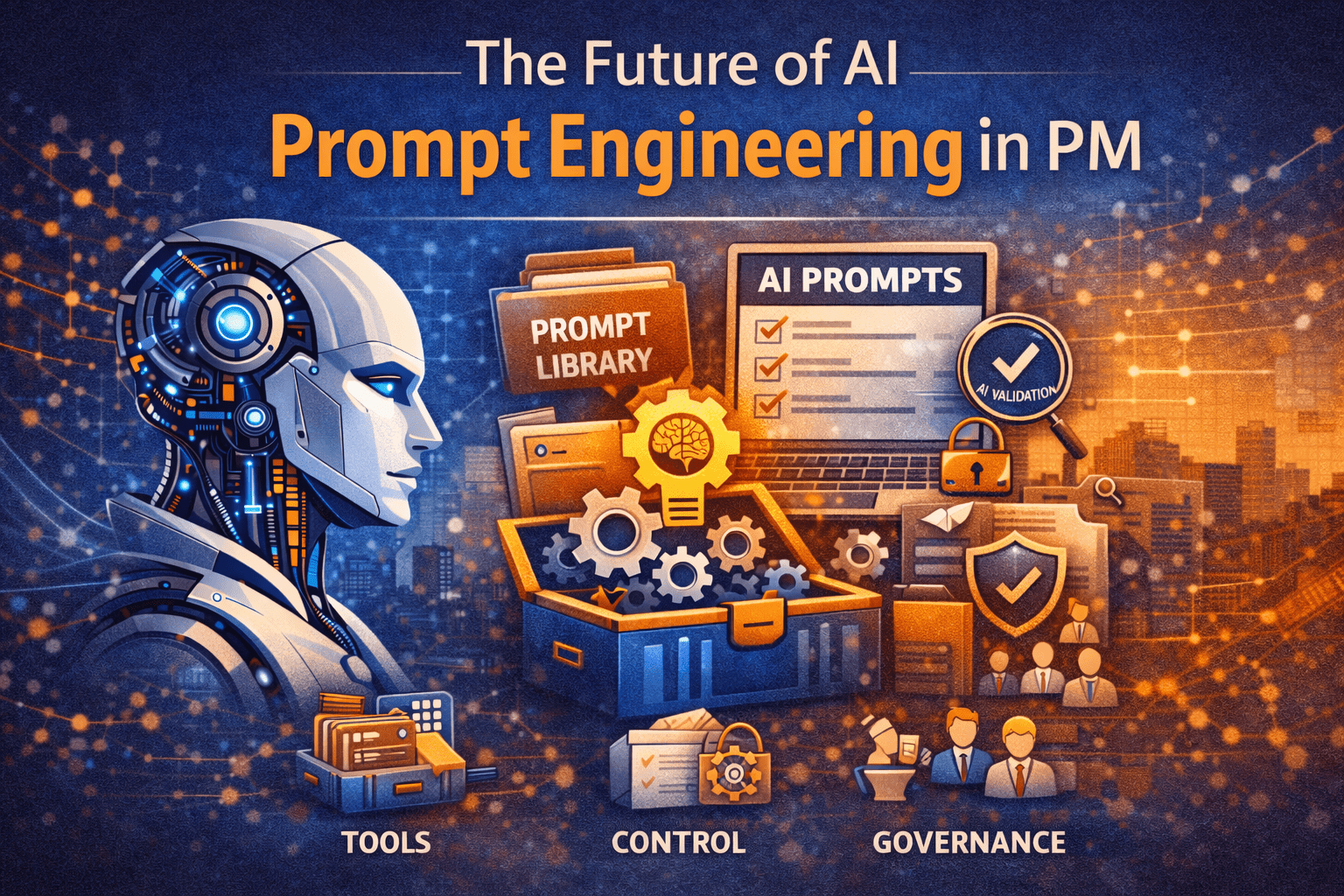
The Future of AI Prompt Engineering in Project Management

As AI evolves: - Prompts will become reusable assets - Organizations will standardize prompt libraries - PMOs will govern AI usage - Prompt engineering will become a core PM competency

Project managers who master this skill early will lead the next generation of project delivery.

👉 Related article: The Future of AI Prompt Engineering


Frequently Asked Questions

What is AI prompt engineering in project management?
It is the practice of designing structured instructions that guide AI tools to support project planning, cost, risk, and reporting tasks.

Do project managers need technical skills to use AI prompts?
No. Prompt engineering relies on structured thinking, not coding.

Can AI prompts replace project managers?
No. AI supports analysis and documentation, while humans retain judgment, leadership, and accountability.


Final Thoughts

AI prompt engineering is quickly becoming a foundational skill for modern project managers.

Those who master structured prompting will gain: - Faster execution - Better insights - Improved governance - Stronger stakeholder confidence

This pillar page serves as the foundation for PM Intelli’s complete AI prompt engineering knowledge hub.


The Future of AI Prompt Engineering in PM

Why Prompt Engineering Tools Are Critical for Project Management

Artificial intelligence has become an integral part of modern project management. From drafting reports to analyzing risks and monitoring schedules, AI helps PMs, schedulers, and PMO leaders make better decisions faster. However, the efficiency and reliability of AI depend on Prompt Engineering tools—the systems, templates, and frameworks used to guide AI responses.

For project professionals, understanding and leveraging these tools is no longer optional. Poorly constructed prompts can produce misleading outputs, compromise governance, or introduce bias. Properly managed, prompt engineering tools enhance consistency, control, and insight across projects.

This article explores the current and future role of Prompt Engineering tools in project management, with actionable guidance and real-world examples for PMOs and project teams.


What Prompt Engineering Tools Are

Prompt Engineering tools are not just AI platforms. They include any structured mechanisms that help project teams design, validate, and reuse prompts effectively. In practice, these tools support:

  • Consistency: Ensuring multiple users generate similar AI outputs.
  • Traceability: Linking AI output to input assumptions and data.
  • Risk Management: Reducing the likelihood of biased or inaccurate outputs.
  • Knowledge Capture: Maintaining prompt libraries and lessons learned.

For project teams, these tools become a bridge between AI capabilities and professional judgment, ensuring outputs remain aligned with project objectives and governance.


Core Categories of Prompt Engineering Tools

1. AI Platforms with Structured Prompt Interfaces

Modern AI platforms often include advanced prompt guidance, such as:

  • Role specification (e.g., “Act as a project risk analyst”)
  • Context persistence across sessions
  • Output formatting constraints

Project example: A PMO uses AI to generate a risk summary for multiple infrastructure projects. Structured prompts ensure every report adheres to the same risk categorization and format, reducing review cycles.


2. Prompt Libraries and Repositories

A central repository of tested prompts ensures that project teams reuse high-quality templates rather than reinventing prompts.

Features:

FeatureBenefit
Purpose & PhaseClarifies when and how to use the prompt
Inputs RequiredEnsures necessary project context is included
Example OutputsSets quality expectations
Risk LevelGuides review requirements

Use case: An IT PMO maintains a library for schedule risk assessments, enabling junior PMs to use proven prompt templates while adhering to governance.


3. Documentation and Knowledge Management Tools

Treating prompts as organizational knowledge allows teams to:

  • Track versions of prompts
  • Assign ownership
  • Audit outputs
  • Capture lessons learned

These practices align with standard project controls frameworks like PMBOK and EVM.


4. Spreadsheet and Template-Based Tools

Even basic tools like spreadsheets can serve as effective prompt engineering support. Templates can enforce structure, capture assumptions, and link AI outputs to project data.

Example: A construction PMO uses a spreadsheet to document:

  • Prompt purpose
  • Input requirements
  • Assumptions
  • Expected AI outputs

This prevents incomplete or inconsistent AI instructions across teams.


5. Collaboration and Workflow Tools

Prompt outputs often require review before influencing decisions. Tools that support collaboration ensure:

  • Peer review of prompts
  • Controlled approval workflows
  • Safe sharing of high-risk outputs

Real-world example: A PMO managing a large infrastructure program implemented workflow tools to review AI-generated cost analysis before executive presentations.


Step-by-Step Approach to Using Prompt Engineering Tools

Step 1: Identify High-Impact Use Cases

Focus on areas where AI outputs influence key decisions, such as:

  • Cost forecasts
  • Schedule recovery strategies
  • Risk narrative development

Step 2: Standardize Where It Matters

High-visibility and repetitive prompts benefit most from templates. Low-risk creative prompts can remain flexible.


Step 3: Align Tools with Team Maturity

Small teams may start with shared spreadsheets and prompts in collaborative documents. Mature PMOs can implement prompt libraries, governance workflows, and usage tracking.


Step 4: Train Teams in Prompt Thinking

Effective tool usage requires understanding how to frame questions, declare assumptions, and interpret AI outputs critically. Tools alone cannot guarantee quality.


Real-World Project Examples

Engineering Design Projects

Design managers used a structured prompt library to generate design review summaries. The tool reduced inconsistencies and improved traceability across complex multi-discipline designs.

Infrastructure Programs

A transportation PMO applied prompt templates for schedule risk reviews. Standardization decreased late-stage surprises and improved portfolio-level reporting.

IT Programs

An enterprise PMO standardized AI-assisted risk summaries across multiple projects. Templates ensured consistent language, reduced confusion in executive reporting, and increased trust in outputs.


Common Mistakes When Using Prompt Engineering Tools

  • Treating AI as a replacement for human judgment
  • Over-standardizing creative problem-solving
  • Sharing sensitive project data without controls
  • Skipping peer review for high-risk outputs
  • Neglecting updates to prompt libraries

Avoiding these pitfalls ensures prompt engineering tools enhance decision quality rather than create risk.


Practical Tips for Project Managers

  • Maintain a personal prompt checklist
  • Label AI-assisted outputs for clarity
  • Store high-performing prompts for reuse
  • Review AI outputs critically against project controls
  • Align prompt use with project governance standards

For applied AI in project controls, see:
https://pmintelli.com/top-ai-tools-for-construction-project-control/


The Future of Prompt Engineering Tools in Project Management

As AI becomes more embedded in project delivery, prompt engineering tools will:

  • Become PMO-owned capabilities
  • Integrate with standard project controls and governance
  • Include automated validation and compliance checks
  • Enable AI to support decision-making without compromising accountability

PMs who adopt these tools proactively position themselves to leverage AI safely, consistently, and strategically.


Strategic Takeaway

Prompt Engineering tools are no longer optional for professional project management. They ensure AI outputs are consistent, auditable, and aligned with governance requirements. When combined with professional judgment, they transform AI from a novelty into a reliable decision-support system.

Project managers and PMOs that invest in structured tools today will define how AI is safely and effectively used in projects tomorrow.


Tools That Support Prompt Engineering

Why Prompt Engineering Tools Matter to Project Managers

Artificial intelligence is now part of everyday project work. Project managers use AI to draft reports, analyze risks, review schedules, and support decisions. However, the value of AI does not come from the tool alone. It comes from how well professionals instruct it.

This is where Prompt Engineering tools matter.

Without the right tools, prompt usage remains inconsistent, difficult to govern, and hard to scale across teams. With the right support tools, prompts become structured assets that improve clarity, repeatability, and decision quality across projects and PMOs.

This article explains Prompt Engineering tools from first principles, shows how they support real project work, and helps PMs choose and apply them responsibly.


What Are Prompt Engineering Tools?

Prompt engineering tools are not limited to AI platforms themselves. They are any tools, features, or systems that help professionals design, manage, validate, reuse, and govern prompts.

In a project management context, these tools support:

  • Consistency of analysis
  • Quality of outputs
  • Risk reduction
  • Knowledge retention

Prompt engineering support tools act as a control layer between human judgment and AI output.


Why Project Environments Need Prompt Engineering Support

Projects operate under constraints: time, cost, scope, risk, and governance. AI tools, by default, do not understand these constraints unless they are explicitly built into prompts.

Without support tools:

  • Prompts vary widely between users
  • Outputs cannot be audited
  • Lessons learned are lost
  • Risky usage goes unnoticed

With Prompt Engineering tools, PMs and PMOs gain structure without slowing down delivery.


Core Categories of Prompt Engineering Tools

1. AI Platforms with Structured Prompt Capabilities

The first category includes AI platforms that allow structured interaction rather than free-form chat.

These platforms support:

  • Role definition
  • Context persistence
  • Output formatting
  • Iterative refinement

For project managers, this enables more predictable and professional outputs.

Project use cases

  • Drafting executive summaries
  • Reviewing risk registers
  • Supporting schedule and cost analysis

For foundational prompt guidance in project settings, see:
https://pmintelli.com/beyond-chatgpt-essential-ai-prompts-every-project-manager-should-master/


2. Prompt Libraries and Repositories

A prompt library is one of the most powerful Prompt Engineering tools for PMOs.

Instead of reinventing prompts, teams reuse approved, tested versions.

What a prompt library typically includes

  • Prompt purpose
  • Intended project phase
  • Required inputs
  • Risk level
  • Example outputs

Benefits

  • Consistency across projects
  • Faster onboarding
  • Reduced ethical and data risks

3. Documentation and Knowledge Management Tools

Prompt engineering improves when prompts are treated like project assets.

Documentation tools support:

  • Version control
  • Ownership tracking
  • Lessons learned
  • Audit trails

These tools align closely with project controls discipline.

For broader context on structured controls, see:
https://pmintelli.com/project-control-explained-the-foundation-of-successful-project-management/


4. Spreadsheet and Template-Based Prompt Tools

Many PMs underestimate the value of simple tools.

Spreadsheets and templates are effective Prompt Engineering tools when used correctly.

They can:

  • Standardize prompt structure
  • Capture assumptions
  • Link prompts to project data

Example
A PMO uses a spreadsheet with columns for:

  • Project phase
  • Prompt objective
  • Constraints
  • Expected output

This reduces prompt variability.


5. Workflow and Collaboration Tools

Prompt usage rarely occurs in isolation.

Collaboration tools support:

  • Peer review of prompts
  • Approval workflows
  • Controlled sharing

In complex projects, this reduces the risk of unreviewed AI outputs influencing decisions.


How Prompt Engineering Tools Support the Project Life Cycle

Initiation Phase Support

During initiation, uncertainty is high.

Prompt Engineering tools help PMs:

  • Structure early risk thinking
  • Capture assumptions
  • Align stakeholders

Example
A prompt template asks AI to identify typical risks for a specific project type, while requiring the PM to input regulatory, budget, and schedule constraints.


Planning Phase Support

Planning is where prompt tools deliver the highest value.

Schedule and Cost Planning

Prompt Engineering tools help ensure:

  • Consistent logic reviews
  • Structured risk identification
  • Repeatable analysis

Example
A stored prompt template supports schedule logic reviews by asking AI to flag missing predecessors, open ends, and excessive lags.


Execution Phase Support

During execution, information overload becomes a risk.

Prompt Engineering support tools:

  • Standardize progress analysis
  • Improve variance explanations
  • Reduce reporting noise

This is especially valuable for PMOs managing portfolios.


Monitoring and Control Phase Support

Monitoring requires insight, not just metrics.

Prompt Engineering tools help transform data into interpretation by:

  • Explaining trends
  • Highlighting leading indicators
  • Structuring management narratives

For AI support applied specifically to controls, see:
https://pmintelli.com/top-ai-tools-for-construction-project-control/


Closeout Phase Support

Prompt tools ensure lessons learned are captured consistently.

Instead of generic closeout summaries, prompts can:

  • Compare planned vs actual assumptions
  • Identify recurring control gaps
  • Inform future planning standards

Step-by-Step: Selecting Prompt Engineering Tools for Your PMO

Step 1: Identify High-Risk Prompt Use Cases

Start by identifying where AI outputs influence decisions:

  • Cost forecasts
  • Schedule recovery strategies
  • Risk narratives

These areas require the strongest support tools.


Step 2: Decide What Needs Standardization

Not every prompt needs a template.

Focus on:

  • Repetitive tasks
  • High-visibility outputs
  • Portfolio-level reporting

Step 3: Match Tools to Maturity Level

A small team may start with shared documents.

A mature PMO may require:

  • Central repositories
  • Approval workflows
  • Usage tracking

Step 4: Train Users on Prompt Thinking, Not Just Tools

Tools fail without understanding.

Training should focus on:

  • Framing questions
  • Declaring assumptions
  • Interpreting outputs critically

Real-World Project Examples

Infrastructure Program Example

A transportation PMO introduced a prompt library for schedule reviews.

Result

  • Improved consistency across contractors
  • Reduced late-stage surprises
  • Clearer escalation triggers

IT Program Example

An enterprise IT PMO used templates to standardize AI-assisted risk summaries.

Result

  • Better executive communication
  • Fewer contradictory narratives
  • Improved trust in reporting

Engineering Design Project Example

Design managers used structured prompts embedded in documentation tools.

Result

  • Faster option evaluation
  • Reduced rework
  • Stronger decision traceability

Common Mistakes When Using Prompt Engineering Tools

  • Treating tools as replacements for judgment
  • Over-standardizing creative problem-solving
  • Ignoring data sensitivity
  • Allowing unreviewed prompts in high-risk areas
  • Failing to update prompt libraries

Prompt Engineering tools must evolve with project experience.


Practical Tips PMs Can Apply Immediately

  • Start a personal prompt checklist
  • Save high-performing prompts
  • Label AI-assisted outputs internally
  • Review prompts before reviewing outputs
  • Align prompt usage with project controls standards

For broader PM and AI integration topics, explore:
https://pmintelli.com/articles/


The Role of PMOs in Prompt Engineering Support

PMOs are natural owners of Prompt Engineering tools.

They already manage:

  • Standards
  • Templates
  • Governance
  • Continuous improvement

Adding prompt engineering support is an extension of existing responsibilities, not a new discipline.


Strategic Takeaway for Project Leaders

Prompt Engineering tools do not make AI smarter. They make project teams more disciplined.

When prompts are structured, reviewed, and governed, AI becomes a reliable support mechanism rather than a risk. For complex projects, this discipline protects credibility, improves decisions, and strengthens delivery outcomes.

Project managers who invest in prompt engineering support tools today are building the next generation of project controls capability.

Prompt Engineering Risks, Ethics, and Governance

Why Prompt Engineering Risks Matter to Project Managers

Artificial intelligence is now embedded in daily project work. Project managers use AI to draft schedules, analyze risks, summarize meetings, and support decision-making. However, as usage grows, so do Prompt Engineering Risks.

Within project environments, prompts are not casual inputs. They directly influence scope interpretations, risk assessments, cost narratives, and stakeholder communications. Poorly designed prompts can introduce bias, expose confidential data, or produce outputs that appear credible but are factually incorrect.

For PMs, PMO leaders, and project control professionals, this creates a new responsibility. Managing AI is no longer just a technical concern. It is a governance issue tied to professional judgment, accountability, and ethical delivery.

This article explains Prompt Engineering Risks, ethics, and governance from first principles, using practical project examples and actionable guidance.


What Prompt Engineering Really Means in Project Management

Prompt engineering is the structured way a professional instructs an AI system to perform a task. In project environments, prompts shape how AI interprets data, constraints, assumptions, and expectations.

Unlike traditional tools, AI does not “know” project context unless the prompt provides it. The prompt becomes the control mechanism.

In project management, prompts are commonly used to:

  • Summarize project status reports
  • Analyze schedule risks
  • Draft stakeholder communications
  • Identify cost trends
  • Support lessons learned

When prompts are unclear or poorly governed, the outputs can mislead decision-makers.

For foundational guidance on professional AI usage, see:
https://pmintelli.com/beyond-chatgpt-essential-ai-prompts-every-project-manager-should-master/


Core Categories of Prompt Engineering Risks

1. Accuracy and Hallucination Risk

AI systems generate responses based on probability, not verified truth. When prompts request certainty without constraints, the system may fabricate details.

In project settings, this risk appears when:

  • AI estimates durations without historical data
  • Risks are generated without project constraints
  • Contract language is summarized incorrectly

Example:
A scheduler asks AI to “identify critical path risks” without providing the schedule logic. The output appears professional but is disconnected from the actual CPM network.


2. Context Loss and Oversimplification

Projects are complex systems. AI tends to simplify unless guided carefully.

Prompt Engineering Risks increase when:

  • Project constraints are omitted
  • Interfaces are ignored
  • Governance rules are not stated

This can result in recommendations that look efficient but violate contractual, regulatory, or stakeholder requirements.


3. Data Confidentiality and Exposure

One of the most serious Prompt Engineering Risks is unintentional data disclosure.

Common triggers include:

  • Copying internal reports into AI tools
  • Including contractor claims language
  • Sharing sensitive cost or risk registers

Without governance, project data can be exposed or reused outside its intended context.


4. Bias Embedded in Prompts

AI reflects the assumptions embedded in the prompt.

If a prompt assumes blame, certainty, or a preferred outcome, the response will reinforce it. This can distort:

  • Risk reviews
  • Change justification narratives
  • Performance evaluations

Bias introduced at the prompt level becomes invisible once the output is circulated.


Prompt Engineering Ethics in Project Environments

Why Ethics Apply to Prompts

Ethics in prompt engineering is not about technology. It is about professional responsibility.

Project managers influence decisions that affect:

  • Public safety
  • Financial outcomes
  • Regulatory compliance
  • Team credibility

Using AI without ethical guardrails risks undermining trust.


Ethical Principles for Prompt Engineering

1. Transparency

PMs should be clear when AI assists project work.

Ethical practice includes:

  • Disclosing AI-assisted analysis to leadership
  • Avoiding presentation of AI outputs as independent judgment
  • Maintaining human accountability

This aligns with professional standards of integrity.


2. Proportional Use

Not every project task requires AI.

Ethical prompt usage means:

  • Avoiding AI for final contractual interpretations
  • Limiting AI use in dispute narratives
  • Using AI for support, not substitution

3. Respect for Professional Judgment

AI should support, not replace, experienced judgment.

Prompts should ask AI to:

  • Present options
  • Identify risks
  • Summarize information

They should not ask AI to make final decisions without review.


Prompt Engineering Governance for PMOs

Why Governance Is Necessary

Without governance, prompt usage becomes inconsistent, risky, and untraceable.

Prompt Engineering Governance establishes:

  • Rules for acceptable use
  • Data protection boundaries
  • Review and approval expectations

This is especially critical at the PMO level.


Key Elements of Prompt Engineering Governance

1. Prompt Classification

Not all prompts carry equal risk.

A simple governance model categorizes prompts as:

  • Low risk: brainstorming, formatting, summaries
  • Medium risk: risk identification, schedule analysis
  • High risk: cost forecasts, claims language, executive recommendations

High-risk prompts require review.


2. Data Handling Rules

Governance must define:

  • What data can be shared
  • What data must be anonymized
  • What data is prohibited

This is consistent with broader project controls discipline.
See foundational controls guidance here:
https://pmintelli.com/project-control-explained-the-foundation-of-successful-project-management/


3. Review and Validation Process

AI outputs should never bypass review.

Best practice includes:

  • Technical review by subject matter experts
  • PM validation against project constraints
  • Documentation of assumptions

Step-by-Step: A Safe Prompt Engineering Workflow

Step 1: Define the Project Context Clearly

Before writing the prompt, clarify:

  • Project type
  • Phase
  • Constraints
  • Decision purpose

This reduces ambiguity.


Step 2: Frame the Prompt with Boundaries

Effective prompts include:

  • Explicit assumptions
  • Defined exclusions
  • Expected format

This controls risk.


Step 3: Request Options, Not Answers

Ask AI to present alternatives rather than conclusions.

This preserves professional judgment.


Step 4: Validate Against Project Reality

Compare outputs against:

  • Schedule logic
  • Cost baselines
  • Contract requirements

AI outputs are inputs, not decisions.


Real-World Project Examples

Infrastructure Project Example

On a transportation project, AI was used to identify schedule acceleration options. The prompt omitted environmental permit constraints.

The AI proposed resequencing that violated regulatory approvals.

Lesson: Prompt Engineering Risks often stem from missing constraints.


IT Program Example

A PMO used AI to summarize risks across multiple projects. The prompt lacked risk ownership criteria.

The output blurred accountability, creating confusion during executive review.

Lesson: Governance requires structure in prompts.


Construction Claims Context

Using AI to summarize claim narratives without legal review can unintentionally weaken position statements.

This is where ethical restraint is essential.


Common Prompt Engineering Mistakes to Avoid

  • Treating AI output as verified fact
  • Using AI for final contractual language
  • Sharing sensitive project data
  • Skipping peer review
  • Allowing untrained staff to draft high-risk prompts

These mistakes are preventable with governance.


Practical Tips PMs Can Apply Immediately

  • Create a personal prompt checklist
  • Label AI-assisted content internally
  • Use AI for drafts, not approvals
  • Maintain version control on AI outputs
  • Align prompts with project controls standards

For applied AI usage in project controls, see:
https://pmintelli.com/top-ai-tools-for-construction-project-control/


The Strategic Role of PMOs in Prompt Governance

PMOs are uniquely positioned to:

  • Standardize prompt templates
  • Define ethical boundaries
  • Train teams on responsible usage
  • Monitor AI adoption maturity

Prompt engineering is becoming a PMO capability, not an individual skill.


Strong Conclusion: Strategic Takeaway for Project Leaders

Prompt engineering is now part of project governance. Prompt Engineering Risks are real, manageable, and preventable when approached with professional discipline.

Ethical prompt usage protects credibility. Governance protects the organization. Structured prompts protect decision quality.

AI does not remove accountability from project managers. It raises the bar for how judgment, ethics, and controls are applied.

Project leaders who treat prompt engineering as a controlled professional practice—not an experiment—will gain value without compromising trust.

Advanced Prompt Techniques for Complex Projects

Complex projects do not fail because teams lack software or data. They struggle because information is fragmented, decisions are delayed, and insights arrive too late to matter. This is where Advanced Prompt Techniques become valuable—not as a replacement for project managers, but as a force multiplier for judgment, analysis, and communication.

When used correctly, Advanced prompts Techniques allow project managers, schedulers, and PMO leaders to extract structured, actionable insight from AI across planning, execution, and control activities. The difference between basic and advanced prompting is the difference between generic responses and decision-ready outputs.

This article explains advanced prompt techniques from scratch, shows how they apply to complex projects, and provides practical examples you can use immediately on engineering, infrastructure, IT, and PMO programs.


Why Advanced Prompt Techniques Matter in Complex Projects

Simple projects tolerate ambiguity. Complex projects do not.

Large capital programs, multi-vendor IT initiatives, and infrastructure portfolios involve:

  • Interdependent schedules
  • Competing constraints
  • Multiple stakeholders with conflicting priorities
  • Incomplete or evolving information

AI can help, but only if it is guided properly. Basic prompts such as “summarize this schedule” or “analyze project risks” produce shallow results. Advanced prompts Techniques introduce structure, assumptions, roles, and decision context into the request.

In other words, the quality of output depends on the quality of thinking embedded in the prompt.


What Makes a Prompt “Advanced”?

An advanced prompt is not longer. It is clearer.

At a minimum, advanced prompts define:

  • Context – What type of project and environment
  • Role – Who the AI is acting as
  • Inputs – What information is available
  • Constraints – Time, cost, risk, or contractual limits
  • Output format – How results should be structured

Think of advanced prompting as delegating work to a skilled analyst, not asking a search engine a question.


Core Advanced Prompt Techniques Explained Step by Step

1. Role-Based Prompting

Role-based prompting assigns the AI a professional identity relevant to the task.

Why it works:
Different roles focus on different signals. A scheduler sees logic risk. A PMO director sees governance gaps.

Example Prompt

Act as a senior project controls manager supporting a multi-contract infrastructure program. Review the following project update and identify control risks related to schedule integration and reporting consistency.

Where it helps

  • Schedule reviews
  • Cost trend analysis
  • Executive reporting
  • Claims avoidance

2. Constraint-Driven Prompting

Complex projects are defined by constraints. Advanced prompts explicitly state them.

Typical constraints include:

  • Fixed completion dates
  • Budget ceilings
  • Regulatory approvals
  • Labor or access restrictions

Example Prompt

Given a fixed completion date and no ability to add crews, analyze the schedule recovery options and identify which activities offer true float versus artificial float.

This prevents generic answers and forces realistic analysis.


3. Sequential Reasoning Prompts

Complex problems require step-by-step thinking. Advanced prompts request the reasoning process explicitly.

Example Prompt

Analyze the project delay claim using the following steps:

  1. Identify delay events
  2. Classify them as excusable or non-excusable
  3. Assess schedule impact
  4. Summarize owner exposure

This mirrors how experienced professionals actually think.


Using Advanced Prompts Across the Project Life Cycle

Initiation Phase: Shaping the Right Project

At initiation, uncertainty is high and information is limited. Advanced prompts help structure ambiguity.

Use cases

  • Business case validation
  • Stakeholder risk identification
  • Early scope definition

Example Prompt

Act as a PMO advisor. Based on the project objectives and constraints, identify hidden risks typically overlooked during project initiation for large public infrastructure projects.


Planning Phase: Turning Strategy into Control

Planning is where advanced prompts deliver the highest value.

Schedule Development and Logic Review

Example Prompt

Review this draft schedule logic as a planning-level CPM model. Identify missing predecessors, open ends, and logic that may distort float.

Cost and Resource Planning

Example Prompt

Given this cost-loaded schedule, identify periods of resource over-allocation and recommend leveling strategies without extending the project end date.


Execution Phase: Managing Complexity in Motion

During execution, advanced prompts support situational awareness.

Common applications

  • Variance analysis
  • Trend forecasting
  • Change impact assessment

Example Prompt

Act as a project controls lead. Analyze the current SPI and CPI trends and explain what corrective actions should be prioritized in the next 60 days.


Monitoring and Control: Turning Data into Decisions

This is where many teams drown in reports but lack insight.

Advanced prompts help by:

  • Explaining why metrics changed
  • Highlighting leading indicators
  • Translating data into actions

Example Prompt

Based on this monthly report, identify early warning signals that suggest future schedule slippage, even if current SPI is above 1.0.


Closeout Phase: Capturing Lessons That Matter

Closeout often becomes an administrative exercise. Advanced prompts can turn it into institutional learning.

Example Prompt

Summarize the top five project control lessons from this project and explain how they should change planning assumptions on future projects.


Real-World Examples from Complex Projects

Example 1: Transportation Infrastructure Program

A multi-year roadway expansion involved multiple contractors and overlapping work zones.

Advanced Prompt Used

Act as an independent scheduler. Identify interface risks caused by overlapping contractor schedules and propose coordination milestones.

Outcome

  • Reduced access conflicts
  • Improved milestone alignment
  • Clearer owner oversight

Example 2: Enterprise IT System Implementation

An ERP rollout suffered from repeated scope changes.

Advanced Prompt Used

Analyze the change log and identify which changes indicate scope creep versus legitimate requirement clarification.

Outcome

  • Stronger change control discipline
  • Better executive decision-making

Example 3: PMO Portfolio Reporting

A PMO struggled to explain why projects appeared “green” until late-stage failure.

Advanced Prompt Used

Review this portfolio dashboard and identify metrics that lag reality. Recommend leading indicators better suited for early intervention.

Outcome

  • Improved portfolio governance
  • Earlier escalation of issues

Common Mistakes to Avoid When Using Advanced Prompts

Even experienced professionals make these errors:

  • Asking vague questions without decision context
  • Ignoring constraints, leading to unrealistic recommendations
  • Overloading prompts with unnecessary detail
  • Accepting outputs without validation

AI supports judgment; it does not replace it.


Practical Tips You Can Apply Immediately

  • Write prompts as if briefing a senior analyst
  • Always specify the decision you are supporting
  • Request structured outputs (tables, bullets, steps)
  • Reuse and refine high-performing prompts
  • Combine AI outputs with professional review

For related guidance, link here:
👉 Project Control Fundamentals
👉 AI in Project Management


How PMOs Should Standardize Advanced Prompt Techniques

PMOs can scale value by:

  • Creating approved prompt libraries
  • Embedding prompts into reporting cycles
  • Training teams on prompt thinking, not tools

This turns AI from an experiment into an operational capability.


Strategic Takeaway for Project Leaders

Advanced prompts Techniques are not about smarter technology. They are about clearer thinking.

Complex projects demand structure, discipline, and insight. When prompts reflect how experienced professionals reason—step by step, within constraints, and tied to decisions—AI becomes a practical extension of the project controls function.

Used correctly, advanced prompting improves clarity, accelerates insight, and strengthens leadership decisions across the entire project life cycle.


AI Prompt Use Cases Across the Project Life Cycle

Project managers are trained to think in phases. We initiate, plan, execute, monitor, and close. Each phase has different information needs, decision pressures, and stakeholder expectations. This is exactly why AI prompts across project life cycle matter.

AI is not a single-use tool for drafting emails or summarizing notes. When used deliberately, AI prompts can support every phase of the project life cycle, from early concept development through closeout and lessons learned. The value comes from aligning prompts with how projects actually progress, not from treating AI as a generic assistant.

This article explains, step by step, how project managers can apply AI prompts across the project life cycle in a practical, disciplined way—without technical jargon or unrealistic promises.


Why AI Prompts Matter Across the Project Life Cycle

Each project phase answers a different question:

  • Initiation: Should we do this project?
  • Planning: How will we deliver it?
  • Execution: Are we building what we planned?
  • Monitoring: Are we still in control?
  • Closeout: What did we learn?

AI becomes useful when prompts are designed to support those specific questions.

Unstructured prompts tend to produce:

  • Generic advice
  • Misaligned outputs
  • Content that does not fit PM workflows

Well-structured AI prompts across project life cycle help PMs:

  • Think faster, not sloppier
  • Draft first-pass deliverables
  • Improve clarity and consistency

For a deeper foundation on prompt design, see:
https://pmintelli.com/beyond-chatgpt-essential-ai-prompts-every-project-manager-should-master/


Understanding AI Prompts in Project Management Terms

An AI prompt is not a command. It is closer to a scope definition.

A strong prompt answers:

  • What role should AI play?
  • What project context applies?
  • What output is needed?
  • What constraints exist?

This mirrors how project managers already think. That is why AI prompts fit naturally into professional project management.


AI Prompts in the Initiation Phase

Purpose of the Initiation Phase

Initiation focuses on alignment:

  • Business need
  • High-level scope
  • Feasibility and risks

AI can support structured thinking before major commitments are made.


Example AI Prompt Use Cases

Use Case 1: Project Charter Drafting

Prompt example:

Act as a senior project advisor.
The project is a municipal infrastructure upgrade with multiple stakeholders.
Draft a concise project charter outline focusing on objectives, constraints, and success criteria.

AI helps generate a starting point, not a final document.


Use Case 2: Stakeholder Identification

AI prompts can help list:

  • Likely stakeholder groups
  • Typical concerns by role
  • Communication expectations

This works well when PMs are entering unfamiliar domains.


Practical Tip

Always review AI-generated initiation content against governance requirements. AI does not understand your organization’s approval thresholds.


AI Prompts in the Planning Phase

Why Planning Is the Highest-Value Phase for AI

Planning is documentation-heavy and logic-driven. That makes it ideal for AI prompts across project life cycle.

AI supports:

  • Structure
  • Consistency
  • First-pass drafts

For project controls fundamentals that align closely with planning prompts, see:
https://pmintelli.com/project-control-explained-the-foundation-of-successful-project-management/


Planning Use Cases and Prompt Examples

Scope Definition and WBS Support

Prompt example:

Act as a project controls specialist.
The project is a water treatment facility upgrade.
Develop a Level 2 WBS aligned with engineering, procurement, and construction phases.

AI helps accelerate early structuring.


Schedule Logic Review

AI can review narrative logic:

  • Sequence assumptions
  • Missing dependencies
  • Phase overlaps

This is especially useful before formal schedule submission.


Risk Register Development

Prompt example:

Identify key planning-phase risks for an IT system integration project.
Focus on interfaces, data migration, and change management.
Present results in a simple risk register table.


Table: Planning Phase AI Prompt Outputs

Planning AreaAI SupportPM Responsibility
ScopeDraft structureFinal validation
ScheduleLogic reviewTechnical accuracy
RiskRisk identificationPrioritization

AI Prompts During Execution

Execution Is About Clarity, Not Creativity

During execution, AI should support:

  • Communication
  • Documentation
  • Issue framing

AI is not managing work—it is supporting the PM.


Execution Phase Use Cases

Daily and Weekly Reporting

Prompt example:

Summarize field progress notes into a weekly status update.
Highlight accomplishments, constraints, and upcoming activities.
Keep language suitable for non-technical stakeholders.


Change and Issue Framing

AI can help PMs:

  • Structure issue descriptions
  • Separate facts from opinions
  • Draft neutral narratives

This is especially helpful in contract-heavy environments.


Real-World Example: Infrastructure Project

On a roadway rehabilitation project, the PM used AI to:

  • Draft weekly traffic impact summaries
  • Standardize contractor updates
  • Reduce report preparation time

The PM still approved all content, but preparation time dropped significantly.


AI Prompts in Monitoring and Controlling

Where AI Supports Project Controls

Monitoring is about variance, trends, and early warning. AI can help explain data—not replace it.

For dashboard-related insights that pair well with AI-generated narratives, see:
https://pmintelli.com/top-ai-tools-for-construction-project-control/


Monitoring Use Cases

Variance Explanation

Prompt example:

Explain schedule variance drivers based on delayed procurement and weather impacts.
Keep explanation factual and suitable for executive reporting.


Trend Identification

AI can review:

  • Cost narratives
  • Schedule updates
  • Risk logs

And help identify recurring themes worth escalation.


Table: Monitoring Phase AI Applications

Control AreaAI RolePM Value
CostNarrative explanationClear communication
ScheduleTrend summariesFaster insight
RiskPattern detectionEarly response

AI Prompts in Project Closeout

Why Closeout Is Often Rushed

Closeout happens when attention shifts to the next project. AI can help capture knowledge before it is lost.


Closeout Use Cases

Lessons Learned Development

Prompt example:

Draft lessons learned for a completed ERP implementation.
Focus on planning assumptions, integration challenges, and stakeholder coordination.


Final Report Structuring

AI can:

  • Organize closeout sections
  • Standardize language
  • Improve clarity

The PM ensures accuracy and completeness.


PMO Example

A PMO used AI prompts to:

  • Normalize lessons learned across projects
  • Identify recurring delivery risks
  • Improve organizational learning

For PMO-focused insights, see:
https://pmintelli.com/tag/pmo/


Common Mistakes to Avoid

1. Using the Same Prompt for Every Phase

Each phase has different objectives. Prompts must change accordingly.


2. Skipping Context

AI without context produces generic output.


3. Treating AI Output as Final

AI drafts. PMs decide.


4. Overloading Prompts

Break tasks into steps, just like real project work.


Practical Tips PMs Can Apply Immediately

  • Create prompt templates by project phase
  • Save high-performing prompts for reuse
  • Align prompts with PMO standards
  • Review AI output like junior staff work
  • Focus on clarity over cleverness

For a broader collection of PM-focused AI content, explore:
https://pmintelli.com/articles/


Strategic Takeaway

AI does not replace project management discipline. It rewards it.

Project managers who apply AI prompts across project life cycle gain speed, consistency, and clarity—without losing control. The advantage is not technical skill. It is structured thinking applied to modern tools. Used properly, AI becomes part of the project management system—not a distraction from it.

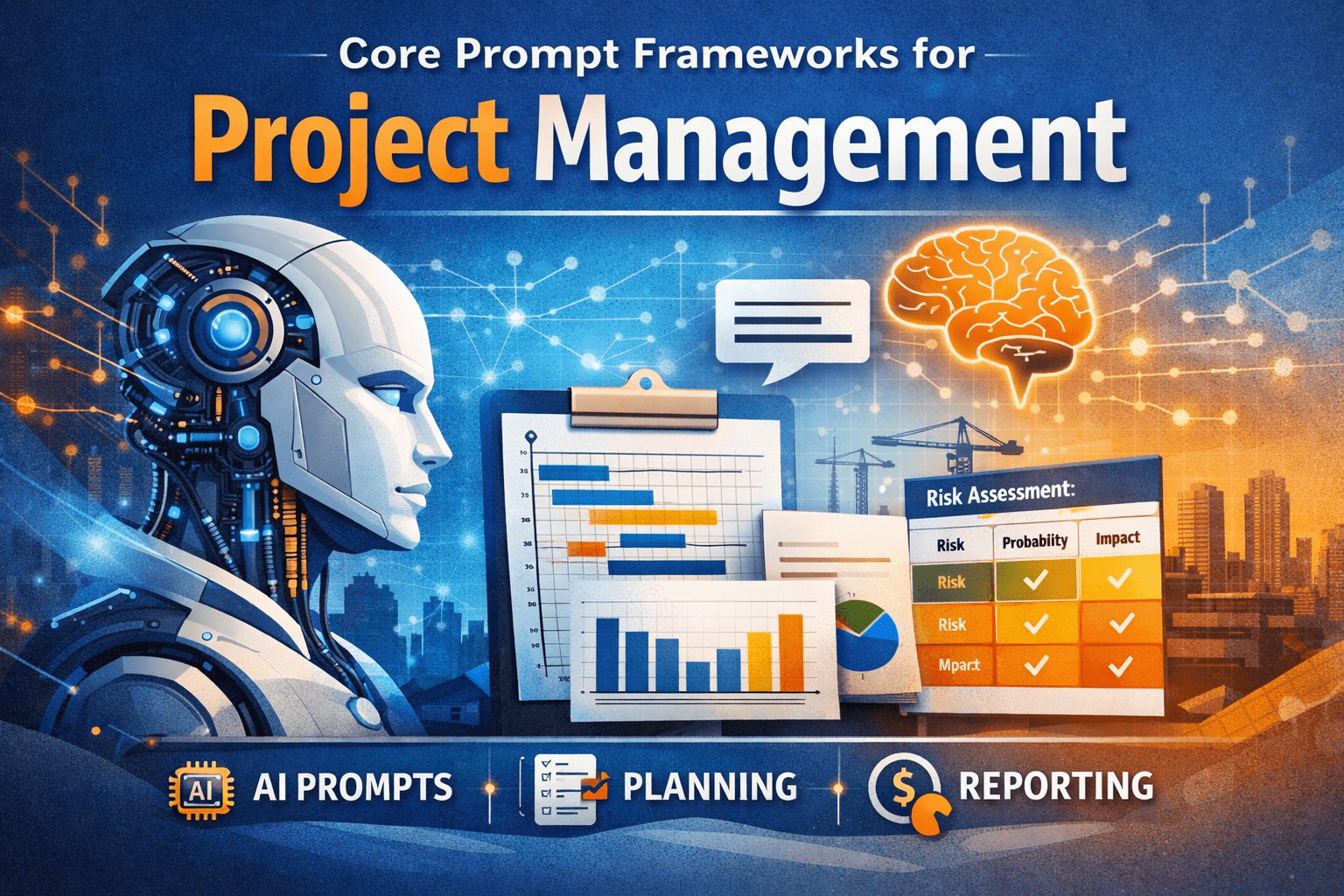
Core Prompt Frameworks for Project Management

Artificial intelligence is quickly becoming a practical assistant for project professionals—not as a decision-maker, but as a force multiplier. When used correctly, ai prompts for project managers can support planning, reporting, risk analysis, and stakeholder communication without replacing professional judgment.

However, many project managers struggle to get consistent value from AI tools. The issue is rarely the tool itself. It is the way the request—the prompt—is framed.

This article explains core prompt frameworks for project management, built from first principles and real project experience. You will learn how to structure prompts so AI produces outputs that align with how projects are actually managed: with constraints, accountability, and context.


Why Prompt Frameworks Matter for Project Managers

Project managers do not ask vague questions in real projects. We define scope, clarify assumptions, and specify constraints. AI works the same way.

Without structure, AI responses tend to be:

  • Overly generic
  • Misaligned with project realities
  • Difficult to apply directly

With structured prompts, AI can:

  • Draft first-pass schedules, reports, and analyses
  • Reframe complex information for executives
  • Support project controls without replacing expertise

This is why ai prompts for project managers should be treated as a professional skill, similar to writing a clear scope statement or risk register.


What Is a Prompt Framework?

A prompt framework is a repeatable structure for asking AI to perform a task.

It ensures the AI understands:

  • Who it is supporting
  • What role it should assume
  • What inputs it can rely on
  • What output format is required
  • What constraints must be respected

Think of a prompt framework as a mini work plan for the AI.


The Core Elements of Effective AI Prompts for Project Managers

Before diving into specific frameworks, it helps to understand the building blocks common to all effective prompts.

1. Role Definition

Tell the AI who it should act as.

Examples:

  • Project controls analyst
  • Scheduler supporting an infrastructure project
  • PMO advisor preparing executive material

This sets the tone and depth of the response.


2. Project Context

AI does not know your project unless you tell it.

Include:

  • Project type (engineering, IT, construction, PMO)
  • Delivery method (design-bid-build, agile, CM-at-risk)
  • Phase (planning, execution, closeout)

Context reduces irrelevant content.


3. Task Objective

State exactly what you want produced.

Avoid:

“Help me with my schedule.”

Prefer:

“Draft a high-level milestone schedule for stakeholder communication.”


4. Constraints and Assumptions

Projects operate under limits. AI should too.

Examples:

  • Assume incomplete data
  • Limit to one page
  • Avoid technical jargon
  • Align with PMBOK terminology

5. Output Format

Specify how the answer should be delivered.

Options include:

  • Bullet points
  • Tables
  • Step-by-step instructions
  • Executive summary

This makes the output usable immediately.


Core Prompt Frameworks for Project Management

Below are practical prompt frameworks project managers can reuse across different project types.


Framework 1: The Role–Context–Task (RCT) Framework

This is the most versatile framework for daily PM work.

Structure

  1. Role – Who the AI is acting as
  2. Context – What project environment it supports
  3. Task – What needs to be produced

Example Prompt

Act as a project controls analyst supporting a municipal infrastructure project.
The project is in early execution with partial cost and schedule data.
Draft a concise monthly status summary highlighting schedule risks and cost trends for senior management.

Where This Works Best

  • Status reports
  • Executive summaries
  • Risk narratives

This framework is ideal when speed matters and inputs are incomplete.


Framework 2: The Input–Process–Output (IPO) Framework

Project managers naturally think in terms of inputs and outputs. This framework mirrors that logic.

Structure

  • Inputs – What data is available
  • Process – What analysis or thinking is required
  • Output – What format the result should take

Example Prompt

Inputs: Weekly progress notes, baseline milestones, and key deliverables.
Process: Analyze progress against planned milestones and identify slippage drivers.
Output: A table summarizing planned vs. actual milestones with short explanations.

Where This Works Best

  • Schedule reviews
  • Cost variance explanations
  • Lessons learned

This approach aligns well with project controls workflows.
[Internal link to Project Control Fundamentals article]


Framework 3: The Constraint-Driven Prompt

AI tends to overproduce content unless constrained. This framework keeps responses focused.

Structure

  • Task definition
  • Explicit constraints
  • Quality criteria

Example Prompt

Prepare a risk register draft for an IT system implementation.
Constraints:
– Limit to 8 risks
– Focus on integration and change management
– Use non-technical language
– Present in a table with probability and impact

Where This Works Best

  • Risk workshops
  • Stakeholder-facing material
  • PMO templates

Framework 4: The Iterative Refinement Framework

This framework treats AI as a junior analyst whose work improves through direction.

Step-by-Step

  1. Generate a first draft
  2. Review and critique
  3. Refine with targeted follow-up prompts

Example Sequence

  • “Draft a preliminary work breakdown structure for a water treatment upgrade.”
  • “Refine this WBS to align with construction sequencing.”
  • “Reduce this to Level 2 for executive review.”

This mirrors how PMs already manage deliverables.


Framework 5: The Perspective-Shifting Framework

Different stakeholders care about different things. This framework adapts outputs to the audience.

Example Prompt

Rewrite this schedule narrative from the perspective of:
– An executive sponsor
– A field superintendent
– A PMO reviewer

Where This Works Best

  • Stakeholder communications
  • Steering committee decks
  • Claims avoidance documentation

Real-World Project Examples

Engineering Project Example

A project manager on a roadway rehabilitation project needs a briefing note for city leadership.

Using an ai prompts for project managers framework:

  • Role: Transportation PM advisor
  • Context: Urban infrastructure with traffic constraints
  • Task: One-page executive briefing

Result: A focused narrative explaining delays without technical overload.


IT Project Example

A PMO supporting an ERP rollout uses AI to standardize reporting.

Framework used:

  • IPO framework for weekly reports
  • Constraint-driven prompts for dashboard summaries

Outputs integrate smoothly into existing PMO processes.
[Internal link to Budget Dashboard article]


PMO Example

A PMO lead needs to train new project managers.

Using iterative prompts, AI helps:

  • Draft training outlines
  • Create case scenarios
  • Prepare discussion questions

This reduces prep time without sacrificing quality.


Common Mistakes to Avoid

Even experienced PMs make these mistakes when using AI.

1. Asking Vague Questions

AI reflects the clarity of the prompt. Vague prompts produce vague outputs.


2. Ignoring Project Context

Without context, AI defaults to generic advice.


3. Treating AI Output as Final

AI drafts. PMs decide.


4. Overloading a Single Prompt

Break complex tasks into stages, just like real project work.


Practical Tips Project Managers Can Apply Immediately

  • Save prompt frameworks as reusable templates
  • Start with executive-level outputs, then refine
  • Use AI to draft, not approve
  • Align prompts with existing PMO standards
  • Review AI output the same way you review junior staff work

For more hands-on examples, see:
[Internal link to AI Prompts for Project Managers article]


How Prompt Engineering Fits into Project Management Practice

Prompt engineering is not a technical skill. It is an extension of:

  • Clear scope definition
  • Structured thinking
  • Professional communication

In that sense, ai for project managers reinforces core PM competencies rather than replacing them.


Strategic Takeaway

AI will not manage projects for you. But project managers who master prompt frameworks will manage projects more effectively with AI.

The advantage does not come from the tool. It comes from:

  • Clear thinking
  • Structured requests
  • Professional judgment

When prompts reflect how projects are actually run, AI becomes a reliable support system—not a distraction.

How Project Managers Should Think About AI Prompts

Introduction: Why AI Prompts Matter to Project Managers

AI is no longer a background technology reserved for data scientists or IT teams. It is now a daily working tool for project managers. However, the value project managers get from AI depends less on the tool itself and more on how they communicate with it.

This is where AI prompts for project managers become critical.

A prompt is not a question typed into a chat box. It is an instruction that guides how AI thinks, analyzes, and responds. When prompts are vague, AI produces generic output. When prompts are structured with project context, constraints, and intent, AI becomes a powerful project support assistant.

Project managers who understand how to think about AI prompts gain practical advantages:

  • Faster planning and analysis
  • Better decision support
  • Clearer communication artifacts
  • Reduced administrative workload

This article explains, from first principles, how project managers should think about AI prompts, how to structure them, and how to apply them responsibly across real projects.


What Are AI Prompts for Project Managers?

AI prompts for project managers are structured instructions used to guide AI tools to perform project-related tasks such as analysis, drafting, validation, or scenario evaluation.

A strong prompt provides:

  • Context about the project
  • Intent of the task
  • Constraints the output must respect
  • Expected format of the response

Unlike search queries, prompts are operational. They ask AI to do work, not just retrieve information.

Prompt vs. Question: A Practical Difference

QuestionPrompt
What is a risk register?Act as a project risk analyst and generate a draft risk register for a wastewater treatment upgrade project with cost, schedule, and safety risks
How do I manage stakeholders?Create a stakeholder communication plan for a public infrastructure project with weekly reporting requirements
Explain earned valueReview this EVM data and identify early warning indicators of cost overrun

Project managers who treat prompts as work instructions unlock consistent, repeatable value from AI.


Why Project Managers Must Think Differently About AI Prompts

Project management is structured by nature. Scope, schedule, cost, risk, and governance all rely on clarity. AI performs best under the same conditions.

When PMs approach AI casually, results feel unreliable. When PMs approach AI the same way they approach a junior analyst—by giving clear instructions—the output improves dramatically.

Thinking properly about AI prompts allows PMs to:

  • Maintain professional judgment
  • Control assumptions
  • Reduce rework
  • Avoid misleading outputs

This mindset shift is essential for responsible AI adoption in PMOs and project teams.


A Practical Mental Model for AI Prompts

Before writing any prompt, project managers should answer five questions.

1. What Role Should AI Play?

AI works best when assigned a role.

Examples:

  • Project controls analyst
  • Risk manager
  • Scheduler assistant
  • PMO reporting specialist

Assigning a role aligns the response with professional expectations.


2. What Project Context Is Required?

AI has no awareness of your project unless you provide it.

Include:

  • Project type (engineering, IT, infrastructure)
  • Delivery model (design-bid-build, design-build, agile)
  • Phase (planning, execution, closeout)
  • Constraints (budget caps, deadlines, regulations)

Context reduces generic responses.


3. What Decision or Output Is Needed?

Every prompt should have a clear outcome.

Examples:

  • Identify risks
  • Compare scenarios
  • Draft documentation
  • Validate assumptions
  • Summarize performance

Avoid open-ended prompts that do not lead to action.


4. What Constraints Must Be Respected?

Constraints protect quality and realism.

Common constraints include:

  • Budget limits
  • Schedule milestones
  • Resource availability
  • Contractual obligations
  • Regulatory compliance

AI should work within the same rules as the project team.


5. What Format Should the Output Use?

Specify structure:

  • Table
  • Bullet list
  • Narrative summary
  • Step-by-step analysis

This improves usability and reduces editing time.


Core Prompt Structure Project Managers Should Use

A strong AI prompt for project management typically follows this structure:

  1. Role definition
  2. Project context
  3. Task description
  4. Constraints
  5. Output format

Example Prompt Structure

Act as a project controls analyst.
You are supporting a municipal infrastructure project currently in construction.
Review the provided cost and schedule data to identify early indicators of cost overrun.
Assume the project must remain within approved contingency.
Present findings in a table with recommended corrective actions.

This structure mirrors how PMs already communicate with their teams.


Applying AI Prompts Across the Project Lifecycle

AI Prompts During Project Initiation

Use AI to:

  • Draft project charters
  • Identify high-level risks
  • Clarify objectives and assumptions

Example:
Generate a draft project charter for a capital improvement project, including objectives, assumptions, constraints, and success criteria.


AI Prompts During Planning

Planning benefits significantly from structured AI prompts.

Common uses:

  • WBS validation
  • Schedule logic reviews
  • Risk identification workshops
  • Cost estimate narratives

This aligns closely with topics discussed in our video "Project Control Fundamentals"


AI Prompts During Execution

During execution, AI supports monitoring and control.

Examples:

  • Variance analysis explanations
  • Trend identification
  • Meeting summary generation
  • Action item tracking

AI should assist analysis, not replace judgment.


AI Prompts During Monitoring and Reporting

Well-written prompts help:

  • Generate executive summaries
  • Translate data into insights
  • Prepare dashboard narratives

This connects naturally to
👉 https://pmintelli.com/how-to-create-a-project-budget-dashboard-step-by-step-guide-for-project-managers/


AI Prompts During Closeout

AI can assist with:

  • Lessons learned documentation
  • Final reporting
  • Performance summaries

Prompts should focus on synthesis, not storytelling.


Real-World Project Examples

Engineering Project Example

On a transportation upgrade project, AI prompts were used to:

  • Review change order trends
  • Identify recurring root causes
  • Recommend preventive actions

The PM used AI as a structured analyst, not a decision-maker.


PMO Example

A PMO used AI prompts to standardize:

  • Status report narratives
  • Risk register descriptions
  • Executive briefings

This reduced reporting effort while improving consistency.

This approach aligns with
👉 https://pmintelli.com/beyond-chatgpt-essential-ai-prompts-every-project-manager-should-master/


Common Mistakes Project Managers Make with AI Prompts

1. Writing Prompts That Are Too Broad

Broad prompts produce shallow answers.


2. Treating AI as an Authority

AI provides suggestions, not approvals.


3. Ignoring Project Context

Without context, AI guesses—and guesses poorly.


4. Skipping Validation

Every AI output must be reviewed by a PM.


5. Using AI to Replace Thinking

AI should support thinking, not outsource it.


Practical Tips PMs Can Apply Immediately

  • Start every prompt with a role
  • Always state the project phase
  • Limit each prompt to one objective
  • Ask AI to explain assumptions
  • Request structured outputs
  • Save effective prompts as templates

Small improvements compound quickly.


Governance and Professional Responsibility

Project managers remain accountable for:

  • Decisions
  • Recommendations
  • Communications

AI does not carry accountability. PMs do.

Responsible use of AI prompts aligns with good PMO governance and ethical standards.


Strategic Takeaway for Project Managers

AI is not changing what project managers are responsible for. It is changing how efficiently they can think, analyze, and communicate.

Project managers who understand how to design strong AI prompts:

  • Reduce noise
  • Improve clarity
  • Strengthen decision-making
  • Increase professional leverage

The future belongs to PMs who can translate project thinking into precise instructions, whether for people or for AI.

image_print