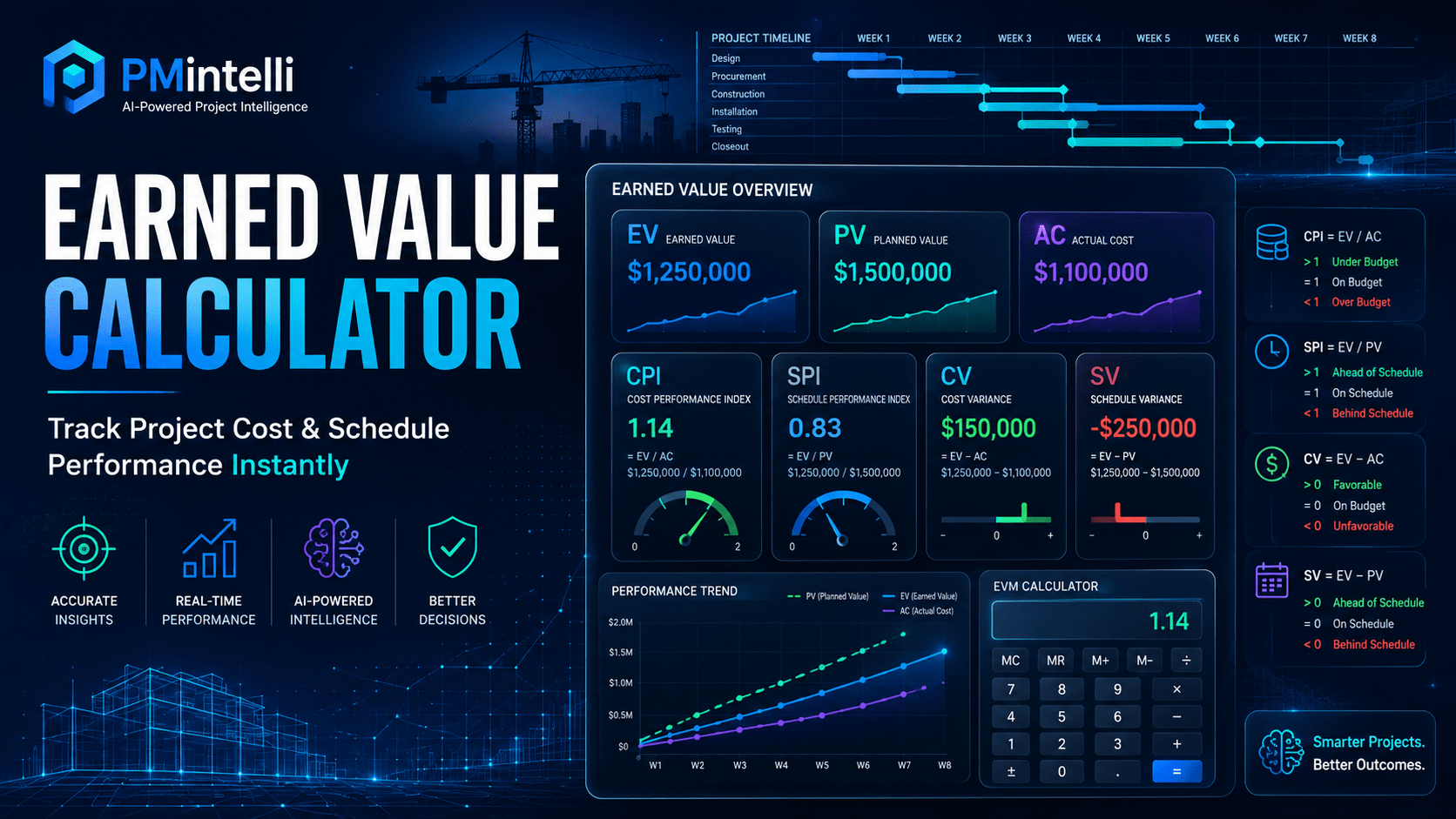
Instant CPI, SPI, EAC, ETC, VAC, CV, SV & TCPI — with interactive charts and automated performance insights. Built for project managers, cost engineers, and construction professionals.
PMBOK® Aligned Real-Time Calculations Export to CSV
Enter Project Data
Total approved project budget
#
Period Date
Planned Value (PV) $
Earned Value (EV) $
Actual Cost (AC) $
Performance KPIs
Performance Charts
Project S-Curve (PV / EV / AC)
CPI & SPI Performance Trend
Cost & Schedule Variance
Cost Forecast (EAC vs BAC)
Detailed Results
Period
PV
EV
AC
CV
SV
CPI
SPI
EAC
Status
Performance Insights
AI-POWERED
How It Works
Three steps to full EVM visibility
STEP 01
Enter Your Data
Input your BAC and per-period PV, EV, and AC values. Add multiple periods for trend analysis or use a single period for snapshot reporting.
STEP 02
Calculate Metrics
Hit Calculate to instantly compute CPI, SPI, CV, SV, EAC, ETC, VAC, and TCPI using PMBOK®-standard formulas with full input safeguards.
STEP 03
Analyze & Export
Review KPI cards, interactive charts, and automated insights. Export to CSV for reporting or print the dashboard for stakeholder meetings.
Instantly calculate your project's contractual completion date.
Accounts for NTP-based scheduling logic used in real construction and infrastructure contracts.
One of the most common scheduling mistakes happens right at the beginning —
incorrectly counting the first day of your project duration.
Whether your contract counts the NTP date as Day 1, or the clock starts the following day,
can shift your entire project end date by one full calendar day.
Use this tool to calculate your precise project end date based on your contract's NTP logic.
Enter Project Details
Notice to Proceed (NTP) — Day Count Logic
How does your contract count the project duration?
This determines whether the NTP issue date is Day 1 of the contract, or if the clock starts the following day.
📅Calculation Results
Project Start Date—
Contract Duration—
NTP Logic Applied—
Effective Duration Used—
Project End Date
—
⚠ NTP Day-1 Rule Applied — 1 day deducted
Key Takeaways
Always check your contract language. Terms like "within X days of NTP" or "commencing on the date of NTP" directly determine which rule applies.
The NTP Day-1 rule is common in public sector contracts. Many government and infrastructure contracts treat the NTP issuance date as Day 1, effectively shortening your usable duration by one day.
Contractual end date ≠ substantial completion date. Your baseline schedule should reflect the contractual end date, with float protecting against delays.
Document your assumption. The NTP logic you apply should be documented in your Schedule Basis Memorandum and agreed with the client before baseline approval.
Artificial Intelligence is no longer limited to data scientists or software engineers. AI for Non-Technical Project Managers is quickly becoming a practical advantage for professionals who manage scope, schedules, budgets, risks, and stakeholders — without writing a single line of code.
If you lead projects, run a PMO, build schedules, or manage engineering contracts, AI is not about replacing your expertise. It is about amplifying it. Used correctly, AI helps you think faster, analyze better, and communicate more clearly.
This guide explains AI from first principles and shows how non-technical project managers can start using it immediately in real-world projects.
What AI Actually Means for Project Managers
Before tools and trends, we need clarity.
At its core, AI is software that can:
Recognize patterns in data
Generate structured text or reports
Summarize complex information
Suggest options based on historical inputs
Automate repetitive analysis
For project managers, that translates into:
Faster risk identification
Automated schedule analysis
Smarter cost forecasting
Improved stakeholder communication
Better decision support
AI does not replace project judgment. Instead, it strengthens your ability to process information quickly.
Why AI for Non-Technical Project Managers Matters
Most project managers are domain experts — not programmers. Yet they deal with:
Massive schedules
Thousands of cost line items
Complex contracts
Frequent change orders
Multi-stakeholder communications
AI becomes powerful when applied to these daily realities.
For example:
Project Area
Traditional Approach
AI-Enhanced Approach
Risk Register
Manual brainstorming
Pattern-based risk suggestions
Schedule Review
Manual critical path checks
Automated delay impact simulation
Cost Forecast
Spreadsheet extrapolation
Predictive trend analysis
Reporting
Manually written summaries
AI-drafted executive reports
The difference is not sophistication. It is speed and clarity.
Let’s simplify AI into three practical categories relevant to project management.
1. Generative AI
This type creates content. Examples include:
Drafting risk descriptions
Writing meeting summaries
Creating executive updates
Generating project charters
It saves time on documentation-heavy work.
2. Predictive AI
This analyzes historical data to forecast outcomes.
Applications in projects:
Cost overrun prediction
Schedule slippage probability
Resource utilization forecasting
This type supports decision-making rather than documentation.
3. Analytical AI
This identifies trends, anomalies, or patterns.
Use cases:
Detecting unusual cost spikes
Identifying repetitive delay causes
Spotting risk clusters
For PMO leaders, this category can elevate portfolio oversight.
Step-by-Step: How to Get Started with AI for Non-Technical Project Managers
You do not need a digital transformation program to begin. Follow this structured approach.
Step 1: Identify Repetitive Mental Work
Start by asking:
What tasks consume mental energy every week?
What reports are manually recreated?
Where do I analyze patterns repeatedly?
Common candidates include:
Weekly status reports
Risk register updates
Lessons learned summaries
Change impact narratives
If the task involves text, patterns, or repetitive structure, AI can likely assist.
Step 2: Start with Low-Risk Applications
Avoid jumping into predictive modeling immediately.
Begin with:
Drafting executive summaries
Rewriting technical updates into plain language
Creating structured meeting minutes
Developing communication plans
Example: An infrastructure PM managing a wastewater pump station project uses AI to convert field engineer notes into concise stakeholder-ready updates. The PM reviews and refines — but saves 45 minutes per report cycle.
Step 3: Use AI to Think, Not Just Write
Many PMs limit AI to drafting emails. That is a missed opportunity.
Try prompting AI to:
Identify potential risks in a scope description
Suggest failure points in a procurement strategy
Stress-test your schedule logic assumptions
Challenge your mitigation plan
AI becomes a thinking partner, not just a writing assistant.
Step 4: Integrate AI into Project Controls
For schedulers and cost engineers, AI can assist with:
Interpreting variance trends
Identifying likely root causes
Simulating “what-if” scenarios
If you work with earned value metrics, AI can help explain:
Challenge: Repeated schedule delays due to utility relocation conflicts.
AI Use:
Analyze delay logs
Identify recurring root causes
Suggest preventive controls
Result: The PM identifies a pattern: coordination gaps between utility providers and roadway crews. A structured pre-construction utility workshop is introduced, reducing recurring delays.
Example 2: IT System Implementation
Challenge: Executive stakeholders complain that status reports are too technical.
AI Use:
Convert detailed sprint updates into business-impact language
Summarize risks into three decision-oriented bullet points
Result: Stakeholder clarity improves. Meeting time reduces by 20%.
Example 3: PMO Portfolio Oversight
Challenge: 40 active capital projects with inconsistent reporting.
AI Use:
Normalize risk language
Categorize issues by trend type
Highlight cross-project themes
Result: The PMO shifts from reactive reporting to proactive intervention.
Common Mistakes Non-Technical PMs Make with AI
Understanding what not to do is critical.
1. Treating AI as an Authority
AI generates suggestions — not validated truths.
Always verify:
Contract clauses
Engineering specifications
Regulatory references
2. Over-Automating Decision-Making
AI should support decisions, not replace them.
Professional accountability remains with the project manager.
3. Feeding Sensitive Data Without Controls
Avoid uploading:
Confidential contract details
Proprietary engineering drawings
Personal employee data
Establish internal guidelines first.
4. Using Vague Prompts
Weak prompt:
“Analyze this project.”
Strong prompt:
“Identify potential cost overrun risks in this civil construction scope based on procurement sequencing and subcontractor dependencies.”
Specificity improves output quality.
Practical Tips You Can Apply This Week
Here are actionable ways to begin immediately.
✔ Improve Weekly Reporting
Prompt AI to:
Draft a 5-bullet executive summary
Translate technical delays into business impact
Highlight top 3 decisions needed
✔ Strengthen Risk Workshops
Before a risk session:
Ask AI to generate 15 potential risks for your project type
This improves organizational learning without additional staff effort.
How AI Elevates Project Leadership
AI for Non-Technical Project Managers is not about technical transformation. It is about leadership leverage.
When used correctly, AI helps you:
Think more strategically
Focus on stakeholder alignment
Detect early warning signals
Communicate clearly under pressure
It shifts your role from document producer to decision facilitator.
The Strategic Advantage for PMOs
For PMO leaders, AI offers portfolio-level visibility.
With structured use:
Risk trends can be aggregated
Variance explanations standardized
Executive dashboards improved
Predictive signals identified earlier
This is not digital hype. It is structured information leverage.
Final Thoughts: Start Small, Think Big
AI for Non-Technical Project Managers is not about becoming technical. It is about becoming more effective.
Start with one use case:
Weekly reporting
Risk analysis
Change narrative drafting
Build comfort. Develop internal standards. Then scale thoughtfully.
The competitive advantage will not go to the PM who uses AI the most. It will go to the PM who uses AI with discipline, judgment, and strategic intent.
AI is a tool. Project leadership remains human.
Frequently Asked Questions
Do I need to learn how to code to use AI as a project manager?
No. AI is now a practical tool for professionals who manage scope, schedules, and budgets without writing any code. The value of AI for a non-technical PM lies in using existing software and platforms to automate repetitive analysis, recognize data patterns, and summarize complex information, rather than building the underlying algorithms themselves.
How does AI actually differ from traditional project management methods?
Traditional approaches often rely on manual brainstorming for risk registers and manual critical path checks for schedule reviews. AI enhances these areas by providing pattern-based risk suggestions and automated simulations of delay impacts. Essentially, it moves project management from reactive, manual reporting to proactive, predictive analysis.
What are some "low-risk" ways to start using AI in my daily workflow?
If you are just starting, focus on documentation-heavy tasks that consume high mental energy. AI can be used to: Draft executive summaries and weekly status reports. Rewrite technical updates into plain language for stakeholders. Summarize "lessons learned" from anonymized issue logs. Create structured meeting minutes and communication plans.
How can AI be used as a "thinking partner" instead of just a writing assistant?
Beyond drafting emails, AI can be prompted to stress-test your project's logic. For example, you can ask AI to identify potential failure points in a procurement strategy, suggest hidden risks in a scope description, or challenge the assumptions in your schedule logic. This helps you identify blind spots you might have otherwise missed.
What are the major "dos and don'ts" when integrating AI into project management?
Do: Use AI to generate options, highlight trends, and accelerate preparation. Don't: Treat AI as an absolute authority; always verify its outputs against contract clauses and engineering specs. Don't: Feed sensitive or confidential contract data into public AI tools without internal governance. Don't: Use AI to replace professional judgment or automate high-stakes decision-making like approving change orders.
Introduction: Why a Project Management Plan Still Matters
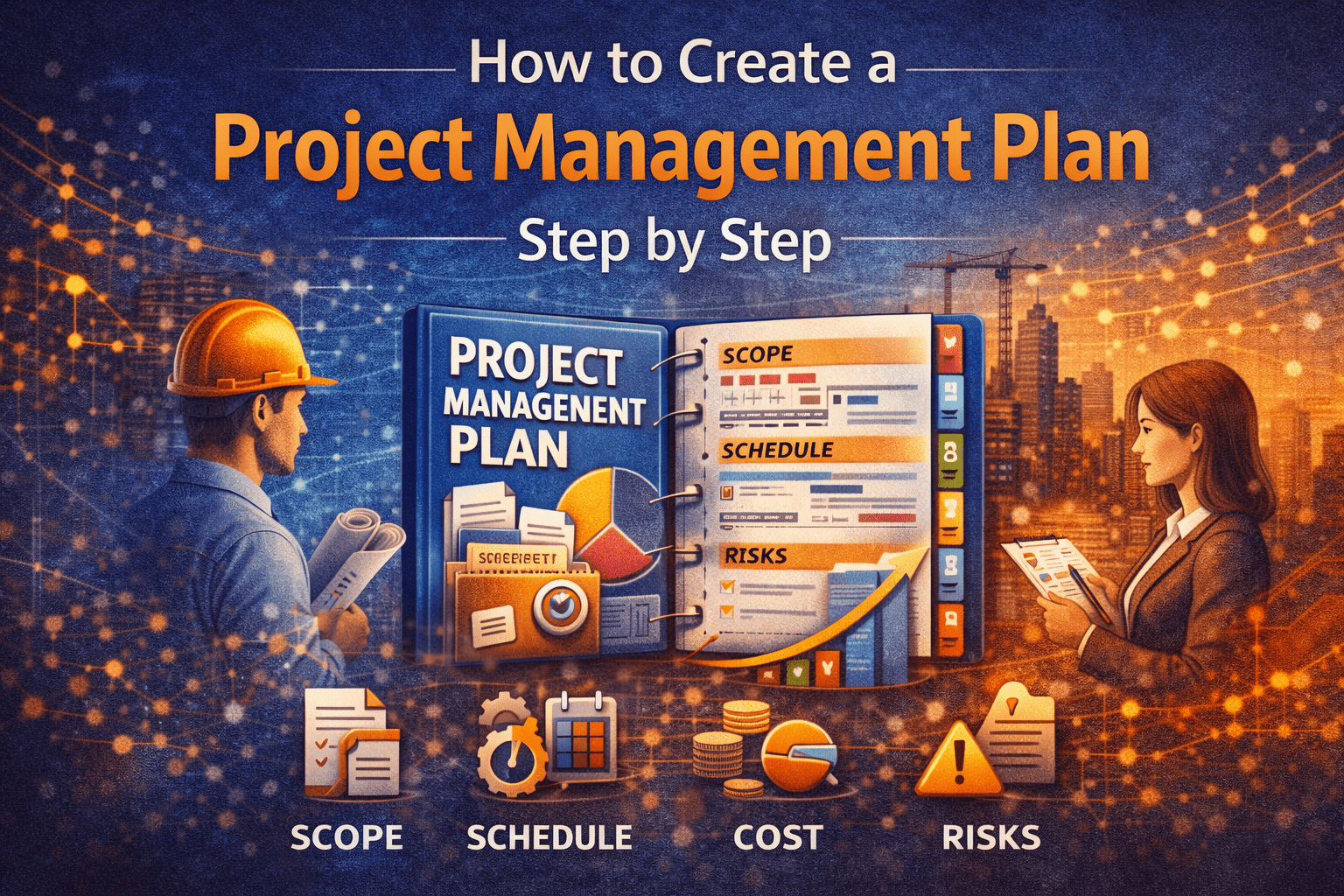
A Project Management Plan is not a formality. It is the single document that explains how a project will actually be managed, not just what will be delivered.
Many project failures do not occur because teams lack tools or talent. They fail because expectations, responsibilities, and decision paths were never clearly defined. A well-constructed Project Management Plan prevents this by turning assumptions into documented agreements.
This article explains, step by step, how to create a practical Project Management Plan that supports delivery, control, and decision-making across the full project life cycle.
Whether you manage engineering, infrastructure, IT, or PMO initiatives, the principles remain the same.
What Is a Project Management Plan?
A Project Management Plan is an integrated document that defines:
How the project will be planned
How work will be executed
How performance will be monitored and controlled
How changes will be evaluated and approved
How the project will be closed
It does not replace schedules, budgets, or risk registers. Instead, it explains how those elements work together.
Think of it as the operating manual for your project.
When the Project Management Plan Should Be Created
The Project Management Plan should be developed after project authorization but before major execution begins.
At this point:
The project has a sponsor
High-level objectives are known
Funding is tentatively approved
Key stakeholders are identified
The plan is refined as the project progresses, but the core structure should be established early.
Step-by-Step Guide to Creating a Project Management Plan
Step 1: Define Project Purpose and Objectives
Start by documenting why the project exists.
This section should clearly state:
The business or operational problem being solved
The expected outcomes
How success will be measured
Avoid vague language. Objectives should be specific and observable.
Example (Infrastructure Project):
The project will replace the existing pump station to increase capacity by 40% and meet updated regulatory discharge requirements.
This clarity anchors every planning decision that follows.
Step 2: Define Project Scope and Boundaries
Scope defines what is included and what is excluded.
A strong scope section includes:
Major deliverables
Key assumptions
Explicit exclusions
Interfaces with other projects or agencies
This is where many projects fail. If something is not written here, it will likely become a dispute later.
A Project Management Plan is not about compliance.
It is about control, clarity, and consistency.
Projects succeed when teams understand how decisions are made, how performance is measured, and how issues are resolved. A strong Project Management Plan makes that understanding explicit.
If you manage complex projects, this document is one of your most valuable tools.
Every successful project—whether it’s building infrastructure, launching software, or implementing AI—follows a structured journey known as the Project Life Cycle. Understanding this life cycle is foundational to effective project management, better decision-making, and predictable outcomes.
In this guide, we break down each phase of the project life cycle, explain what happens in practice, and share real-world examples to show how theory translates into execution.
What Is the Project Life Cycle?
The Project Life Cycle is a structured sequence of phases that a project goes through from start to finish. It provides a framework for planning, executing, controlling, and closing work in a disciplined and repeatable way.
While methodologies may differ (Waterfall, Agile, Hybrid), most projects follow five core phases:
Initiation
Planning
Execution
Monitoring & Controlling
Closing
Each phase has clear objectives, deliverables, and decision points.
Phase 1: Project Initiation
Purpose
The initiation phase defines why the project exists and whether it should proceed.
Key Activities
Identify the business need
Define high-level scope
Identify stakeholders
Assess feasibility and risks
Develop a project charter
Key Deliverables
Project Charter
Stakeholder Register
High-level Risk Assessment
Real Example
Construction Project: A city identifies recurring flooding issues. During initiation, engineers assess feasibility, funding sources, and environmental constraints before approving a drainage improvement project.
IT / AI Project: A company explores using AI to automate schedule updates. A business case is created to evaluate ROI, data readiness, and integration complexity before approving development.
Phase 2: Project Planning
Purpose
Planning establishes how the project will be executed, monitored, and controlled.
Key Activities
Define detailed scope
Create the Work Breakdown Structure (WBS)
Develop the schedule
Estimate costs and create a budget
Identify risks and mitigation strategies
Define communication and quality plans
Key Deliverables
Project Management Plan
Schedule (CPM or Agile roadmap)
Cost Estimate & Budget
Risk Register
Real Example
Infrastructure Project: A highway resurfacing project develops a WBS broken into lanes, work zones, and phases. The schedule accounts for traffic control, night work, and weather risks.
Software Project: A SaaS team creates sprint plans, defines user stories, estimates effort, and uses AI tools to forecast delivery risks based on historical velocity.
Phase 3: Project Execution
Purpose
Execution is where plans are turned into tangible results.
Key Activities
Perform project work
Manage teams and resources
Execute procurement
Communicate with stakeholders
Implement quality assurance
Key Deliverables
Completed deliverables
Performance reports
Updated issue logs
Real Example
Utility Project: Crews install duct banks, manholes, and conduits while inspectors verify work meets specifications. Daily reports capture progress and issues.
Digital Transformation Project: Developers build features, AI models are trained, and integrations are tested. Generative AI may assist with documentation and test case generation.
Phase 4: Monitoring & Controlling
Purpose
This phase ensures the project stays on track in terms of scope, schedule, cost, and quality.
Key Activities
Track performance metrics
Compare planned vs. actual progress
Manage changes
Update risk and issue logs
Implement corrective actions
Key Deliverables
Status reports
Forecasts (schedule & cost)
Approved change requests
Real Example
Capital Project: Earned Value Management (EVM) shows schedule slippage due to material delays. The team re-sequences work and accelerates critical activities.
AI-Enabled PMO: AI tools analyze trends across multiple projects, predict delays, and recommend resource reallocation before issues become critical.
Phase 5: Project Closing
Purpose
Closing formally completes the project and captures lessons learned.
Key Activities
Finalize deliverables
Obtain client acceptance
Close contracts
Release resources
Document lessons learned
Key Deliverables
Final project report
Lessons learned register
Closeout documentation
Real Example
Public Sector Project: After final inspections, as-built drawings are submitted, warranties are recorded, and the project is formally accepted by the owner.
Technology Project: The system goes live, support transitions to operations, and the team documents performance metrics and improvement opportunities.
Why the Project Life Cycle Matters
Understanding the project life cycle helps organizations:
Improve predictability and control
Reduce risks and surprises
Enhance communication
Align strategy with execution
Leverage AI more effectively across phases
Projects that skip phases—or rush through them—often suffer from scope creep, delays, and cost overruns.
The Role of AI Across the Project Life Cycle
AI is increasingly embedded in every phase:
Initiation: Business case analysis, feasibility modeling
Closing: Lessons learned extraction and knowledge management
AI doesn’t replace project managers—it augments decision-making and insight.
Final Thoughts
The project life cycle is more than a textbook concept—it’s a practical roadmap for delivering successful outcomes. Whether you’re managing construction projects, IT systems, or AI initiatives, mastering each phase gives you a powerful advantage. At PM Intelli Hub, we focus on combining project management fundamentals with modern AI tools to help professionals lead smarter, more resilient projects.
(Artificial intelligence tools contributed to the development of this article.)
At PM Intelli Hub, we focus on helping project professionals master project management, project controls, and emerging AI tools that drive better decision-making. The following video introduces one of the most critical disciplines in modern project delivery: Project Control.
Project Control is the backbone of successful projects. It provides the structure and visibility needed to manage scope, schedule, cost, and performance—ensuring projects stay aligned with objectives from planning through closeout.
What Is Project Control?
Project Control is a systematic approach to planning, monitoring, and controlling project performance. It transforms raw project data into actionable insights that allow teams to identify risks early, forecast outcomes accurately, and take corrective action before issues impact delivery.
Unlike basic reporting, Project Control integrates:
Schedule data (CPM schedules and milestones)
Cost data (budgets, commitments, and actuals)
Scope definition and change management
Performance metrics and forecasting
This integration enables proactive management instead of reactive problem-solving.
Core Elements of Project Control
the following key components form a strong project control framework:
Schedule Control Monitoring progress against the baseline schedule to identify delays, float erosion, and sequencing issues using CPM scheduling techniques.
Cost Control Tracking budgets, costs, and forecasts to prevent overruns and support informed financial decisions.
Performance Measurement Analyzing productivity and efficiency using objective data to evaluate how well the project is performing.
Integrated Project Controls Aligning scope, schedule, and cost so that changes are evaluated holistically and impacts are clearly understood.
Why Project Control Matters
Effective Project Control allows organizations to:
Deliver projects on time and within budget
Improve forecast accuracy and predict outcomes earlier
Reduce risk through data-driven decision-making
Increase transparency for owners, executives, and stakeholders
Support claims avoidance and defensible project documentation
In today’s complex projects—especially in construction, infrastructure, and engineering—strong project controls are no longer optional. They are essential.
Who Should Learn Project Control?
Project Control principles apply to:
Project Managers and Assistant Project Managers
Schedulers and Planning Engineers
Cost Engineers and Estimators
Owners, PMOs, and Executives
Construction, Infrastructure, and Capital Program Teams
At PM Intelli Hub, we emphasize practical, real-world project control knowledge—enhanced with AI tools and automation—to help professionals work smarter and deliver better results.
Final Thoughts
This video serves as an introduction to Project Control as a strategic capability, not just a reporting function. Mastering project controls empowers teams to manage uncertainty, control risk, and consistently achieve successful project outcomes.
Follow PM Intelli Hub for expert insights on project management, project controls, CPM scheduling, cost management, and AI-powered project delivery.