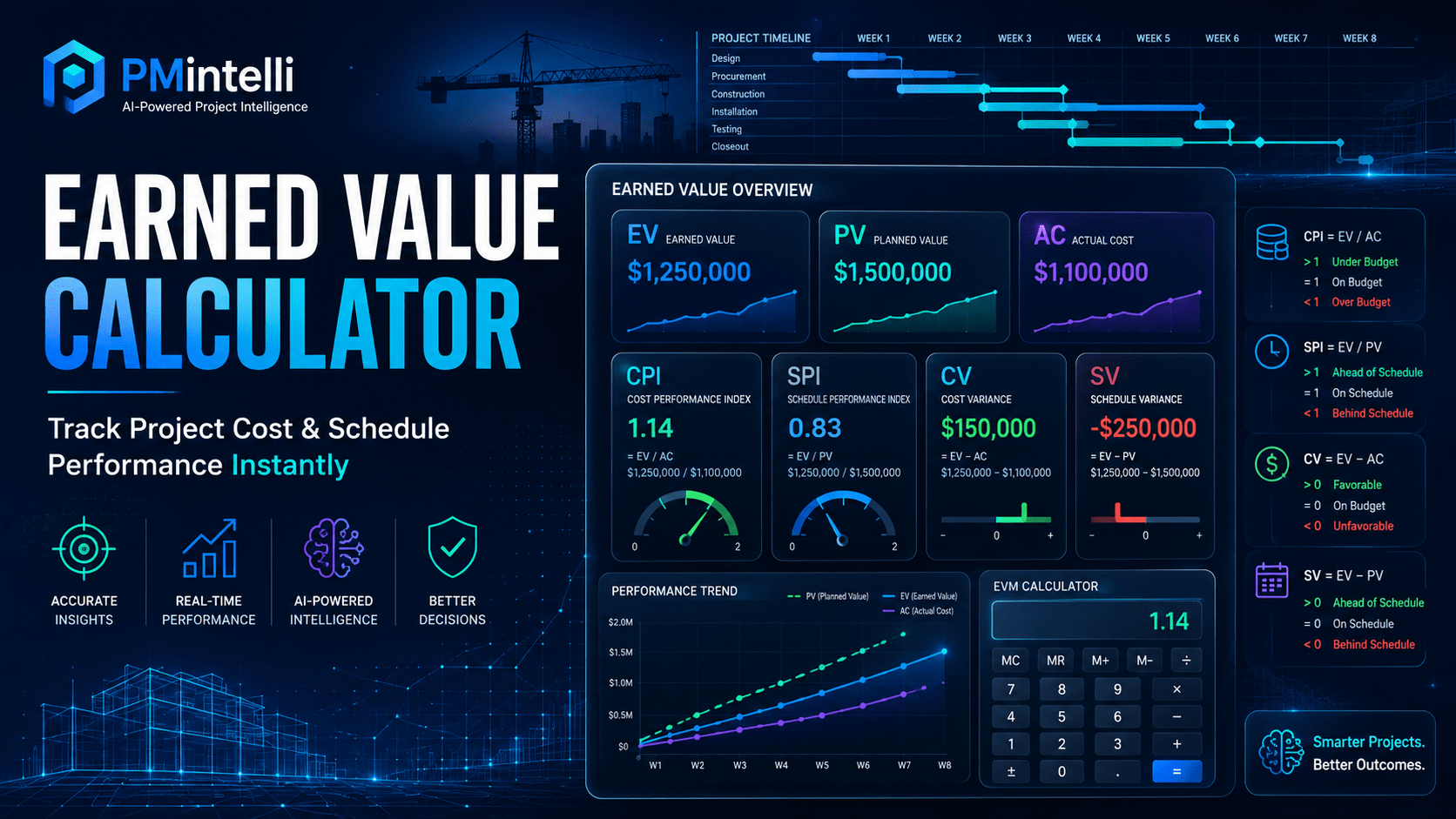
Instant CPI, SPI, EAC, ETC, VAC, CV, SV & TCPI — with interactive charts and automated performance insights. Built for project managers, cost engineers, and construction professionals.
PMBOK® Aligned Real-Time Calculations Export to CSV
Enter Project Data
Total approved project budget
#
Period Date
Planned Value (PV) $
Earned Value (EV) $
Actual Cost (AC) $
Performance KPIs
Performance Charts
Project S-Curve (PV / EV / AC)
CPI & SPI Performance Trend
Cost & Schedule Variance
Cost Forecast (EAC vs BAC)
Detailed Results
Period
PV
EV
AC
CV
SV
CPI
SPI
EAC
Status
Performance Insights
AI-POWERED
How It Works
Three steps to full EVM visibility
STEP 01
Enter Your Data
Input your BAC and per-period PV, EV, and AC values. Add multiple periods for trend analysis or use a single period for snapshot reporting.
STEP 02
Calculate Metrics
Hit Calculate to instantly compute CPI, SPI, CV, SV, EAC, ETC, VAC, and TCPI using PMBOK®-standard formulas with full input safeguards.
STEP 03
Analyze & Export
Review KPI cards, interactive charts, and automated insights. Export to CSV for reporting or print the dashboard for stakeholder meetings.
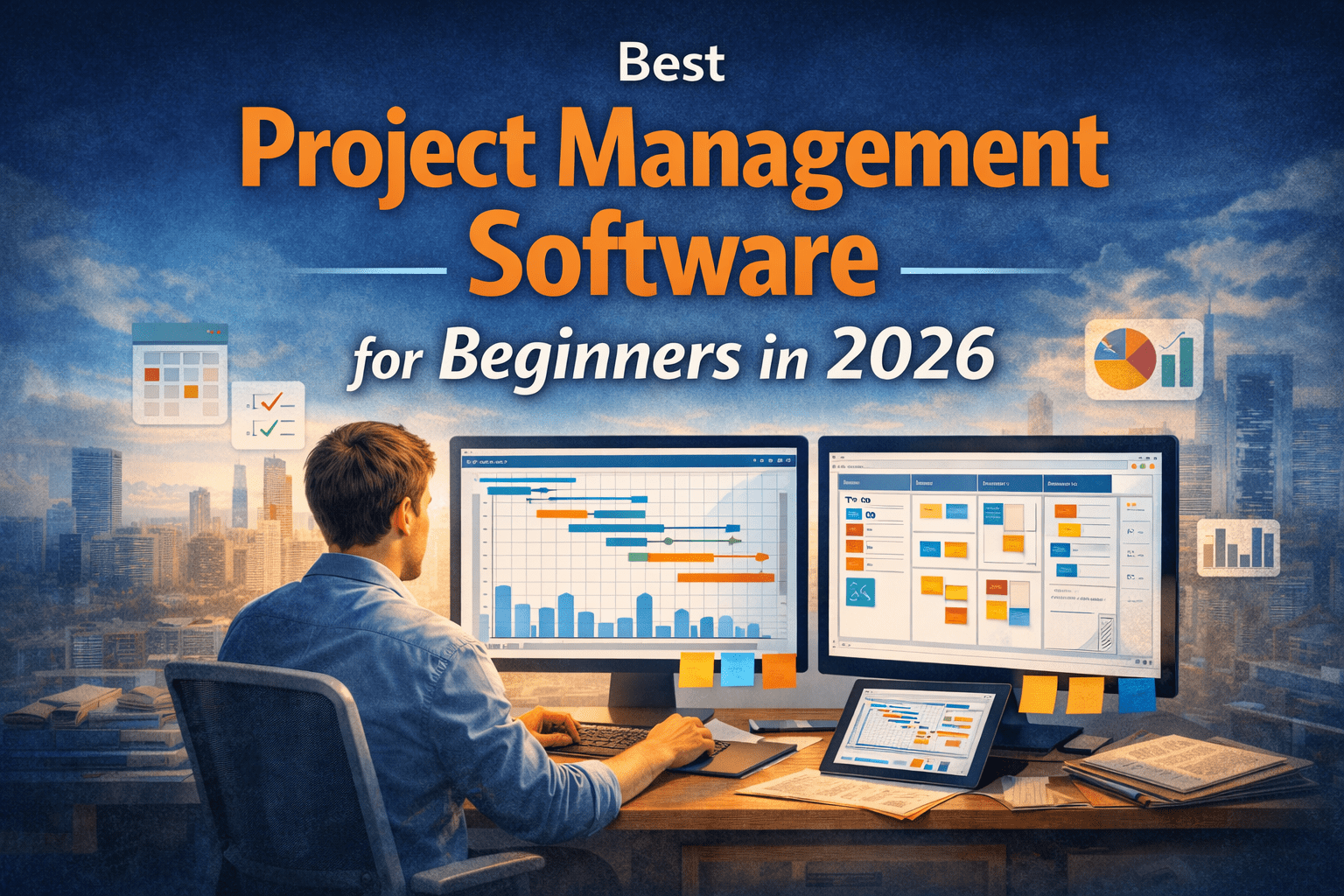
Choosing the right Project Management Software is one of the first real decisions that shapes how a project manager works. For beginners, this decision matters even more. The software you start with influences how you think about planning, tracking, communication, and control.
Many new project managers struggle not because they lack discipline, but because their tools either overwhelm them or hide fundamental project control concepts behind automation. The goal of this article is to explain, from first principles, how beginners should evaluate project management software in 2026 and which types of tools best support early career growth.
This is not a feature comparison or a ranking based on marketing claims. Instead, it is a practical guide written from the perspective of real project delivery across engineering, infrastructure, IT, and PMO environments.
What Is Project Management Software, Really?
At its core, Project Management Software is a structured way to answer four basic questions:
What work needs to be done?
When should it happen?
Who is responsible?
Are we on track?
Good software does not manage projects for you. It makes project behavior visible. That visibility allows project managers to detect issues early, explain trade-offs, and support informed decisions.
For beginners, software should reinforce good habits rather than replace thinking.
Why Beginners Need a Different Approach to PM Software
Experienced project managers can adapt almost any tool to their process. Beginners cannot.
The wrong software choice often leads to:
Overreliance on automation
Poor understanding of schedule logic
Confusing reports that nobody trusts
Frustration and tool abandonment
The best pm software for beginners teaches structure, not shortcuts.
Core Capabilities Beginners Should Look For
Before naming tools, it is important to define what actually matters.
1. Clear Task and Scope Structure
Beginners must learn how scope is broken down.
Look for software that supports:
Hierarchical task lists
Logical grouping of work
Simple dependency management
This reinforces Work Breakdown Structure (WBS) thinking, a foundational project control skill.
2. Visual Scheduling Without Hiding Logic
Scheduling is more than dates on a calendar.
Good Project Scheduling tools for beginners:
Show task dependencies clearly
Allow manual logic editing
Highlight critical or near-critical work
Avoid tools that auto-schedule everything without explaining why.
3. Simple Progress Tracking
Progress should reflect real work performed, not percentage guessing.
Useful features include:
Status-based updates
Planned vs. actual comparisons
Basic trend views
These concepts connect directly to performance measurement used in larger projects.
4. Reporting That Supports Decisions
Beginners should avoid dashboards overloaded with charts.
Instead, look for:
Clear schedule views
Simple milestone tracking
Variance indicators
This builds early confidence in explaining project status to stakeholders.
You can later expand reporting using concepts discussed in [Internal link to Budget Dashboard article]
Categories of Project Management Software for Beginners
Not all software serves the same purpose. In 2026, beginner-friendly tools generally fall into four categories.
Task-Based Project Management Software
These tools focus on task lists, assignments, and collaboration.
They are useful for:
Small teams
Early-career PMs
Low dependency projects
However, they often lack true scheduling depth.
Scheduling-Focused Project Management Software
These tools emphasize logic-driven schedules and timelines.
They are ideal for beginners who want to:
Learn CPM concepts
Understand dependencies
Transition into Project Controls roles
They are commonly used in engineering and construction environments.
Hybrid PM and Project Control Software
These tools combine task management with scheduling and cost tracking.
They support:
PMO environments
Owner-side project oversight
Entry-level project control software users
This category often provides the best long-term learning curve.
Enterprise PMO Software (Not Beginner-Friendly)
Large enterprise platforms offer powerful integration but are rarely suitable for beginners.
They require:
Established processes
Dedicated administrators
Formal governance structures
Beginners should approach these later in their careers.
Best Project Management Software Characteristics for Beginners in 2026
Rather than listing brand names, this section explains what the best tools have in common.
Beginner-Friendly Software Does This Well
Makes dependencies visible
Encourages planning before execution
Allows manual control over schedules
Supports learning, not hiding complexity
Scales with experience
Software Beginners Should Be Cautious With
Fully automated scheduling with no logic view
Tools that focus only on visuals
Platforms that require heavy configuration
Software marketed as “set it and forget it”
Practical Comparison: What Beginners Actually Need
Capability
Why It Matters
Beginner Priority
Task hierarchy
Reinforces scope control
High
Dependencies
Teaches cause and effect
High
Baselines
Supports performance tracking
Medium
Cost linkage
Introduces project controls
Medium
Advanced analytics
Useful later
Low
This mindset keeps beginners focused on fundamentals rather than features.
Step-by-Step: How Beginners Should Select PM Software
Step 1: Define the Type of Projects You Run
Ask:
Are projects linear or iterative?
Do dependencies matter?
Is schedule risk a concern?
Infrastructure and engineering projects benefit from stronger scheduling tools than simple task trackers.
Step 2: Decide What You Want to Learn
Your first Project Management Software should teach you:
Planning discipline
Logical sequencing
Status communication
Avoid tools that promise speed at the cost of understanding.
Step 3: Start Simple, But Not Shallow
A simple interface is good. A shallow model is not.
Choose software that:
Starts easy
Reveals deeper functionality as you grow
This supports long-term career development.
Step 4: Test With a Real Project
Before committing:
Build a small schedule
Add dependencies
Update progress
Review reports
If the software helps you explain what is happening, it is doing its job.
Real-World Examples of Beginner PM Software Use
Engineering Project Example
A junior project manager supporting a design consultant used scheduling-focused software to:
Map design deliverables
Identify long approval paths
Flag risks to permit milestones
This visibility improved coordination with reviewers and reduced late-stage surprises.
Infrastructure Project Example
On a municipal capital program, entry-level PMs used hybrid project control software to:
Track contractor schedules
Monitor milestone payments
Support monthly PMO reporting
The software reinforced schedule discipline without overwhelming users.
IT Project Example
In a system implementation project, a beginner PM:
Built a dependency-driven rollout plan
Tracked integration points
Used trend views to justify scope trade-offs
Even without cost tracking, scheduling logic added credibility.
Common Mistakes Beginners Make With PM Software
Mistake 1: Choosing Software Based on Popularity
Popular does not mean appropriate.
Beginners need learning tools, not enterprise platforms.
Mistake 2: Ignoring Schedule Logic
Skipping dependencies leads to false confidence.
Schedules without logic cannot forecast risk.
Mistake 3: Overloading the Tool
Too many fields, tags, and views confuse stakeholders.
Clarity beats completeness.
Mistake 4: Treating Software as Status Reporting Only
Project Management Software is not a reporting tool—it is a planning and decision tool.
Practical Tips Beginners Can Apply Immediately
Always link tasks logically, even in small projects
Capture a baseline before execution begins
Update progress consistently, not perfectly
Use software outputs to explain decisions, not defend tools
Review schedule changes weekly, even on short projects
As your experience grows, AI can help automate parts of this process. Practical examples are covered in [Internal link to AI Prompts for Project Managers article]
How Project Management Software Connects to Project Controls
Beginners who understand this connection gain a career advantage.
Project Management Software becomes Project Controls software when it:
Integrates scope, schedule, and cost
Supports forecasting
Enables objective performance measurement
Learning this progression early supports long-term growth in PMO and controls roles.
For foundational concepts, see [Internal link to Project Control Fundamentals article]
Strategic Takeaway: Choosing Software Is a Career Decision
The best Project Management Software for beginners in 2026 is not the one with the most features. It is the one that teaches you how projects actually behave.
Strong software choices:
Reinforce planning discipline
Build scheduling intuition
Improve communication with stakeholders
Prepare you for advanced project control roles
When software supports thinking rather than replacing it, beginners build skills that last well beyond their first tool.