Visit PM Intelli Hub YouTube Channel

AI-Powered Skills for Project Managers

Scope Creep in Engineering Projects: Causes and Prevention

Scope Creep in Engineering Projects is one of the most persistent threats to cost, schedule, and stakeholder trust. It rarely appears as a dramatic event. Instead, it develops quietly—through small additions, informal requests, and “quick fixes” that accumulate over time.

For project managers, schedulers, cost engineers, and PMO leaders, understanding scope creep is not optional. It directly affects:

  • Margin protection
  • Forecast accuracy
  • Contract compliance
  • Team morale
  • Client relationships

When scope expands without structured control, performance metrics become unreliable. Schedules lose logic. Budgets stop reflecting reality. Eventually, leadership begins reacting instead of managing.

This article explains Scope Creep in Engineering Projects from first principles, identifies root causes, and provides practical prevention strategies you can apply immediately.


What Is Scope Creep in Engineering Projects?

Scope creep occurs when the project’s defined deliverables expand without formal approval, budget adjustment, or schedule revision.

It is important to distinguish scope creep from approved change.

Approved ChangeScope Creep
Formally requestedInformally introduced
Impact analyzedImpact often ignored
Budget adjustedBudget unchanged
Schedule revisedSchedule remains unrealistic
Documented and trackedOften undocumented

Scope creep is not about change itself. Engineering projects require change. Scope creep occurs when change bypasses governance.


Why Scope Creep in Engineering Projects Is So Dangerous

Engineering and infrastructure projects operate within tight contractual and financial structures. When scope increases without control:

  • Cost overruns accelerate
  • Productivity declines
  • Claims exposure increases
  • Earned value metrics distort
  • Trust between stakeholders erodes

For example, if field teams install additional conduit runs at the client’s request—but no change order exists—the cost hits productivity metrics. CPI declines. Leadership assumes inefficiency, when in fact scope increased.

Over time, that disconnect damages decision-making.


Root Causes of Scope Creep in Engineering Projects

Understanding causes is the first step toward prevention.

1. Poorly Defined Scope at Project Start

Many projects begin with:

  • High-level narratives instead of measurable deliverables
  • Incomplete drawings
  • Unclear technical specifications
  • Ambiguous performance criteria

When scope lacks precision, interpretation fills the gap. Different stakeholders hold different assumptions.

Later, disagreements surface.


2. Weak Change Control Discipline

Sometimes the process exists, but teams bypass it.

Common patterns include:

  • “Let’s just handle it in the field.”
  • “It’s minor. No need for paperwork.”
  • “We’ll reconcile it later.”

These shortcuts feel efficient. However, they create cumulative risk.


3. Client-Driven Incremental Additions

In infrastructure projects, owners often request small improvements:

  • Additional lighting fixtures
  • Enhanced finishes
  • Upgraded materials
  • Minor geometry adjustments

Each item seems manageable. Yet collectively, they shift baseline scope significantly.


4. Engineering Optimizations Without Baseline Alignment

Design teams may refine solutions during execution. For example:

  • Increasing pipe diameter for safety margin
  • Modifying structural reinforcement
  • Enhancing control system redundancy

These decisions may improve quality. However, if the budget and schedule remain unchanged, they introduce scope creep.


5. Internal Gold-Plating

Teams sometimes exceed requirements unintentionally.

Examples:

  • Over-documenting deliverables
  • Adding unnecessary analysis
  • Installing higher-spec components without requirement

While intentions are positive, margins shrink.


Real-World Example: Water Treatment Plant Upgrade

Consider a $45M water treatment facility upgrade.

Original scope included:

  • Replacement of three pumps
  • Electrical panel modernization
  • SCADA integration

During execution:

  • Owner requested enhanced corrosion protection
  • Engineering added vibration monitoring sensors
  • Contractor upgraded cable trays “for long-term reliability”

Individually, each seemed reasonable.

Collectively, these additions increased cost by $3.2M and extended schedule by 3 months.

No single change triggered alarm. The cumulative effect did.

This is classic Scope Creep in Engineering Projects.


Step-by-Step Prevention Framework

Preventing scope creep requires discipline at every stage.

Step 1: Define Scope with Measurable Precision

Scope must translate into quantifiable deliverables.

Instead of writing:

“Install site utilities.”

Define:

  • 1,200 LF of 12-inch water main
  • 800 LF of 8-inch sewer
  • 12 valve assemblies
  • 6 hydrants

Precision reduces interpretation.

For deeper structuring guidance, see:
👉 How to Build a Practical WBS for Infrastructure Projects


Step 2: Align Scope, Budget, and Schedule Baseline

Your baseline must integrate:

  • Work Breakdown Structure (WBS)
  • Cost codes
  • Schedule activities

If cost codes do not match WBS packages, tracking becomes unreliable.

Misalignment creates hidden scope creep because tracking lacks clarity.


Step 3: Establish Clear Change Governance

Effective change control includes:

  • Written request
  • Impact analysis (cost + schedule)
  • Formal approval
  • Baseline update
  • Documentation in change log

No field execution should occur before this process—unless safety requires immediate action.

👉 Change Management in Projects: A practical Guide


Step 4: Train the Field Team

Many scope creep events originate onsite.

Project managers must communicate:

  • What constitutes scope change
  • How to escalate requests
  • Why documentation protects the team

When crews understand financial impact, compliance improves.


Step 5: Use Performance Metrics as Early Warning

Earned Value metrics can reveal hidden scope growth.

For example:

  • CPI consistently below 1.0
  • SPI trending downward without obvious delay cause

If performance declines but productivity appears stable, investigate potential scope expansion.

For further reading:
👉 Earned Value Explained for Engineering Projects


Common Mistakes That Enable Scope Creep

Even experienced PMs unintentionally allow scope creep.

Mistake 1: Confusing Client Satisfaction with Free Work

Strong relationships matter. However, absorbing cost to maintain goodwill creates long-term risk.

Professional communication can preserve trust without sacrificing margins.


Mistake 2: Delayed Change Orders

Waiting to submit change documentation weakens position.

When change orders accumulate and appear late, clients resist approval.

Submit changes promptly.


Mistake 3: Vague Meeting Minutes

Meeting notes should clearly state:

  • Whether request is informational
  • Whether it triggers cost impact
  • Who owns decision

Ambiguity invites scope creep.


Mistake 4: Not Updating Baselines

Even after approved change, some teams fail to update:

  • Budget baseline
  • Schedule baseline
  • Forecast models

This creates artificial variance that distorts reporting.


Practical Tools to Control Scope Creep in Engineering Projects

Below are tools PMs can implement immediately.

1. Scope Control Checklist

Before executing any new request, ask:

  • Is this in the original contract?
  • Does it change quantities?
  • Does it require additional labor or materials?
  • Has cost impact been calculated?
  • Has schedule impact been assessed?
  • Is approval documented?

If any answer is unclear, pause execution.


2. Scope Change Log Template

Maintain a structured log:

Change IDDescriptionCost ImpactSchedule ImpactStatusApproval Date

Visibility discourages informal expansion.


3. Weekly Scope Review Meetings

Dedicate 15 minutes weekly to:

  • Review pending requests
  • Confirm submitted change orders
  • Identify undocumented field modifications

Regular review prevents surprises.


4. Quantify Everything

In engineering projects, quantity drives clarity.

Instead of discussing abstract scope, track:

  • Linear feet
  • Cubic yards
  • Tons of steel
  • Equipment counts

Numbers reduce subjectivity.


PMO-Level Strategies

At the portfolio level, Scope Creep in Engineering Projects becomes a governance issue.

PMOs should:

  • Standardize change control procedures
  • Audit projects quarterly for undocumented scope
  • Require baseline update confirmation
  • Compare original vs. current contract values

Additionally, PMOs can monitor:

  • Percentage of revenue from change orders
  • Frequency of late change approvals
  • CPI trend vs. approved change volume

For broader governance practices, see:
👉 How to Build a High-Impact Project Controls Framework


Special Considerations for Different Project Types

Infrastructure Projects

Public works face political pressure. Owners may push for enhancements midstream.

Strong documentation protects both contractor and agency.


Industrial Projects

Engineering optimizations often drive scope creep. Establish technical review boards to evaluate cost impact before implementation.


IT and Systems Integration

Scope creep often hides in feature expansion.

Prevent it by defining:

  • Functional requirements
  • Acceptance criteria
  • Testing boundaries

Even software projects benefit from engineering-style discipline.


Strategic Takeaway: Control Scope, Protect Performance

Scope creep does not happen because teams are careless. It happens because engineering projects are dynamic and collaborative.

However, unmanaged expansion destroys predictability.

To control Scope Creep in Engineering Projects, leaders must:

  • Define measurable deliverables
  • Align scope, cost, and schedule
  • Enforce change governance
  • Educate teams
  • Monitor performance indicators

When scope remains controlled:

  • Forecasts gain credibility
  • Margins stabilize
  • Client confidence strengthens
  • PMOs mature

Ultimately, scope discipline is not about resisting change. It is about ensuring every change is visible, evaluated, and funded.

Engineering excellence requires technical precision.
Project leadership requires scope precision.

Master both, and performance follows.


Frequently Asked Questions

What is the fundamental difference between an "approved change" and "scope creep"?

The difference lies entirely in governance and impact analysis. An approved change is formally requested, fully analyzed for its impact on cost and schedule, explicitly funded by an adjusted budget, and documented in the project baseline. Conversely, scope creep occurs when changes are introduced informally (such as verbal requests in the field or internal "gold-plating" by engineering teams). With scope creep, the impact on resources is usually ignored, the budget remains unchanged, and the schedule becomes increasingly unrealistic because it is undocumented and untracked.

What are the most common root causes of scope creep in engineering and infrastructure projects?

According to the guide, scope creep is typically driven by five primary factors:
Poorly defined initial scope: Relying on high-level narratives instead of measurable, quantified deliverables and precise technical specifications at the project's start.
Weak change control discipline: Bypassing formal processes with shortcuts like "let's just handle it in the field" or promising to "reconcile it later."
Client-driven incremental additions: Small, seemingly minor owner requests (e.g., upgrading a material or minor geometry adjustments) that quietly accumulate over time.
Engineering optimizations without baseline alignment: Design teams refining technical solutions or adding safety margins (like increasing a pipe diameter) without adjusting the budget or schedule.
Internal gold-plating: Teams unintentionally exceeding contract requirements by adding unnecessary analysis or documentation.

How does unmanaged scope creep negatively impact project controls and performance metrics like CPI?

When field crews execute undocumented work at a client's request without a formal change order, the labor and material costs still hit the project. Because there is no approved budget adjustment to match the extra work, the Cost Performance Index (CPI) and Schedule Performance Index (SPI) will systematically decline. This distorts Earned Value Management (EVM) data, leading executive leadership to assume the team is highly inefficient, when in reality, they are simply performing uncompensated work.

What practical framework can a project manager implement to prevent scope creep?

The article outlines a five-step prevention framework:
Define scope with measurable precision: Quantify everything into exact deliverables (e.g., specifying exact linear feet of pipe or equipment counts rather than vague descriptions like "install site utilities").
Align the project baselines: Ensure the Work Breakdown Structure (WBS), cost codes, and schedule activities are completely integrated so tracking gaps cannot hide scope growth.
Enforce strict change governance: Mandate that no field execution occurs without a written request, impact analysis, formal approval, and a baseline update.
Train the field team: Educate onsite crews on what constitutes a scope change and how to properly escalate requests.
Use metrics as an early warning system: Actively investigate if CPI or SPI decline while actual field productivity seems stable, as this is a classic indicator of hidden scope expansion.

What common mistakes do experienced project managers make that unintentionally allow scope creep to happen?

Even seasoned project managers fall into traps that enable scope creep, including:
Confusing client satisfaction with free work: Absorbing extra costs to maintain a strong relationship or goodwill, which directly erodes project margins.
Delaying change orders: Waiting too long to compile and submit change documentation. When variations accumulate and are submitted late, clients are much more likely to resist or reject them.
Vague meeting minutes: Failing to explicitly document whether a meeting discussion triggers a cost/schedule impact and who owns the ultimate decision.
Neglecting baseline updates: Forgetting to update the budget, schedule, and forecast models even after a change order is formally approved, creating artificial variances in performance reports.

Earned Value Explained for Engineering Projects

Engineering projects rarely fail because of technical complexity alone.
They fail because leaders lose visibility over cost, schedule, and performance at the same time.

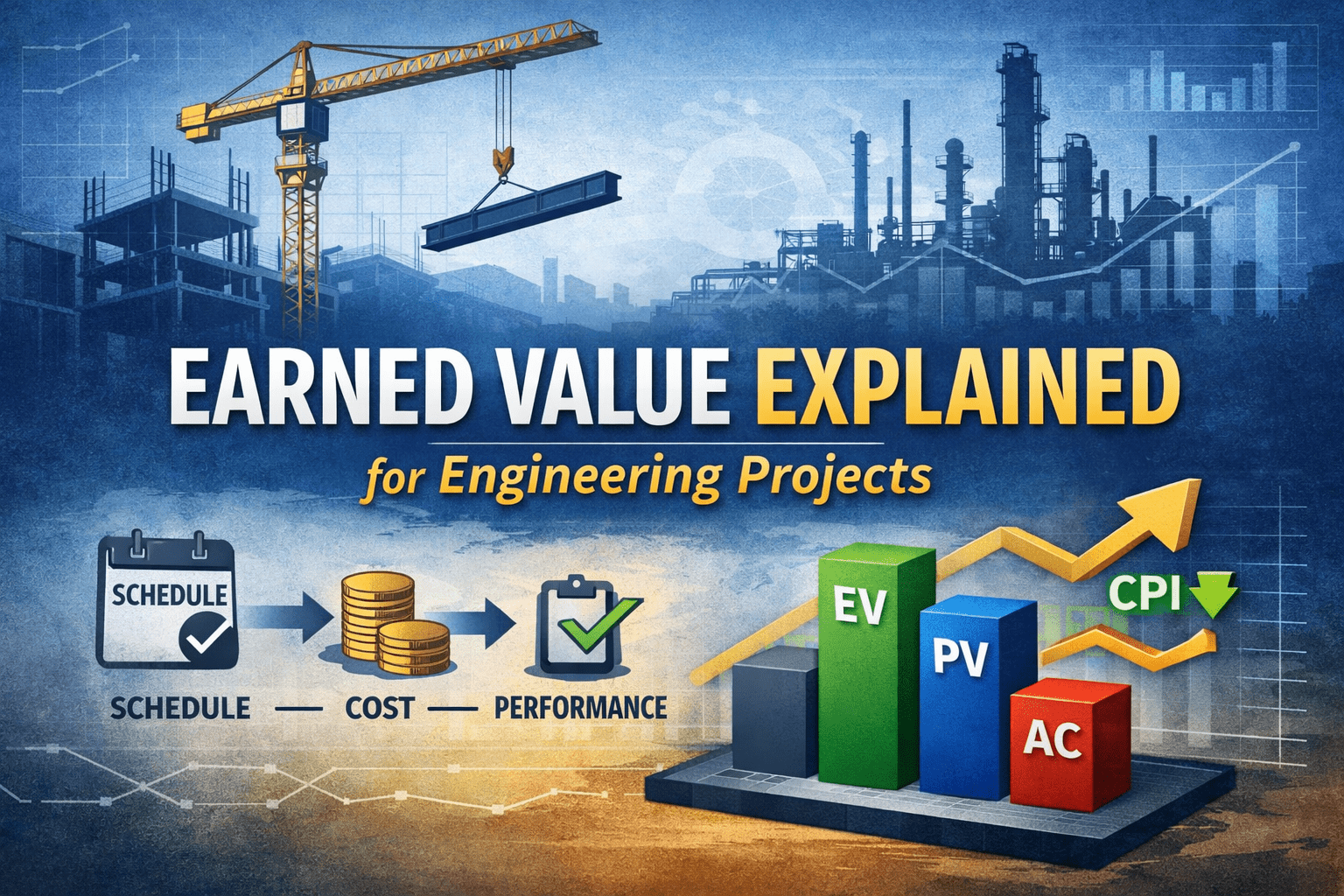
That is why Earned Value Explained clearly and practically matters for project managers, schedulers, cost engineers, and PMO leaders. It connects scope, time, and cost into a single performance picture. Instead of asking:

  • “Are we on schedule?”
  • “Are we under budget?”

Earned Value asks the more powerful question:

“Are we getting the value we planned for the money and time we’ve spent?”

For engineering and infrastructure projects—where contracts are large, risks are high, and public scrutiny is real—this distinction is critical.


What Earned Value Really Means

Many professionals overcomplicate Earned Value Management (EVM). At its core, the concept is simple:

  • Planned Value (PV): What we planned to complete by today.
  • Earned Value (EV): What we actually completed (in budget terms).
  • Actual Cost (AC): What we actually spent.

Earned Value compares these three numbers to reveal performance truth.

Think of it this way:

  • Schedule tells you time.
  • Cost reports tell you money.
  • Earned Value tells you performance.

Without Earned Value, you may think you're “50% done” because you've spent 50% of the budget. But spending money is not progress. Completing measurable scope is progress.


Earned Value Explained Step by Step

Let’s break it down in practical engineering terms.

Step 1: Define Measurable Scope

Everything begins with a solid Work Breakdown Structure (WBS).

If your WBS is vague, Earned Value will fail.
Engineering projects must define measurable deliverables such as:

  • Install 5,000 LF of water main
  • Pour 2,000 CY of concrete
  • Complete 100% of design package
  • Install 12 structural beams

Each activity must have:

  • A budget
  • A duration
  • A measurable completion method

For deeper guidance, you may reference PMIntelli’s article:
👉 How to Build a Practical WBS for Infrastructure Projects


Step 2: Assign Budget to Work (Planned Value)

Planned Value (PV) represents the approved budget for scheduled work.

Example:
A wastewater pump station project has:

ActivityBudgetPlanned % Complete by Month 3PV
Excavation$200,000100%$200,000
Foundation$500,00060%$300,000
Structural Steel$800,00025%$200,000
Total PV$700,000

By Month 3, we planned to complete $700,000 worth of work.


Step 3: Measure Earned Value (EV)

Earned Value reflects actual physical progress, expressed in budget terms.

Suppose actual progress shows:

  • Excavation: 100% complete → $200,000 earned
  • Foundation: 40% complete → $200,000 earned
  • Structural Steel: 10% complete → $80,000 earned

Total Earned Value = $480,000

Even though we planned $700,000, we only earned $480,000.

This is where reality becomes visible.


Step 4: Capture Actual Cost (AC)

Assume the accounting system shows:

  • Actual Cost = $650,000

Now we have the full picture:

MetricValue
PV$700,000
EV$480,000
AC$650,000

Step 5: Interpret the Results

Now the power of Earned Value Explained becomes clear.

Schedule Variance (SV)

SV = EV – PV
= $480,000 – $700,000
= –$220,000

We are behind schedule.


Cost Variance (CV)

CV = EV – AC
= $480,000 – $650,000
= –$170,000

We are over budget.


Performance Indexes

IndexFormulaResultMeaning
SPIEV / PV0.69Behind schedule
CPIEV / AC0.74Cost inefficient

Interpretation:

  • For every $1 planned, we are earning $0.69.
  • For every $1 spent, we are getting $0.74 of value.

That is an early warning signal—not a postmortem.


Why Earned Value Matters in Engineering Projects

Engineering projects have:

  • Long durations
  • High capital investment
  • Contractual payment structures
  • Liquidated damages risks

Without Earned Value:

  • You may report “70% spent” and assume good progress.
  • Meanwhile, physical progress may only be 50%.

In design-build, heavy civil, or public infrastructure projects, that gap can destroy margins quickly.


Real-World Example: Highway Expansion Project

Consider a $120M highway widening project.

At Month 12:

  • Budget Planned: $40M
  • Actual Spent: $45M
  • Physical Progress Measured: 30% of total scope
  • Total Budget: $120M

Earned Value = 30% × $120M = $36M

Now compare:

  • EV = $36M
  • AC = $45M
  • PV = $40M

Interpretation:

  • Behind schedule (36 < 40)
  • Over budget (36 < 45)

Without Earned Value, management might say:

“We’ve spent $45M. That seems aligned.”

But Earned Value reveals the real issue:

The project is earning only $0.80 per dollar spent.

That early insight allows:

  • Crew reallocation
  • Subcontractor performance review
  • Productivity root cause analysis
  • Cash flow forecast adjustments

Common Mistakes When Applying Earned Value

Even experienced PMs misuse EVM. Here are the most frequent issues.

1. Measuring Effort Instead of Output

Percent complete should reflect deliverables, not time spent.

Bad example:
“Activity is 50% complete because half the duration passed.”

Good example:
“4 out of 8 beams installed = 50%.”


2. Poor WBS Structure

If scope packages are too large, progress becomes subjective.

Instead of:

  • “Mechanical Installation – $5M”

Break it into:

  • Pump installation
  • Piping systems
  • Electrical integration
  • Commissioning

Granularity improves accuracy.


3. Ignoring Schedule Logic

Earned Value does not replace CPM scheduling.

You still need:

  • Proper critical path analysis
  • Logic-driven sequencing
  • Float monitoring

For more on this, see PMIntelli’s article:
👉 Baseline Vs. Current Schedule


4. Using EV Only for Reporting

Earned Value is a management tool, not a dashboard decoration.

If SPI drops below 0.90, leadership must act immediately.


Practical Tips to Implement Earned Value Immediately

You do not need a government megaproject to use EVM. Here is how to apply it practically:

1. Start with Major Cost Drivers

Focus on:

  • Civil works
  • Structural components
  • Equipment procurement
  • Long-lead materials

2. Use Simple Percent Complete Rules

Choose objective methods:

  • 0/100 rule (for short tasks)
  • 50/50 rule (start/finish)
  • Measured quantity installed
  • Milestone-based measurement

3. Align Finance and Scheduling

Cost data must match schedule structure.

If accounting codes and WBS do not align, Earned Value becomes unreliable.

PMOs should standardize coding across projects.


4. Forecast Early Using CPI and SPI

If CPI remains at 0.85, final cost overrun is predictable.

Forecast Estimate at Completion (EAC):

EAC = Budget / CPI

If Budget = $10M
CPI = 0.80

EAC = $12.5M

That insight allows executive intervention before the problem escalates.

👉 Check our Earned Value Calculator


Earned Value in PMO Environments

At the portfolio level, Earned Value enables:

  • Cross-project comparison
  • Early risk detection
  • Executive reporting consistency
  • Resource allocation decisions

A PMO can track:

  • Projects with CPI < 0.90
  • Projects with SPI < 0.95
  • Trend deterioration over 3 reporting cycles

This shifts governance from reactive to proactive.

For strategic PMO thinking, see:
👉 What is a PMO - Roles, Types and Benefits


When Earned Value Is Not Enough

Earned Value does not measure:

  • Quality issues
  • Safety incidents
  • Scope changes not yet budgeted
  • External risks

Therefore, it must be integrated with:

  • Risk registers
  • Change management logs
  • Safety KPIs
  • Quality metrics

EVM shows performance efficiency—not technical adequacy.


Strategic Takeaway: Why Earned Value Explained Matters

Engineering projects demand disciplined control.
Earned Value provides a structured, quantitative truth.

It answers three critical leadership questions:

  1. Are we earning what we planned?
  2. Are we spending efficiently?
  3. Where will we finish if current trends continue?

When used correctly:

  • It protects margins.
  • It improves forecast credibility.
  • It strengthens client confidence.
  • It elevates PMO maturity.

Earned Value is not about formulas.
It is about decision-making clarity.

For project managers, schedulers, and cost engineers, mastering Earned Value means moving from reporting history to controlling outcomes. That is the real power behind Earned Value Explained


Frequently Asked Questions

Why can't I just compare my actual costs against the planned budget to see how my project is doing?

Traditional variance analysis only tells you what you spent versus what you planned to spend, completely ignoring what you actually accomplished.
EVM introduces a third variable: Earned Value (EV)—the budgeted cost of work actually performed. Without EV, if you spent $50,000 of a $100,000 engineering budget, you might assume you are exactly on track. However, if you have only completed 20% of the drawing packages, you are actually significantly over budget and behind schedule. EVM exposes this gap.

How do CPI and SPI work, and how do I interpret their values?

The Cost Performance Index (CPI) and Schedule Performance Index (SPI) are efficiency metrics calculated as ratios:
Cost Performance Index (CPI): Measures financial efficiency.
$$CPI = \frac{EV}{AC}$$
Schedule Performance Index (SPI): Measures time efficiency relative to the plan.
$$SPI = \frac{EV}{PV}$$
How to read the results:
Value = 1.0: Exactly on target.
Value > 1.0: Favorable performance (under budget or ahead of schedule).
Value < 1.0: Unfavorable performance (over budget or behind schedule).

How should a project manager determine "Percent Complete" for subjective tasks like engineering design?

Objectivity is the greatest challenge in EVM. To avoid the trap of a project being "90% complete for half the project duration," engineering PMs should use Weighted Milestones.
Instead of guessing progress, assign fixed, earning percentages to verifiable gates:
10% upon Kickoff & Data Collection
30% upon 30% Schematic Review Approval
30% upon 90% Detailed Design Review Approval
30% upon Final Issued for Construction (IFC) Package Approval
For physical field construction, switch to Physical Percent Complete based on quantifiable units (e.g., linear feet of pipe installed or tons of steel erected).

What is the difference between ETC and EAC, and how do they forecast project cost overruns?

Both metrics are forward-looking forecasting tools used to project final outcomes while there is still time to pivot:
Estimate to Complete (ETC): The expected cost required to finish all remaining project work.
Estimate at Completion (EAC): The anticipated total cost of the project when the entire scope is finished.
A standard formula to calculate EAC, assuming the project will continue to perform at its current cost efficiency rate, is:
$$EAC = \frac{BAC}{CPI}$$
(Where $BAC$ is the original Budget at Completion.)

Why can the Schedule Performance Index (SPI) sometimes give a misleading picture near the end of a project?

SPI measures the total volume of work completed against the volume planned, not critical path delays. Because of this, SPI has a dangerous mathematical quirk: as a project reaches its final stages, the Planned Value ($PV$) stops growing, and the Earned Value ($EV$) eventually catches up as late tasks are completed.
Consequently, SPI will always drift back toward 1.0 at the end of a project, even if the project is months behind schedule. To get an accurate picture of time constraints, a PM must always pair EVM metrics with Critical Path Method (CPM) schedule analysis to track true project duration and float.

Guide to AI for Non-Technical Project Managers: Getting Started

Artificial Intelligence is no longer limited to data scientists or software engineers. AI for Non-Technical Project Managers is quickly becoming a practical advantage for professionals who manage scope, schedules, budgets, risks, and stakeholders — without writing a single line of code.

If you lead projects, run a PMO, build schedules, or manage engineering contracts, AI is not about replacing your expertise. It is about amplifying it. Used correctly, AI helps you think faster, analyze better, and communicate more clearly.

This guide explains AI from first principles and shows how non-technical project managers can start using it immediately in real-world projects.


What AI Actually Means for Project Managers

Before tools and trends, we need clarity.

At its core, AI is software that can:

  • Recognize patterns in data
  • Generate structured text or reports
  • Summarize complex information
  • Suggest options based on historical inputs
  • Automate repetitive analysis

For project managers, that translates into:

  • Faster risk identification
  • Automated schedule analysis
  • Smarter cost forecasting
  • Improved stakeholder communication
  • Better decision support

AI does not replace project judgment. Instead, it strengthens your ability to process information quickly.


Why AI for Non-Technical Project Managers Matters

Most project managers are domain experts — not programmers. Yet they deal with:

  • Massive schedules
  • Thousands of cost line items
  • Complex contracts
  • Frequent change orders
  • Multi-stakeholder communications

AI becomes powerful when applied to these daily realities.

For example:

Project AreaTraditional ApproachAI-Enhanced Approach
Risk RegisterManual brainstormingPattern-based risk suggestions
Schedule ReviewManual critical path checksAutomated delay impact simulation
Cost ForecastSpreadsheet extrapolationPredictive trend analysis
ReportingManually written summariesAI-drafted executive reports

The difference is not sophistication. It is speed and clarity.

For a deeper foundation on performance tracking, see:
Baseline vs Current Schedule: What Every Scheduler must Know


Understanding AI Without Technical Jargon

Let’s simplify AI into three practical categories relevant to project management.

1. Generative AI

This type creates content. Examples include:

  • Drafting risk descriptions
  • Writing meeting summaries
  • Creating executive updates
  • Generating project charters

It saves time on documentation-heavy work.


2. Predictive AI

This analyzes historical data to forecast outcomes.

Applications in projects:

  • Cost overrun prediction
  • Schedule slippage probability
  • Resource utilization forecasting

This type supports decision-making rather than documentation.


3. Analytical AI

This identifies trends, anomalies, or patterns.

Use cases:

  • Detecting unusual cost spikes
  • Identifying repetitive delay causes
  • Spotting risk clusters

For PMO leaders, this category can elevate portfolio oversight.


Step-by-Step: How to Get Started with AI for Non-Technical Project Managers

You do not need a digital transformation program to begin. Follow this structured approach.


Step 1: Identify Repetitive Mental Work

Start by asking:

  • What tasks consume mental energy every week?
  • What reports are manually recreated?
  • Where do I analyze patterns repeatedly?

Common candidates include:

  • Weekly status reports
  • Risk register updates
  • Lessons learned summaries
  • Change impact narratives

If the task involves text, patterns, or repetitive structure, AI can likely assist.


Step 2: Start with Low-Risk Applications

Avoid jumping into predictive modeling immediately.

Begin with:

  • Drafting executive summaries
  • Rewriting technical updates into plain language
  • Creating structured meeting minutes
  • Developing communication plans

Example:
An infrastructure PM managing a wastewater pump station project uses AI to convert field engineer notes into concise stakeholder-ready updates. The PM reviews and refines — but saves 45 minutes per report cycle.


Step 3: Use AI to Think, Not Just Write

Many PMs limit AI to drafting emails. That is a missed opportunity.

Try prompting AI to:

  • Identify potential risks in a scope description
  • Suggest failure points in a procurement strategy
  • Stress-test your schedule logic assumptions
  • Challenge your mitigation plan

AI becomes a thinking partner, not just a writing assistant.


Step 4: Integrate AI into Project Controls

For schedulers and cost engineers, AI can assist with:

  • Interpreting variance trends
  • Identifying likely root causes
  • Simulating “what-if” scenarios

If you work with earned value metrics, AI can help explain:

  • CPI/SPI trends
  • Forecast implications
  • Narrative explanations for leadership

For additional context, see:
Earned Value Explained for Engineering Projects


Step 5: Establish Boundaries and Governance

AI should never:

  • Approve change orders
  • Replace engineering validation
  • Make contractual decisions
  • Substitute professional judgment

Instead, use it to:

  • Generate options
  • Highlight blind spots
  • Accelerate preparation

PMOs should define:

  • Acceptable AI use cases
  • Data privacy guidelines
  • Human review requirements

Real-World Project Examples

Let’s make this practical.


Example 1: Highway Construction Project

Challenge: Repeated schedule delays due to utility relocation conflicts.

AI Use:

  • Analyze delay logs
  • Identify recurring root causes
  • Suggest preventive controls

Result:
The PM identifies a pattern: coordination gaps between utility providers and roadway crews. A structured pre-construction utility workshop is introduced, reducing recurring delays.


Example 2: IT System Implementation

Challenge: Executive stakeholders complain that status reports are too technical.

AI Use:

  • Convert detailed sprint updates into business-impact language
  • Summarize risks into three decision-oriented bullet points

Result:
Stakeholder clarity improves. Meeting time reduces by 20%.


Example 3: PMO Portfolio Oversight

Challenge: 40 active capital projects with inconsistent reporting.

AI Use:

  • Normalize risk language
  • Categorize issues by trend type
  • Highlight cross-project themes

Result:
The PMO shifts from reactive reporting to proactive intervention.


Common Mistakes Non-Technical PMs Make with AI

Understanding what not to do is critical.

1. Treating AI as an Authority

AI generates suggestions — not validated truths.

Always verify:

  • Contract clauses
  • Engineering specifications
  • Regulatory references

2. Over-Automating Decision-Making

AI should support decisions, not replace them.

Professional accountability remains with the project manager.


3. Feeding Sensitive Data Without Controls

Avoid uploading:

  • Confidential contract details
  • Proprietary engineering drawings
  • Personal employee data

Establish internal guidelines first.


4. Using Vague Prompts

Weak prompt:

“Analyze this project.”

Strong prompt:

“Identify potential cost overrun risks in this civil construction scope based on procurement sequencing and subcontractor dependencies.”

Specificity improves output quality.


Practical Tips You Can Apply This Week

Here are actionable ways to begin immediately.

Improve Weekly Reporting

Prompt AI to:

  • Draft a 5-bullet executive summary
  • Translate technical delays into business impact
  • Highlight top 3 decisions needed

Strengthen Risk Workshops

Before a risk session:

  • Ask AI to generate 15 potential risks for your project type
  • Use them to stimulate discussion
  • Filter with your team

Analyze Change Orders

Use AI to:

  • Categorize change drivers
  • Identify recurring scope gaps
  • Suggest prevention strategies

For deeper insights on scope control, see:
Scope Creep in Engineering Projects: Causes and Prevention


Enhance Lessons Learned

After project closeout:

  • Feed anonymized issue logs
  • Ask AI to group themes
  • Extract systemic improvement areas

This improves organizational learning without additional staff effort.


How AI Elevates Project Leadership

AI for Non-Technical Project Managers is not about technical transformation. It is about leadership leverage.

When used correctly, AI helps you:

  • Think more strategically
  • Focus on stakeholder alignment
  • Detect early warning signals
  • Communicate clearly under pressure

It shifts your role from document producer to decision facilitator.


The Strategic Advantage for PMOs

For PMO leaders, AI offers portfolio-level visibility.

With structured use:

  • Risk trends can be aggregated
  • Variance explanations standardized
  • Executive dashboards improved
  • Predictive signals identified earlier

This is not digital hype. It is structured information leverage.


Final Thoughts: Start Small, Think Big

AI for Non-Technical Project Managers is not about becoming technical. It is about becoming more effective.

Start with one use case:

  • Weekly reporting
  • Risk analysis
  • Change narrative drafting

Build comfort. Develop internal standards. Then scale thoughtfully.

The competitive advantage will not go to the PM who uses AI the most.
It will go to the PM who uses AI with discipline, judgment, and strategic intent.

AI is a tool.
Project leadership remains human.


Frequently Asked Questions

Do I need to learn how to code to use AI as a project manager?

No. AI is now a practical tool for professionals who manage scope, schedules, and budgets without writing any code. The value of AI for a non-technical PM lies in using existing software and platforms to automate repetitive analysis, recognize data patterns, and summarize complex information, rather than building the underlying algorithms themselves.

How does AI actually differ from traditional project management methods?

Traditional approaches often rely on manual brainstorming for risk registers and manual critical path checks for schedule reviews. AI enhances these areas by providing pattern-based risk suggestions and automated simulations of delay impacts. Essentially, it moves project management from reactive, manual reporting to proactive, predictive analysis.

What are some "low-risk" ways to start using AI in my daily workflow?

If you are just starting, focus on documentation-heavy tasks that consume high mental energy. AI can be used to:
Draft executive summaries and weekly status reports.
Rewrite technical updates into plain language for stakeholders.
Summarize "lessons learned" from anonymized issue logs.
Create structured meeting minutes and communication plans.

How can AI be used as a "thinking partner" instead of just a writing assistant?

Beyond drafting emails, AI can be prompted to stress-test your project's logic. For example, you can ask AI to identify potential failure points in a procurement strategy, suggest hidden risks in a scope description, or challenge the assumptions in your schedule logic. This helps you identify blind spots you might have otherwise missed.

What are the major "dos and don'ts" when integrating AI into project management?

Do: Use AI to generate options, highlight trends, and accelerate preparation.
Don't: Treat AI as an absolute authority; always verify its outputs against contract clauses and engineering specs.
Don't: Feed sensitive or confidential contract data into public AI tools without internal governance.
Don't: Use AI to replace professional judgment or automate high-stakes decision-making like approving change orders.

Baseline vs Current Schedule: What Every Scheduler Must Know

Introduction: Why the Baseline Schedule Still Matters

Every project schedule tells a story. Some show what was supposed to happen. Others show what is actually happening. The ability to clearly distinguish between those two stories is one of the most important skills a scheduler or project manager can develop.

At the center of that distinction sits the baseline schedule.

Many project teams create a baseline schedule at the start of a project and then rarely revisit it. Others overwrite it, adjust it casually, or use it incorrectly in progress reporting. When that happens, teams lose their ability to measure performance, explain delays, or defend decisions.

Understanding the difference between the baseline schedule and the current schedule is not a software issue. It is a project controls discipline issue. This article explains the concepts from first principles, shows how they apply to real projects, and highlights common mistakes that even experienced teams still make.


What Is a Baseline Schedule?

A baseline schedule is the approved version of the project schedule that represents the agreed-upon plan for delivering the work.

It answers one simple question:

What did we commit to deliver, and when?

Once approved, the baseline schedule becomes the reference point for all future performance measurement.

Key Characteristics of a Baseline Schedule

A proper baseline schedule has several defining traits:

  • It is formally approved by the project sponsor or client
  • It reflects the agreed scope, logic, durations, and milestones
  • It is frozen in time and does not change casually
  • It is used to measure progress, delays, and recovery actions

The baseline is not just a copy of the schedule file. It is a management commitment.


What Is the Current Schedule?

The current schedule (sometimes called the updated or live schedule) reflects where the project stands right now.

It answers a different question:

Based on what we know today, how is the project expected to finish?

The current schedule changes regularly as progress is recorded, logic is refined, risks occur, and mitigation actions are added.

Key Characteristics of the Current Schedule

  • Updated at regular intervals (weekly or monthly)
  • Includes actual dates, remaining durations, and revised logic
  • Reflects real-world conditions and constraints
  • Used for forecasting completion and near-term planning

Unlike the baseline, the current schedule is dynamic and always evolving.


Baseline Schedule vs Current Schedule: Side-by-Side Comparison

AspectBaseline ScheduleCurrent Schedule
PurposePerformance measurementForecasting and control
ApprovalFormally approvedUsually not re-approved
ChangesControlled, infrequentFrequent and expected
Used forDelay analysis, claims, KPIsLook-ahead planning
RepresentsOriginal commitmentLatest projection

Both schedules are essential. Problems arise when teams confuse their roles or allow one to replace the other.


Why the Difference Matters to Project Managers

When baseline and current schedules are not clearly separated, several issues appear quickly:

  • Schedule variance becomes meaningless
  • Delay responsibility cannot be established
  • Recovery plans lose credibility
  • Executive reporting becomes inconsistent

For PMs and PMO leaders, the baseline schedule is the anchor that keeps reporting honest. Without it, progress updates become opinions instead of facts.


How a Baseline Schedule Is Created: Step by Step

Step 1: Develop a Logic-Driven Schedule

Before baselining anything, the schedule must be credible:

  • Activities tied to a clear WBS
  • Logical relationships reflect real work flow
  • Durations based on experience, not wishful thinking
  • Key milestones clearly defined

A weak schedule should never be baselined.


Step 2: Validate with the Project Team

Schedulers should review the schedule with:

  • Project managers
  • Discipline leads
  • Contractors or vendors (when applicable)

This review ensures the baseline reflects how the work will actually be executed.


Step 3: Secure Formal Approval

A baseline schedule must be approved by the appropriate authority:

  • Client or owner
  • Internal steering committee
  • PMO governance body

Approval should be documented. Without it, the baseline has little control value.


Step 4: Freeze the Baseline

Once approved:

  • Save the baseline in the scheduling tool
  • Lock it against accidental changes
  • Clearly label the baseline version

From this point forward, the baseline becomes the historical reference.


How the Current Schedule Evolves Over Time

The current schedule is updated continuously through the life of the project.

Typical update steps include:

  • Recording actual start and finish dates
  • Updating remaining durations
  • Adjusting logic based on field conditions
  • Incorporating approved changes

The current schedule answers the question: If we keep going this way, where will we land?


Real-World Example: Infrastructure Project

Scenario:
A municipal water treatment plant upgrade with a 30-month contract duration.

Baseline Schedule

  • Mechanical installation planned to finish in Month 18
  • Commissioning scheduled for Months 25–27
  • Substantial completion at Month 30

This baseline was approved by the owner and contractor.


Current Schedule at Month 12

  • Mechanical installation trending 6 weeks late
  • Procurement delays affecting electrical work
  • Commissioning forecast to start in Month 26

By comparing current dates to baseline dates, the team can clearly quantify schedule slippage and evaluate mitigation options.

Without the baseline, these variances would be invisible.


Real-World Example: IT System Implementation

Scenario:
An enterprise ERP rollout across multiple departments.

  • Baseline schedule defines phased go-live dates
  • Current schedule reflects user testing delays

The PMO uses baseline vs current comparisons to:

  • Reforecast benefits realization
  • Adjust training schedules
  • Communicate impacts to executives

This is where schedule control directly supports decision-making.


When Should a Baseline Schedule Be Changed?

A baseline schedule should not change every time the project slips.

However, it may be revised under controlled conditions:

  • Approved scope changes
  • Contract modifications
  • Major re-baselining events authorized by governance

When this happens, best practice is to:

  • Preserve the original baseline
  • Create a new approved baseline version
  • Clearly document the reason for change

This maintains transparency and auditability.


Common Mistakes to Avoid

1. Overwriting the Baseline

Replacing the baseline with the current schedule destroys historical accountability.

Once overwritten, performance trends cannot be reconstructed.


2. Baselining an Incomplete Schedule

Baselining before logic, durations, or scope are stable creates a false reference that will be challenged later.


3. Treating the Baseline as “Outdated”

The baseline does not become obsolete just because the project changes. Its value lies in showing how much it changed.


4. Ignoring Governance

Baseline changes without formal approval undermine PMO controls and weaken executive confidence.


Practical Tips You Can Apply Immediately

  • Always label baseline versions clearly (Baseline 0, Baseline 1, etc.)
  • Never update a baseline without documented approval
  • Use baseline comparisons in every status report
  • Educate stakeholders on what the baseline represents
  • Store baseline schedules securely and separately

These small habits dramatically improve schedule credibility.


How Baseline vs Current Schedules Support Claims and Disputes

In engineering and construction projects, the baseline schedule often becomes legal evidence.

It is used to:

  • Demonstrate planned sequencing
  • Quantify excusable vs non-excusable delays
  • Support time extension requests

A poorly managed baseline weakens claims before they even begin.


The Role of the PMO in Baseline Control

Strong PMOs establish clear rules for:

  • When a baseline can be set
  • Who can approve changes
  • How many baselines are allowed
  • How comparisons are reported

This governance ensures consistency across projects.

How PMOs Use Schedules for Portfolio Control


How AI Is Changing Baseline Management (Without Replacing Judgment)

AI tools can help:

  • Detect baseline erosion early
  • Flag logic changes that affect milestones
  • Analyze trends across multiple updates

However, AI does not decide when a baseline should change. That remains a leadership and governance decision.

Using AI to Improve Schedule Forecasting


Strategic Takeaway

The baseline schedule is not a static artifact or a formality. It is the foundation of schedule control, accountability, and trust.

The current schedule shows where the project is heading.
The baseline schedule shows where it promised to go.

Project managers and schedulers who understand—and protect—that distinction are far more effective at managing risk, communicating performance, and delivering credible outcomes.


Developing a Project Risk Register Using AI

Faster, Smarter, and More Predictive Risk Management

A well-built Risk Register is essential for managing uncertainty in any project. It helps project teams identify threats and opportunities, evaluate their impact, and plan proactive responses. Traditionally, creating a comprehensive register takes time, expertise, and multiple workshops.

But with today’s AI tools, you can generate a high-quality risk register in minutes—complete with probability scoring, impacts, mitigation plans, and role assignments.

Below is a step-by-step guide showing how AI transforms the risk management process, along with examples and accompanying images (generated in the next messages).


Why Use AI for Risk Management?

AI enhances risk management by:

  • Rapidly generating a comprehensive list of risks
  • Suggesting probability and impact ratings
  • Providing sample mitigation and contingency plans
  • Helping standardize risk categories across projects
  • Speeding up preparation for workshops and proposals

Instead of brainstorming from scratch, you can begin with an 80–90% complete draft and refine it with stakeholders.


Step-by-Step: Creating a Risk Register with AI


### Step 1 — Provide Project Context

AI performs best when given clear project details such as scope, duration, stakeholders, budget, and environment.

Example Input:

“Create a risk register for a 24-month wastewater pump station upgrade project. Include technical, environmental, scheduling, safety, and stakeholder risks.”


### Step 2 — Ask AI to Generate a Risk Register

A single prompt can produce an entire draft list of risks with probability, impact, score, mitigation, and owners.

Example Prompt:

“Generate a Risk Register in table format with the following columns: ID, Category, Risk Description, Probability (1–5), Impact (1–5), Risk Score, Mitigation Plan, Contingency Plan, Risk Owner.”


### Step 3 — Review & Customize

AI-generated risks are a starting point. Your team should refine:

  • Probability and impact scoring
  • Mitigation actions
  • Owners and due dates
  • Links to schedule activities

### Step 4 — Add AI-Enhanced Mitigation Strategies

AI can help expand vague mitigation plans into SMART actions.

Example:

AI-generated baseline mitigation:
“Coordinate early with utility agencies.”

Refined using AI:
“Establish biweekly coordination meetings with utility agencies; secure written relocation timelines; assign a Utility Coordinator; integrate utility impacts into the project schedule using a linked logic path.”


### Step 5 — Export to Excel, CSV, or a Dashboard

Ask AI to format the data for import into:

  • Primavera P6
  • Microsoft Project
  • Power BI
  • Excel
  • Jira or Monday.com

AI-Generated Example Risk Register

IDCategoryRisk DescriptionProbImpactScoreMitigationContingencyOwner
R-01TechnicalSubsurface unknown conditions delay excavation4520Perform geotech survey, review as-builts, schedule exploratory digsAdd float to excavation activitiesProject Engineer
R-02ScheduleLong-lead pumps arrive late3515Place order early; weekly vendor check-insTemporary bypass setupProcurement Manager
R-03EnvironmentalUnexpected permit delays3412Start permitting early; assign a permit specialistAccelerate post-approval activitiesEnvironmental Lead
R-04SafetyConfined space risks during wet well entry2510Safety training; gas monitoring; rescue planHalt work and reassess safety controlsSafety Officer
R-05StakeholderNearby residents complain about noise339Limit nighttime work; noise barriersAdjust work hoursPM

Using AI to Automate Ongoing Risk Monitoring

AI can also help:

  • Summarize weekly risk updates
  • Flag risks with increasing impact
  • Rewrite mitigation plans for clarity
  • Generate dashboard-ready summaries
  • Draft communication updates for clients

This shifts project managers from admin-heavy tasks to strategic decision-making.


Final Thoughts

AI doesn’t replace the project manager or risk manager—but it dramatically accelerates the process of creating, refining, and managing a project risk register.

You get:

✔ Faster workshops
✔ Better-quality mitigation plans
✔ A standardized approach across all projects
✔ More time for leadership and analysis

Engineering Project Cost Management Best Practices

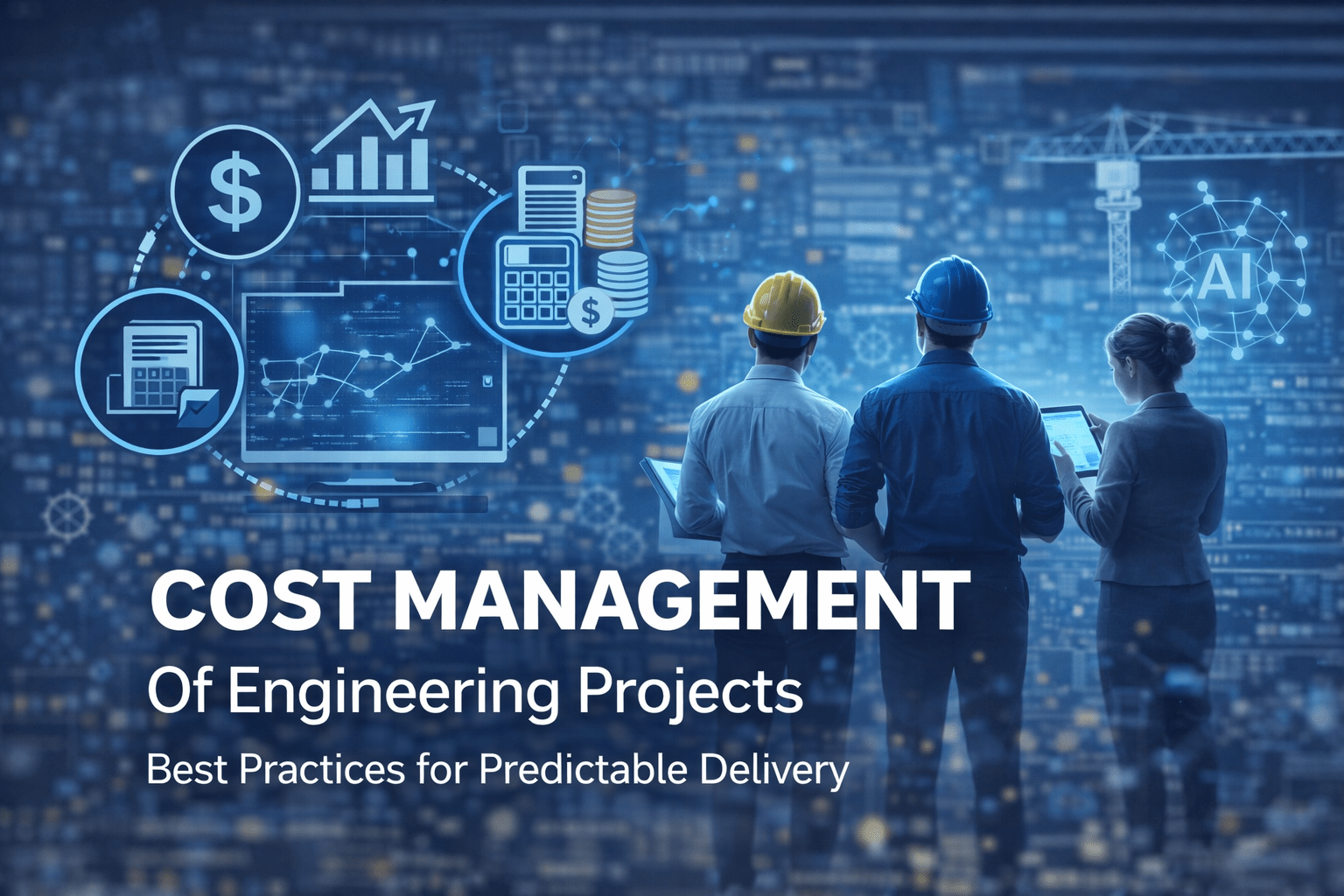
Engineering projects—whether in construction, infrastructure, utilities, or industrial facilities—are capital‑intensive and technically complex. Without disciplined engineering project cost management, even well‑designed projects can suffer from overruns, disputes, and loss of stakeholder confidence.

This guide explains how cost management works in engineering projects, the key processes involved, common failure points, and modern best practices—including how AI and project controls improve forecasting and financial predictability.


Table of Contents

  • What Is Cost Management in Engineering Projects?
  • Why Cost Management Is Critical in Engineering Projects
  • Key Cost Management Processes in Engineering Projects
  • Common Cost Management Challenges in Engineering Projects
  • Role of Project Controls in Cost Management
  • How AI Is Transforming Cost Management in Engineering Projects
  • Best Practices for Engineering Project Cost Management

What Is Cost Management in Engineering Projects?

Cost management in engineering projects is the structured process of planning, estimating, budgeting, controlling, and forecasting costs to ensure delivery within approved financial limits.

Unlike simple expense tracking, engineering cost management integrates:

  • Engineering quantities and design maturity
  • Construction productivity and sequencing
  • Procurement and contract strategies
  • Schedule impacts and critical path changes
  • Risk and uncertainty

Effective cost management provides early warning indicators, not just historical reporting.


Why Cost Management Is Critical in Engineering Projects

Engineering projects face unique financial pressures:

  • Long execution durations
  • Scope evolution during design development
  • Volatile labor and material markets
  • Regulatory and environmental constraints
  • High exposure to claims and change orders

Without proactive project cost control, small deviations can escalate into major overruns.


Key Cost Management Processes in Engineering Projects

1. Cost Estimating

Cost estimating establishes the financial foundation of the project. Estimates evolve as engineering maturity increases:

  • Conceptual estimates (Class 4/5)
  • Preliminary estimates (Class 3)
  • Definitive estimates (Class 1/2)

Accurate engineering cost estimates rely on:

  • Quantified takeoffs
  • Historical cost data
  • Market intelligence
  • Risk allowances

2. Cost Budgeting and Baseline Development

Once approved, the estimate becomes the cost baseline, including:

  • Direct costs
  • Indirect costs
  • Contingency
  • Management reserves

The baseline must be time‑phased and aligned with the project schedule to support effective cost control.


3. Cost Control and Monitoring

Cost control ensures actual spending aligns with the approved baseline through:

  • Tracking actual costs
  • Measuring earned value
  • Monitoring commitments
  • Identifying variances early

This allows project teams to act before overruns materialize.


4. Change Management and Cost Impact Analysis

Engineering projects inevitably experience scope changes. Effective cost management requires:

  • Formal change control procedures
  • Cost and schedule impact assessments
  • Approval documentation
  • Integration with claims management

Uncontrolled changes remain a leading cause of cost overruns.


5. Cost Forecasting and Trend Analysis

Forecasting predicts the estimate at completion (EAC) using:

  • Trend analysis
  • Earned Value Management (EVM)
  • Productivity analysis
  • Risk‑adjusted forecasting

Forecasts should be updated regularly and communicated clearly to decision‑makers.


Common Cost Management Challenges in Engineering Projects

  • Limited estimate accuracy due to early‑stage design
  • Poor integration between schedule and cost
  • Weak change control discipline
  • Delayed cost reporting
  • Reactive rather than predictive forecasting

These challenges highlight the need for strong project controls systems.


Role of Project Controls in Cost Management

Project controls integrate cost, schedule, risk, and performance measurement into a single control framework.

A mature project controls function ensures:

  • Cost and schedule alignment
  • Consistent forecasting
  • Reliable performance metrics
  • Executive‑level transparency

👉 Related reading: Project Control Explained: The Foundation of Successful Project Management


How AI Is Transforming Cost Management in Engineering Projects

Artificial intelligence is reshaping engineering cost management by:

  • Predicting cost overruns using historical data
  • Identifying abnormal spending patterns
  • Improving estimate accuracy
  • Automating cost reporting
  • Supporting scenario‑based decision making

AI allows cost managers to shift from reactive reporting to predictive and prescriptive control.

👉 Related reading: The Future of Project Management: Five AI Trends Redefining 2026 and BeyondI in Project Management: Tools, Use Cases & Future Trends


Best Practices for Engineering Project Cost Management

✔ Establish realistic, risk‑adjusted baselines
✔ Integrate cost and schedule data
✔ Apply disciplined change control
✔ Forecast costs regularly—not just monthly
✔ Use AI and analytics for early trend detection
✔ Maintain transparent stakeholder communication


Final Thoughts

Cost management in engineering projects is not merely a financial task—it is a strategic project controls discipline.

By combining sound estimating practices, integrated project controls, proactive forecasting, and emerging AI technologies, organizations can significantly improve cost predictability and reduce financial risk.

Engineering projects will always involve uncertainty—but effective cost management ensures uncertainty does not become surprise.


image_print