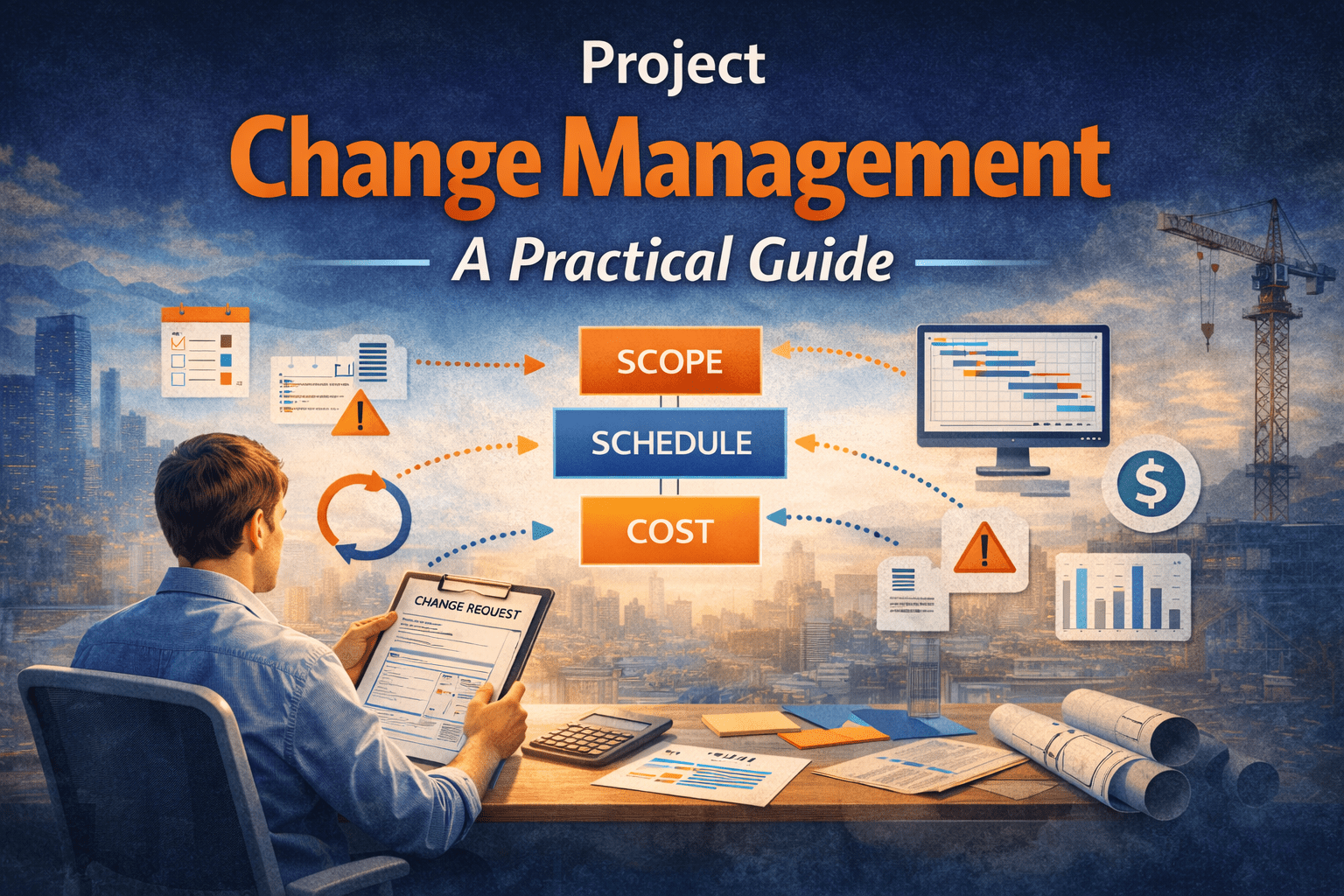
Scope Creep in Engineering Projects is one of the most persistent threats to cost, schedule, and stakeholder trust. It rarely appears as a dramatic event. Instead, it develops quietly—through small additions, informal requests, and “quick fixes” that accumulate over time.
For project managers, schedulers, cost engineers, and PMO leaders, understanding scope creep is not optional. It directly affects:
- Margin protection
- Forecast accuracy
- Contract compliance
- Team morale
- Client relationships
When scope expands without structured control, performance metrics become unreliable. Schedules lose logic. Budgets stop reflecting reality. Eventually, leadership begins reacting instead of managing.
This article explains Scope Creep in Engineering Projects from first principles, identifies root causes, and provides practical prevention strategies you can apply immediately.
What Is Scope Creep in Engineering Projects?
Scope creep occurs when the project’s defined deliverables expand without formal approval, budget adjustment, or schedule revision.
It is important to distinguish scope creep from approved change.
| Approved Change | Scope Creep |
| Formally requested | Informally introduced |
| Impact analyzed | Impact often ignored |
| Budget adjusted | Budget unchanged |
| Schedule revised | Schedule remains unrealistic |
| Documented and tracked | Often undocumented |
Scope creep is not about change itself. Engineering projects require change. Scope creep occurs when change bypasses governance.
Why Scope Creep in Engineering Projects Is So Dangerous
Engineering and infrastructure projects operate within tight contractual and financial structures. When scope increases without control:
- Cost overruns accelerate
- Productivity declines
- Claims exposure increases
- Earned value metrics distort
- Trust between stakeholders erodes
For example, if field teams install additional conduit runs at the client’s request—but no change order exists—the cost hits productivity metrics. CPI declines. Leadership assumes inefficiency, when in fact scope increased.
Over time, that disconnect damages decision-making.
Root Causes of Scope Creep in Engineering Projects
Understanding causes is the first step toward prevention.
1. Poorly Defined Scope at Project Start
Many projects begin with:
- High-level narratives instead of measurable deliverables
- Incomplete drawings
- Unclear technical specifications
- Ambiguous performance criteria
When scope lacks precision, interpretation fills the gap. Different stakeholders hold different assumptions.
Later, disagreements surface.
2. Weak Change Control Discipline
Sometimes the process exists, but teams bypass it.
Common patterns include:
- “Let’s just handle it in the field.”
- “It’s minor. No need for paperwork.”
- “We’ll reconcile it later.”
These shortcuts feel efficient. However, they create cumulative risk.
3. Client-Driven Incremental Additions
In infrastructure projects, owners often request small improvements:
- Additional lighting fixtures
- Enhanced finishes
- Upgraded materials
- Minor geometry adjustments
Each item seems manageable. Yet collectively, they shift baseline scope significantly.
4. Engineering Optimizations Without Baseline Alignment
Design teams may refine solutions during execution. For example:
- Increasing pipe diameter for safety margin
- Modifying structural reinforcement
- Enhancing control system redundancy
These decisions may improve quality. However, if the budget and schedule remain unchanged, they introduce scope creep.
5. Internal Gold-Plating
Teams sometimes exceed requirements unintentionally.
Examples:
- Over-documenting deliverables
- Adding unnecessary analysis
- Installing higher-spec components without requirement
While intentions are positive, margins shrink.
Real-World Example: Water Treatment Plant Upgrade
Consider a $45M water treatment facility upgrade.
Original scope included:
- Replacement of three pumps
- Electrical panel modernization
- SCADA integration
During execution:
- Owner requested enhanced corrosion protection
- Engineering added vibration monitoring sensors
- Contractor upgraded cable trays “for long-term reliability”
Individually, each seemed reasonable.
Collectively, these additions increased cost by $3.2M and extended schedule by 3 months.
No single change triggered alarm. The cumulative effect did.
This is classic Scope Creep in Engineering Projects.
Step-by-Step Prevention Framework
Preventing scope creep requires discipline at every stage.
Step 1: Define Scope with Measurable Precision
Scope must translate into quantifiable deliverables.
Instead of writing:
“Install site utilities.”
Define:
- 1,200 LF of 12-inch water main
- 800 LF of 8-inch sewer
- 12 valve assemblies
- 6 hydrants
Precision reduces interpretation.
For deeper structuring guidance, see:
👉 How to Build a Practical WBS for Infrastructure Projects
Step 2: Align Scope, Budget, and Schedule Baseline
Your baseline must integrate:
- Work Breakdown Structure (WBS)
- Cost codes
- Schedule activities
If cost codes do not match WBS packages, tracking becomes unreliable.
Misalignment creates hidden scope creep because tracking lacks clarity.
Step 3: Establish Clear Change Governance
Effective change control includes:
- Written request
- Impact analysis (cost + schedule)
- Formal approval
- Baseline update
- Documentation in change log
No field execution should occur before this process—unless safety requires immediate action.
👉 Change Management in Projects: A practical Guide
Step 4: Train the Field Team
Many scope creep events originate onsite.
Project managers must communicate:
- What constitutes scope change
- How to escalate requests
- Why documentation protects the team
When crews understand financial impact, compliance improves.
Step 5: Use Performance Metrics as Early Warning
Earned Value metrics can reveal hidden scope growth.
For example:
- CPI consistently below 1.0
- SPI trending downward without obvious delay cause
If performance declines but productivity appears stable, investigate potential scope expansion.
For further reading:
👉 Earned Value Explained for Engineering Projects
Common Mistakes That Enable Scope Creep
Even experienced PMs unintentionally allow scope creep.
Mistake 1: Confusing Client Satisfaction with Free Work
Strong relationships matter. However, absorbing cost to maintain goodwill creates long-term risk.
Professional communication can preserve trust without sacrificing margins.
Mistake 2: Delayed Change Orders
Waiting to submit change documentation weakens position.
When change orders accumulate and appear late, clients resist approval.
Submit changes promptly.
Mistake 3: Vague Meeting Minutes
Meeting notes should clearly state:
- Whether request is informational
- Whether it triggers cost impact
- Who owns decision
Ambiguity invites scope creep.
Mistake 4: Not Updating Baselines
Even after approved change, some teams fail to update:
- Budget baseline
- Schedule baseline
- Forecast models
This creates artificial variance that distorts reporting.
Practical Tools to Control Scope Creep in Engineering Projects
Below are tools PMs can implement immediately.
1. Scope Control Checklist
Before executing any new request, ask:
- Is this in the original contract?
- Does it change quantities?
- Does it require additional labor or materials?
- Has cost impact been calculated?
- Has schedule impact been assessed?
- Is approval documented?
If any answer is unclear, pause execution.
2. Scope Change Log Template
Maintain a structured log:
| Change ID | Description | Cost Impact | Schedule Impact | Status | Approval Date |
Visibility discourages informal expansion.
3. Weekly Scope Review Meetings
Dedicate 15 minutes weekly to:
- Review pending requests
- Confirm submitted change orders
- Identify undocumented field modifications
Regular review prevents surprises.
4. Quantify Everything
In engineering projects, quantity drives clarity.
Instead of discussing abstract scope, track:
- Linear feet
- Cubic yards
- Tons of steel
- Equipment counts
Numbers reduce subjectivity.
PMO-Level Strategies
At the portfolio level, Scope Creep in Engineering Projects becomes a governance issue.
PMOs should:
- Standardize change control procedures
- Audit projects quarterly for undocumented scope
- Require baseline update confirmation
- Compare original vs. current contract values
Additionally, PMOs can monitor:
- Percentage of revenue from change orders
- Frequency of late change approvals
- CPI trend vs. approved change volume
For broader governance practices, see:
👉 How to Build a High-Impact Project Controls Framework
Special Considerations for Different Project Types
Infrastructure Projects
Public works face political pressure. Owners may push for enhancements midstream.
Strong documentation protects both contractor and agency.
Industrial Projects
Engineering optimizations often drive scope creep. Establish technical review boards to evaluate cost impact before implementation.
IT and Systems Integration
Scope creep often hides in feature expansion.
Prevent it by defining:
- Functional requirements
- Acceptance criteria
- Testing boundaries
Even software projects benefit from engineering-style discipline.
Strategic Takeaway: Control Scope, Protect Performance
Scope creep does not happen because teams are careless. It happens because engineering projects are dynamic and collaborative.
However, unmanaged expansion destroys predictability.
To control Scope Creep in Engineering Projects, leaders must:
- Define measurable deliverables
- Align scope, cost, and schedule
- Enforce change governance
- Educate teams
- Monitor performance indicators
When scope remains controlled:
- Forecasts gain credibility
- Margins stabilize
- Client confidence strengthens
- PMOs mature
Ultimately, scope discipline is not about resisting change. It is about ensuring every change is visible, evaluated, and funded.
Engineering excellence requires technical precision.
Project leadership requires scope precision.
Master both, and performance follows.
Frequently Asked Questions
What is the fundamental difference between an "approved change" and "scope creep"?
The difference lies entirely in governance and impact analysis. An approved change is formally requested, fully analyzed for its impact on cost and schedule, explicitly funded by an adjusted budget, and documented in the project baseline. Conversely, scope creep occurs when changes are introduced informally (such as verbal requests in the field or internal "gold-plating" by engineering teams). With scope creep, the impact on resources is usually ignored, the budget remains unchanged, and the schedule becomes increasingly unrealistic because it is undocumented and untracked.
What are the most common root causes of scope creep in engineering and infrastructure projects?
According to the guide, scope creep is typically driven by five primary factors:
Poorly defined initial scope: Relying on high-level narratives instead of measurable, quantified deliverables and precise technical specifications at the project's start.
Weak change control discipline: Bypassing formal processes with shortcuts like "let's just handle it in the field" or promising to "reconcile it later."
Client-driven incremental additions: Small, seemingly minor owner requests (e.g., upgrading a material or minor geometry adjustments) that quietly accumulate over time.
Engineering optimizations without baseline alignment: Design teams refining technical solutions or adding safety margins (like increasing a pipe diameter) without adjusting the budget or schedule.
Internal gold-plating: Teams unintentionally exceeding contract requirements by adding unnecessary analysis or documentation.
How does unmanaged scope creep negatively impact project controls and performance metrics like CPI?
When field crews execute undocumented work at a client's request without a formal change order, the labor and material costs still hit the project. Because there is no approved budget adjustment to match the extra work, the Cost Performance Index (CPI) and Schedule Performance Index (SPI) will systematically decline. This distorts Earned Value Management (EVM) data, leading executive leadership to assume the team is highly inefficient, when in reality, they are simply performing uncompensated work.
What practical framework can a project manager implement to prevent scope creep?
The article outlines a five-step prevention framework:
Define scope with measurable precision: Quantify everything into exact deliverables (e.g., specifying exact linear feet of pipe or equipment counts rather than vague descriptions like "install site utilities").
Align the project baselines: Ensure the Work Breakdown Structure (WBS), cost codes, and schedule activities are completely integrated so tracking gaps cannot hide scope growth.
Enforce strict change governance: Mandate that no field execution occurs without a written request, impact analysis, formal approval, and a baseline update.
Train the field team: Educate onsite crews on what constitutes a scope change and how to properly escalate requests.
Use metrics as an early warning system: Actively investigate if CPI or SPI decline while actual field productivity seems stable, as this is a classic indicator of hidden scope expansion.
What common mistakes do experienced project managers make that unintentionally allow scope creep to happen?
Even seasoned project managers fall into traps that enable scope creep, including:
Confusing client satisfaction with free work: Absorbing extra costs to maintain a strong relationship or goodwill, which directly erodes project margins.
Delaying change orders: Waiting too long to compile and submit change documentation. When variations accumulate and are submitted late, clients are much more likely to resist or reject them.
Vague meeting minutes: Failing to explicitly document whether a meeting discussion triggers a cost/schedule impact and who owns the ultimate decision.
Neglecting baseline updates: Forgetting to update the budget, schedule, and forecast models even after a change order is formally approved, creating artificial variances in performance reports.