
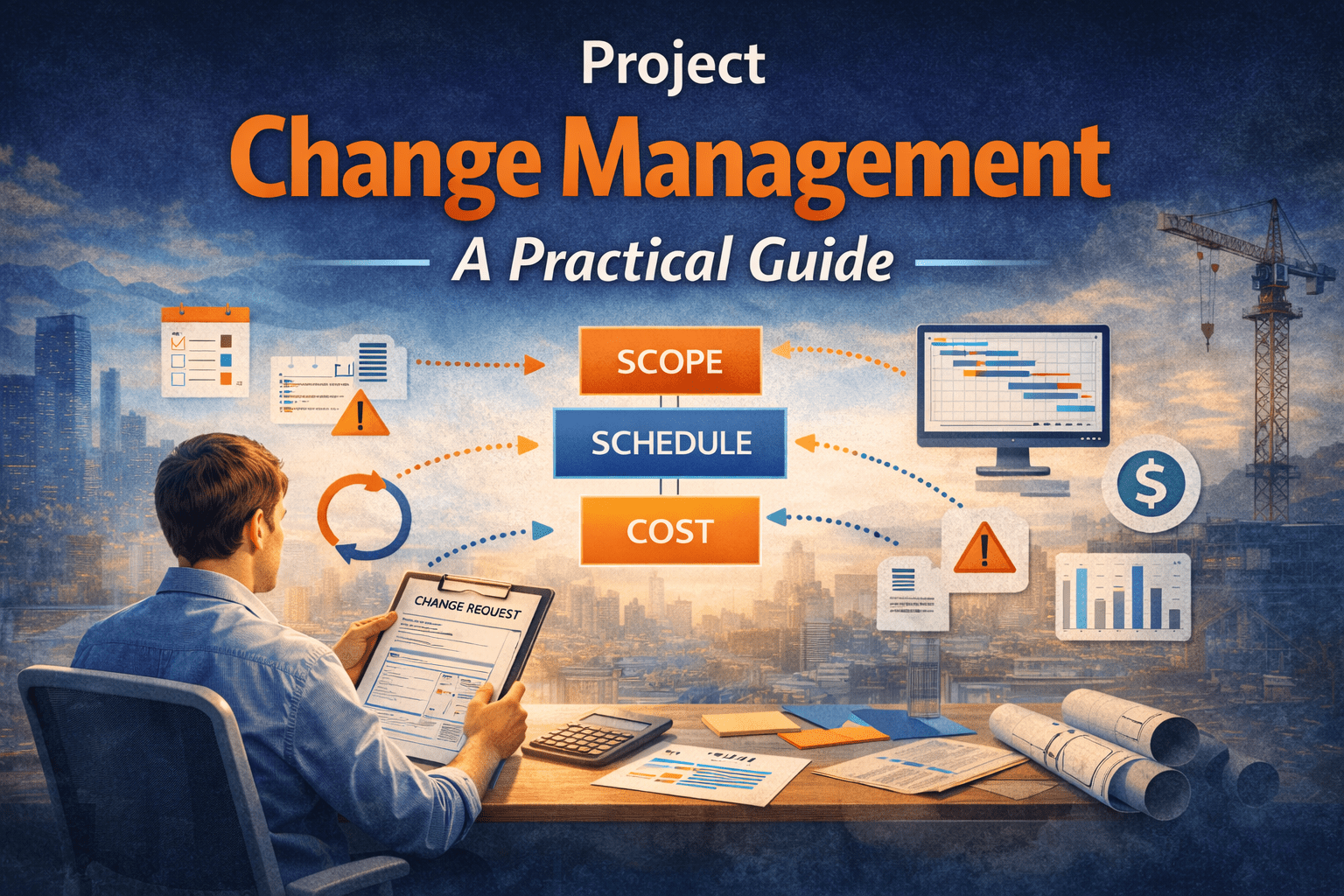
Project Change Management is one of the most misunderstood—and most critical—disciplines in project delivery. Many projects fail not because the original plan was poor, but because changes were handled informally, inconsistently, or too late.
Every project changes. Scope evolves, conditions shift, stakeholders adjust priorities, and new risks emerge. The difference between a controlled project and a troubled one is not whether change occurs, but how change is evaluated, approved, and integrated into the plan.
This practical guide explains Project Change Management from first principles, using real project examples and clear language. It is written for project managers, PMO leaders, schedulers, and project controls professionals who want to manage change deliberately rather than reactively.
What Is Project Change Management?
At its core, Project Change Management is the structured process of handling any modification to an approved project baseline.
A change may affect:
- Scope (what is being delivered)
- Schedule (when it will be delivered)
- Cost (how much it will cost)
- Quality (how performance is defined)
- Risk (what could go wrong)
Change management ensures that adjustments are:
- Clearly defined
- Properly evaluated
- Formally approved
- Fully integrated into project controls
Without this structure, projects drift. With it, projects remain defensible and predictable—even under pressure.
Why Project Change Management Matters to PMs
Project managers are often judged on outcomes they do not fully control. Change management provides a professional mechanism to separate performance from change.
When change is unmanaged:
- Baselines lose meaning
- Schedules become unreliable
- Budgets no longer reflect reality
- Disputes become personal instead of factual
When change is managed well:
- Decisions are documented
- Trade-offs are transparent
- Accountability is shared
- Leadership confidence increases
For PMs, Project Change Management is not paperwork. It is decision protection.
What Counts as a Project Change?
One of the most common mistakes is assuming only “big” changes matter.
In practice, project changes include:
- Added or removed deliverables
- Revised technical requirements
- Design clarifications that alter effort
- Schedule acceleration or resequencing
- New regulatory or permitting conditions
- Assumption changes identified late
Even small changes accumulate. Without control, they quietly erode schedule and budget integrity.
Project Change vs. Project Variance
Understanding the difference is essential.
| Concept | Meaning |
| Change | A modification to the approved baseline |
| Variance | A difference between planned and actual performance |
Good Project Change Management ensures that:
- Approved changes reset the baseline
- Variances reflect execution performance, not scope creep
This distinction underpins credible project controls and reporting.
[Internal link to Project Control Fundamentals article]
Step-by-Step Project Change Management Process
Step 1: Identify and Clearly Define the Change
Every change starts with clarity.
A good change description answers:
- What is changing?
- Why is it changing?
- When did the need arise?
- Who is requesting it?
Avoid vague language. Ambiguity at this stage creates disputes later.
Step 2: Assess Impacts Across the Project
Changes never affect just one area.
A proper impact assessment considers:
- Schedule logic and milestones
- Cost, including indirect effects
- Resource availability
- Risk exposure
- Contractual obligations
This is where schedulers and project controls professionals add the most value.
Step 3: Evaluate Options, Not Just the Change
Not all changes have a single solution.
Often, PMs can present:
- A low-cost, longer-duration option
- A faster, higher-cost option
- A partial or phased solution
Project Change Management supports informed choice, not automatic acceptance.
Step 4: Obtain Formal Approval
Approval authority must be clear.
Approval should include:
- Defined scope adjustment
- Approved budget change
- Schedule impact acknowledgment
- Effective date of the change
Verbal approvals are not approvals. They are assumptions.
Step 5: Update Baselines and Controls
Once approved, the change must be integrated.
This includes:
- Updating scope documents
- Revising the schedule baseline
- Adjusting budgets and forecasts
- Communicating changes to the team
If baselines are not updated, change management fails—even if approval was obtained.
Real-World Project Examples
Infrastructure Project Example
On a highway widening project, unexpected utility conflicts required design revisions.
Effective Project Change Management:
- Documented the differing site condition
- Modeled schedule impacts using CPM
- Negotiated a time extension
- Updated milestones and payment schedules
The result was delay recognition without performance penalties.
Engineering Design Project Example
During a transit station design, stakeholder accessibility requirements expanded.
The PM:
- Issued a formal change request
- Assessed design rework impacts
- Adjusted deliverable sequencing
- Reset design completion baselines
This avoided later claims that the team “missed” original deadlines.
IT Program Example
In a system rollout, regulatory guidance changed mid-project.
Through structured change management:
- Requirements were re-baselined
- Sprint priorities were realigned
- Go-live expectations were reset
Leadership accepted the revised outcome because the change was transparent and defensible.
The Role of Project Controls in Change Management
Project Change Management does not work without strong project controls.
Project controls provide:
- Impact analysis using schedules and budgets
- Baseline integrity
- Trend analysis to separate change from performance
Schedulers, cost engineers, and PMO analysts are central—not peripheral—to change decisions.
Common Project Change Management Mistakes
Treating Change as a Contract Issue Only
Even internal projects require disciplined change management.
Lack of a contract does not remove the need for structure.
Delaying Change Decisions
Undecided changes still affect work.
Delays often cost more than early, imperfect decisions.
Bundling Multiple Changes Together
Combining unrelated changes hides true impacts.
Each change should stand on its own merit.
Failing to Communicate Approved Changes
If the team does not understand the new baseline, old expectations persist.
Communication is part of control.
Practical Tips PMs Can Apply Immediately
- Log potential changes as soon as they appear
- Require impact assessments before approval discussions
- Maintain a live change register
- Separate change approval from schedule recovery plans
- Use visuals to explain impacts, not just numbers
Budget and schedule visibility tools can support this discipline.
[Internal link to Budget Dashboard article]
How AI Can Support Project Change Management
AI does not decide changes. It supports analysis.
AI tools can help:
- Identify scope drift early
- Compare schedule scenarios quickly
- Draft change narratives consistently
- Flag cumulative change trends
Used correctly, AI strengthens—not replaces—professional judgment.
[Internal link to AI Prompts for Project Managers article]
Integrating Change Management Into Daily Project Work
The most effective PMs do not treat change as a separate process.
They integrate it into:
- Weekly status reviews
- Schedule updates
- Forecast discussions
- Stakeholder communications
Change management becomes part of how the project thinks.
Strategic Takeaway: Control the Change, or the Change Controls You
Project Change Management is not about resisting change. It is about owning it.
Projects that manage change well:
- Maintain credibility
- Protect teams from unfair performance judgments
- Support better leadership decisions
- Reduce claims and conflict
For project managers and PMO leaders, mastering change management is not optional. It is one of the clearest signals of professional maturity in project delivery.
