
Engineering projects rarely fail because of technical complexity alone.
They fail because leaders lose visibility over cost, schedule, and performance at the same time.
That is why Earned Value Explained clearly and practically matters for project managers, schedulers, cost engineers, and PMO leaders. It connects scope, time, and cost into a single performance picture. Instead of asking:
- “Are we on schedule?”
- “Are we under budget?”
Earned Value asks the more powerful question:
“Are we getting the value we planned for the money and time we’ve spent?”
For engineering and infrastructure projects—where contracts are large, risks are high, and public scrutiny is real—this distinction is critical.
What Earned Value Really Means
Many professionals overcomplicate Earned Value Management (EVM). At its core, the concept is simple:
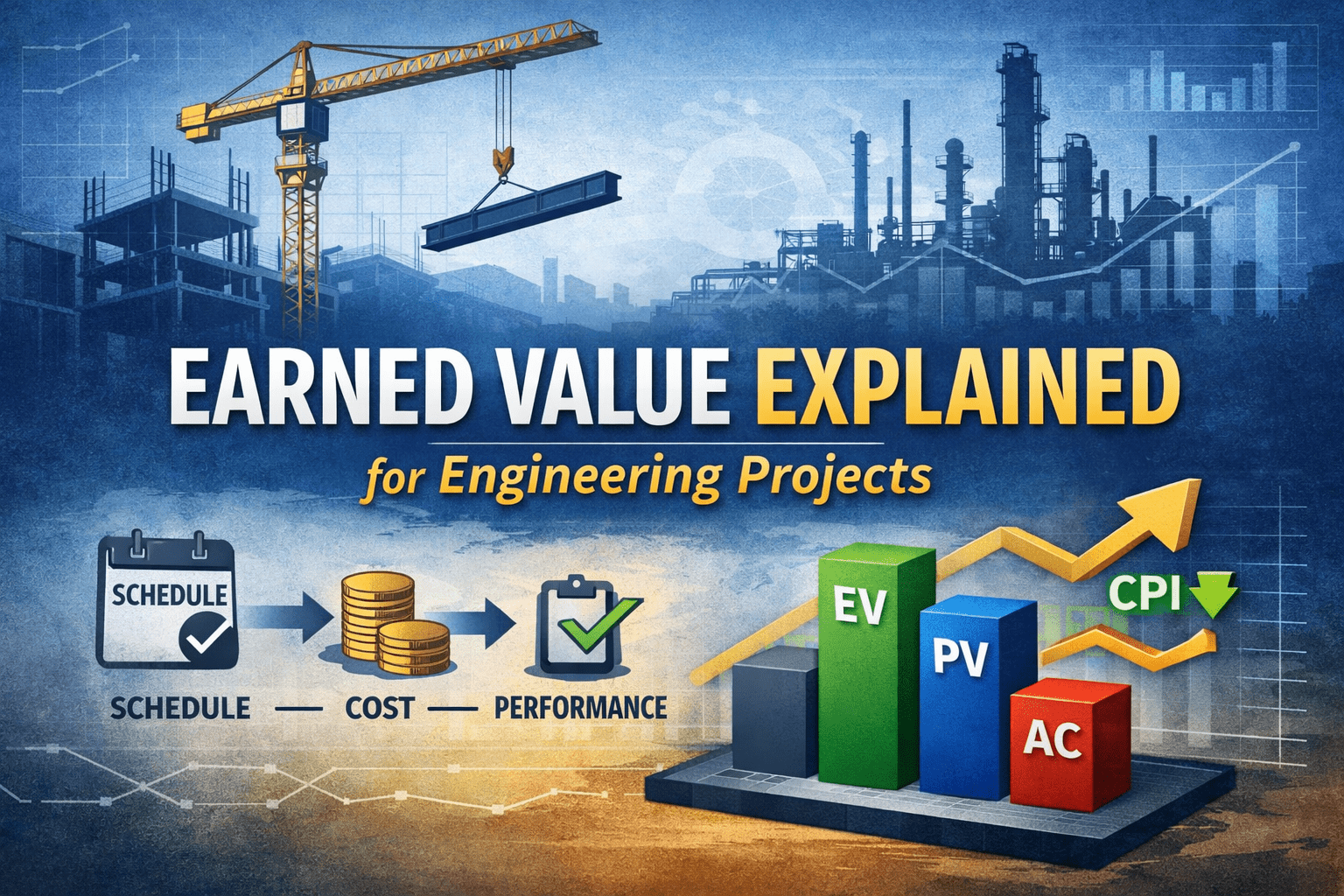
- Planned Value (PV): What we planned to complete by today.
- Earned Value (EV): What we actually completed (in budget terms).
- Actual Cost (AC): What we actually spent.
Earned Value compares these three numbers to reveal performance truth.
Think of it this way:
- Schedule tells you time.
- Cost reports tell you money.
- Earned Value tells you performance.
Without Earned Value, you may think you're “50% done” because you've spent 50% of the budget. But spending money is not progress. Completing measurable scope is progress.
Earned Value Explained Step by Step
Let’s break it down in practical engineering terms.
Step 1: Define Measurable Scope
Everything begins with a solid Work Breakdown Structure (WBS).
If your WBS is vague, Earned Value will fail.
Engineering projects must define measurable deliverables such as:
- Install 5,000 LF of water main
- Pour 2,000 CY of concrete
- Complete 100% of design package
- Install 12 structural beams
Each activity must have:
- A budget
- A duration
- A measurable completion method
For deeper guidance, you may reference PMIntelli’s article:
👉 How to Build a Practical WBS for Infrastructure Projects
Step 2: Assign Budget to Work (Planned Value)
Planned Value (PV) represents the approved budget for scheduled work.
Example:
A wastewater pump station project has:
| Activity | Budget | Planned % Complete by Month 3 | PV |
| Excavation | $200,000 | 100% | $200,000 |
| Foundation | $500,000 | 60% | $300,000 |
| Structural Steel | $800,000 | 25% | $200,000 |
| Total PV | $700,000 |
By Month 3, we planned to complete $700,000 worth of work.
Step 3: Measure Earned Value (EV)
Earned Value reflects actual physical progress, expressed in budget terms.
Suppose actual progress shows:
- Excavation: 100% complete → $200,000 earned
- Foundation: 40% complete → $200,000 earned
- Structural Steel: 10% complete → $80,000 earned
Total Earned Value = $480,000
Even though we planned $700,000, we only earned $480,000.
This is where reality becomes visible.
Step 4: Capture Actual Cost (AC)
Assume the accounting system shows:
- Actual Cost = $650,000
Now we have the full picture:
| Metric | Value |
| PV | $700,000 |
| EV | $480,000 |
| AC | $650,000 |
Step 5: Interpret the Results
Now the power of Earned Value Explained becomes clear.
Schedule Variance (SV)
SV = EV – PV
= $480,000 – $700,000
= –$220,000
We are behind schedule.
Cost Variance (CV)
CV = EV – AC
= $480,000 – $650,000
= –$170,000
We are over budget.
Performance Indexes
| Index | Formula | Result | Meaning |
| SPI | EV / PV | 0.69 | Behind schedule |
| CPI | EV / AC | 0.74 | Cost inefficient |
Interpretation:
- For every $1 planned, we are earning $0.69.
- For every $1 spent, we are getting $0.74 of value.
That is an early warning signal—not a postmortem.
Why Earned Value Matters in Engineering Projects
Engineering projects have:
- Long durations
- High capital investment
- Contractual payment structures
- Liquidated damages risks
Without Earned Value:
- You may report “70% spent” and assume good progress.
- Meanwhile, physical progress may only be 50%.
In design-build, heavy civil, or public infrastructure projects, that gap can destroy margins quickly.
Real-World Example: Highway Expansion Project
Consider a $120M highway widening project.
At Month 12:
- Budget Planned: $40M
- Actual Spent: $45M
- Physical Progress Measured: 30% of total scope
- Total Budget: $120M
Earned Value = 30% × $120M = $36M
Now compare:
- EV = $36M
- AC = $45M
- PV = $40M
Interpretation:
- Behind schedule (36 < 40)
- Over budget (36 < 45)
Without Earned Value, management might say:
“We’ve spent $45M. That seems aligned.”
But Earned Value reveals the real issue:
The project is earning only $0.80 per dollar spent.
That early insight allows:
- Crew reallocation
- Subcontractor performance review
- Productivity root cause analysis
- Cash flow forecast adjustments
Common Mistakes When Applying Earned Value
Even experienced PMs misuse EVM. Here are the most frequent issues.
1. Measuring Effort Instead of Output
Percent complete should reflect deliverables, not time spent.
Bad example:
“Activity is 50% complete because half the duration passed.”
Good example:
“4 out of 8 beams installed = 50%.”
2. Poor WBS Structure
If scope packages are too large, progress becomes subjective.
Instead of:
- “Mechanical Installation – $5M”
Break it into:
- Pump installation
- Piping systems
- Electrical integration
- Commissioning
Granularity improves accuracy.
3. Ignoring Schedule Logic
Earned Value does not replace CPM scheduling.
You still need:
- Proper critical path analysis
- Logic-driven sequencing
- Float monitoring
For more on this, see PMIntelli’s article:
👉 Baseline Vs. Current Schedule
4. Using EV Only for Reporting
Earned Value is a management tool, not a dashboard decoration.
If SPI drops below 0.90, leadership must act immediately.
Practical Tips to Implement Earned Value Immediately
You do not need a government megaproject to use EVM. Here is how to apply it practically:
1. Start with Major Cost Drivers
Focus on:
- Civil works
- Structural components
- Equipment procurement
- Long-lead materials
2. Use Simple Percent Complete Rules
Choose objective methods:
- 0/100 rule (for short tasks)
- 50/50 rule (start/finish)
- Measured quantity installed
- Milestone-based measurement
3. Align Finance and Scheduling
Cost data must match schedule structure.
If accounting codes and WBS do not align, Earned Value becomes unreliable.
PMOs should standardize coding across projects.
4. Forecast Early Using CPI and SPI
If CPI remains at 0.85, final cost overrun is predictable.
Forecast Estimate at Completion (EAC):
EAC = Budget / CPI
If Budget = $10M
CPI = 0.80
EAC = $12.5M
That insight allows executive intervention before the problem escalates.
👉 Check our Earned Value Calculator
Earned Value in PMO Environments
At the portfolio level, Earned Value enables:
- Cross-project comparison
- Early risk detection
- Executive reporting consistency
- Resource allocation decisions
A PMO can track:
- Projects with CPI < 0.90
- Projects with SPI < 0.95
- Trend deterioration over 3 reporting cycles
This shifts governance from reactive to proactive.
For strategic PMO thinking, see:
👉 What is a PMO - Roles, Types and Benefits
When Earned Value Is Not Enough
Earned Value does not measure:
- Quality issues
- Safety incidents
- Scope changes not yet budgeted
- External risks
Therefore, it must be integrated with:
- Risk registers
- Change management logs
- Safety KPIs
- Quality metrics
EVM shows performance efficiency—not technical adequacy.
Strategic Takeaway: Why Earned Value Explained Matters
Engineering projects demand disciplined control.
Earned Value provides a structured, quantitative truth.
It answers three critical leadership questions:
- Are we earning what we planned?
- Are we spending efficiently?
- Where will we finish if current trends continue?
When used correctly:
- It protects margins.
- It improves forecast credibility.
- It strengthens client confidence.
- It elevates PMO maturity.
Earned Value is not about formulas.
It is about decision-making clarity.
For project managers, schedulers, and cost engineers, mastering Earned Value means moving from reporting history to controlling outcomes. That is the real power behind Earned Value Explained
Frequently Asked Questions
Why can't I just compare my actual costs against the planned budget to see how my project is doing?
Traditional variance analysis only tells you what you spent versus what you planned to spend, completely ignoring what you actually accomplished.
EVM introduces a third variable: Earned Value (EV)—the budgeted cost of work actually performed. Without EV, if you spent $50,000 of a $100,000 engineering budget, you might assume you are exactly on track. However, if you have only completed 20% of the drawing packages, you are actually significantly over budget and behind schedule. EVM exposes this gap.
How do CPI and SPI work, and how do I interpret their values?
The Cost Performance Index (CPI) and Schedule Performance Index (SPI) are efficiency metrics calculated as ratios:
Cost Performance Index (CPI): Measures financial efficiency.
$$CPI = \frac{EV}{AC}$$
Schedule Performance Index (SPI): Measures time efficiency relative to the plan.
$$SPI = \frac{EV}{PV}$$
How to read the results:
Value = 1.0: Exactly on target.
Value > 1.0: Favorable performance (under budget or ahead of schedule).
Value < 1.0: Unfavorable performance (over budget or behind schedule).
How should a project manager determine "Percent Complete" for subjective tasks like engineering design?
Objectivity is the greatest challenge in EVM. To avoid the trap of a project being "90% complete for half the project duration," engineering PMs should use Weighted Milestones.
Instead of guessing progress, assign fixed, earning percentages to verifiable gates:
10% upon Kickoff & Data Collection
30% upon 30% Schematic Review Approval
30% upon 90% Detailed Design Review Approval
30% upon Final Issued for Construction (IFC) Package Approval
For physical field construction, switch to Physical Percent Complete based on quantifiable units (e.g., linear feet of pipe installed or tons of steel erected).
What is the difference between ETC and EAC, and how do they forecast project cost overruns?
Both metrics are forward-looking forecasting tools used to project final outcomes while there is still time to pivot:
Estimate to Complete (ETC): The expected cost required to finish all remaining project work.
Estimate at Completion (EAC): The anticipated total cost of the project when the entire scope is finished.
A standard formula to calculate EAC, assuming the project will continue to perform at its current cost efficiency rate, is:
$$EAC = \frac{BAC}{CPI}$$
(Where $BAC$ is the original Budget at Completion.)
Why can the Schedule Performance Index (SPI) sometimes give a misleading picture near the end of a project?
SPI measures the total volume of work completed against the volume planned, not critical path delays. Because of this, SPI has a dangerous mathematical quirk: as a project reaches its final stages, the Planned Value ($PV$) stops growing, and the Earned Value ($EV$) eventually catches up as late tasks are completed.
Consequently, SPI will always drift back toward 1.0 at the end of a project, even if the project is months behind schedule. To get an accurate picture of time constraints, a PM must always pair EVM metrics with Critical Path Method (CPM) schedule analysis to track true project duration and float.
