
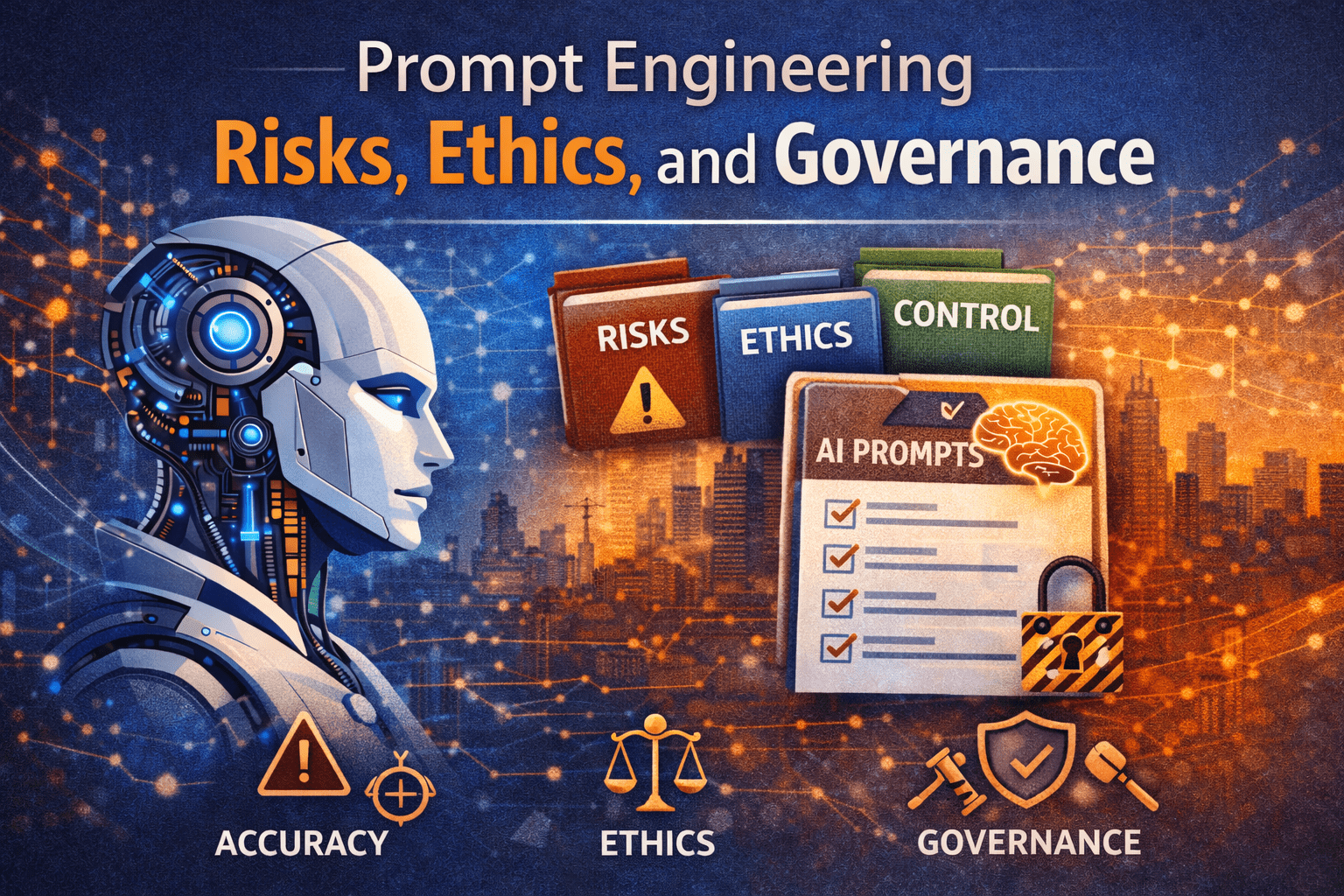
Why Prompt Engineering Risks Matter to Project Managers
Artificial intelligence is now embedded in daily project work. Project managers use AI to draft schedules, analyze risks, summarize meetings, and support decision-making. However, as usage grows, so do Prompt Engineering Risks.
Within project environments, prompts are not casual inputs. They directly influence scope interpretations, risk assessments, cost narratives, and stakeholder communications. Poorly designed prompts can introduce bias, expose confidential data, or produce outputs that appear credible but are factually incorrect.
For PMs, PMO leaders, and project control professionals, this creates a new responsibility. Managing AI is no longer just a technical concern. It is a governance issue tied to professional judgment, accountability, and ethical delivery.
This article explains Prompt Engineering Risks, ethics, and governance from first principles, using practical project examples and actionable guidance.
What Prompt Engineering Really Means in Project Management
Prompt engineering is the structured way a professional instructs an AI system to perform a task. In project environments, prompts shape how AI interprets data, constraints, assumptions, and expectations.
Unlike traditional tools, AI does not “know” project context unless the prompt provides it. The prompt becomes the control mechanism.
In project management, prompts are commonly used to:
- Summarize project status reports
- Analyze schedule risks
- Draft stakeholder communications
- Identify cost trends
- Support lessons learned
When prompts are unclear or poorly governed, the outputs can mislead decision-makers.
For foundational guidance on professional AI usage, see:
https://pmintelli.com/beyond-chatgpt-essential-ai-prompts-every-project-manager-should-master/
Core Categories of Prompt Engineering Risks
1. Accuracy and Hallucination Risk
AI systems generate responses based on probability, not verified truth. When prompts request certainty without constraints, the system may fabricate details.
In project settings, this risk appears when:
- AI estimates durations without historical data
- Risks are generated without project constraints
- Contract language is summarized incorrectly
Example:
A scheduler asks AI to “identify critical path risks” without providing the schedule logic. The output appears professional but is disconnected from the actual CPM network.
2. Context Loss and Oversimplification
Projects are complex systems. AI tends to simplify unless guided carefully.
Prompt Engineering Risks increase when:
- Project constraints are omitted
- Interfaces are ignored
- Governance rules are not stated
This can result in recommendations that look efficient but violate contractual, regulatory, or stakeholder requirements.
3. Data Confidentiality and Exposure
One of the most serious Prompt Engineering Risks is unintentional data disclosure.
Common triggers include:
- Copying internal reports into AI tools
- Including contractor claims language
- Sharing sensitive cost or risk registers
Without governance, project data can be exposed or reused outside its intended context.
4. Bias Embedded in Prompts
AI reflects the assumptions embedded in the prompt.
If a prompt assumes blame, certainty, or a preferred outcome, the response will reinforce it. This can distort:
- Risk reviews
- Change justification narratives
- Performance evaluations
Bias introduced at the prompt level becomes invisible once the output is circulated.
Prompt Engineering Ethics in Project Environments
Why Ethics Apply to Prompts
Ethics in prompt engineering is not about technology. It is about professional responsibility.
Project managers influence decisions that affect:
- Public safety
- Financial outcomes
- Regulatory compliance
- Team credibility
Using AI without ethical guardrails risks undermining trust.
Ethical Principles for Prompt Engineering
1. Transparency
PMs should be clear when AI assists project work.
Ethical practice includes:
- Disclosing AI-assisted analysis to leadership
- Avoiding presentation of AI outputs as independent judgment
- Maintaining human accountability
This aligns with professional standards of integrity.
2. Proportional Use
Not every project task requires AI.
Ethical prompt usage means:
- Avoiding AI for final contractual interpretations
- Limiting AI use in dispute narratives
- Using AI for support, not substitution
3. Respect for Professional Judgment
AI should support, not replace, experienced judgment.
Prompts should ask AI to:
- Present options
- Identify risks
- Summarize information
They should not ask AI to make final decisions without review.
Prompt Engineering Governance for PMOs
Why Governance Is Necessary
Without governance, prompt usage becomes inconsistent, risky, and untraceable.
Prompt Engineering Governance establishes:
- Rules for acceptable use
- Data protection boundaries
- Review and approval expectations
This is especially critical at the PMO level.
Key Elements of Prompt Engineering Governance
1. Prompt Classification
Not all prompts carry equal risk.
A simple governance model categorizes prompts as:
- Low risk: brainstorming, formatting, summaries
- Medium risk: risk identification, schedule analysis
- High risk: cost forecasts, claims language, executive recommendations
High-risk prompts require review.
2. Data Handling Rules
Governance must define:
- What data can be shared
- What data must be anonymized
- What data is prohibited
This is consistent with broader project controls discipline.
See foundational controls guidance here:
https://pmintelli.com/project-control-explained-the-foundation-of-successful-project-management/
3. Review and Validation Process
AI outputs should never bypass review.
Best practice includes:
- Technical review by subject matter experts
- PM validation against project constraints
- Documentation of assumptions
Step-by-Step: A Safe Prompt Engineering Workflow
Step 1: Define the Project Context Clearly
Before writing the prompt, clarify:
- Project type
- Phase
- Constraints
- Decision purpose
This reduces ambiguity.
Step 2: Frame the Prompt with Boundaries
Effective prompts include:
- Explicit assumptions
- Defined exclusions
- Expected format
This controls risk.
Step 3: Request Options, Not Answers
Ask AI to present alternatives rather than conclusions.
This preserves professional judgment.
Step 4: Validate Against Project Reality
Compare outputs against:
- Schedule logic
- Cost baselines
- Contract requirements
AI outputs are inputs, not decisions.
Real-World Project Examples
Infrastructure Project Example
On a transportation project, AI was used to identify schedule acceleration options. The prompt omitted environmental permit constraints.
The AI proposed resequencing that violated regulatory approvals.
Lesson: Prompt Engineering Risks often stem from missing constraints.
IT Program Example
A PMO used AI to summarize risks across multiple projects. The prompt lacked risk ownership criteria.
The output blurred accountability, creating confusion during executive review.
Lesson: Governance requires structure in prompts.
Construction Claims Context
Using AI to summarize claim narratives without legal review can unintentionally weaken position statements.
This is where ethical restraint is essential.
Common Prompt Engineering Mistakes to Avoid
- Treating AI output as verified fact
- Using AI for final contractual language
- Sharing sensitive project data
- Skipping peer review
- Allowing untrained staff to draft high-risk prompts
These mistakes are preventable with governance.
Practical Tips PMs Can Apply Immediately
- Create a personal prompt checklist
- Label AI-assisted content internally
- Use AI for drafts, not approvals
- Maintain version control on AI outputs
- Align prompts with project controls standards
For applied AI usage in project controls, see:
https://pmintelli.com/top-ai-tools-for-construction-project-control/
The Strategic Role of PMOs in Prompt Governance
PMOs are uniquely positioned to:
- Standardize prompt templates
- Define ethical boundaries
- Train teams on responsible usage
- Monitor AI adoption maturity
Prompt engineering is becoming a PMO capability, not an individual skill.
Strong Conclusion: Strategic Takeaway for Project Leaders
Prompt engineering is now part of project governance. Prompt Engineering Risks are real, manageable, and preventable when approached with professional discipline.
Ethical prompt usage protects credibility. Governance protects the organization. Structured prompts protect decision quality.
AI does not remove accountability from project managers. It raises the bar for how judgment, ethics, and controls are applied.
Project leaders who treat prompt engineering as a controlled professional practice—not an experiment—will gain value without compromising trust.
