Artificial intelligence is becoming a practical tool in modern project environments, supporting planning, reporting, forecasting, and decision-making. However, many professionals quickly realize that simply using AI does not guarantee useful results. The real differentiator is prompt engineering for project managers—the ability to clearly instruct AI tools to produce structured, reliable, and relevant outputs.
For project managers, prompt engineering is not a technical exercise. Instead, it builds on familiar skills such as defining scope, setting constraints, and communicating expectations. When applied correctly, prompt engineering allows AI to enhance project controls rather than introduce uncertainty.
What Is Prompt Engineering for Project Managers?
Prompt engineering is the discipline of structuring requests so AI tools understand the task, context, and constraints before generating an output.
In project management terms, a prompt functions much like:
- A scope statement
- A task assignment
- A request for analysis
Without structure, AI produces generic responses. With structure, it delivers insights aligned with project objectives.
This mirrors the principles behind effective project controls, where defined inputs lead to predictable results.
👉 https://pmintelli.com/project-control-explained-the-foundation-of-successful-project-management/
Why Prompt Engineering Matters in Project Management
AI does not independently evaluate project priorities. It responds to how instructions are framed. When prompts lack clarity, outputs often ignore cost, schedule, risk, or stakeholder considerations.
Prompt engineering matters because it helps project managers:
- Reduce time spent drafting documents
- Improve consistency across reports
- Identify risks earlier
- Support data-informed decisions
- Maintain control over AI-assisted work
Rather than replacing judgment, prompt engineering strengthens it.
Prompt Engineering as a Natural Extension of PM Skills
Project managers already rely on structured thinking throughout the project life cycle. Prompt engineering applies the same logic to AI interaction.
| Project Management Practice | Prompt Engineering Equivalent |
|---|---|
| Scope definition | Clear task instruction |
| Constraints | Budget, schedule, resources |
| Assumptions | Project context |
| Deliverables | Output format |
| Quality standards | Level of detail |
Because of this alignment, prompt engineering fits naturally within PM and PMO environments.
👉 https://pmintelli.com/what-is-a-pmo-roles-types-and-benefits-explained/
Step-by-Step: How Project Managers Should Engineer Prompts
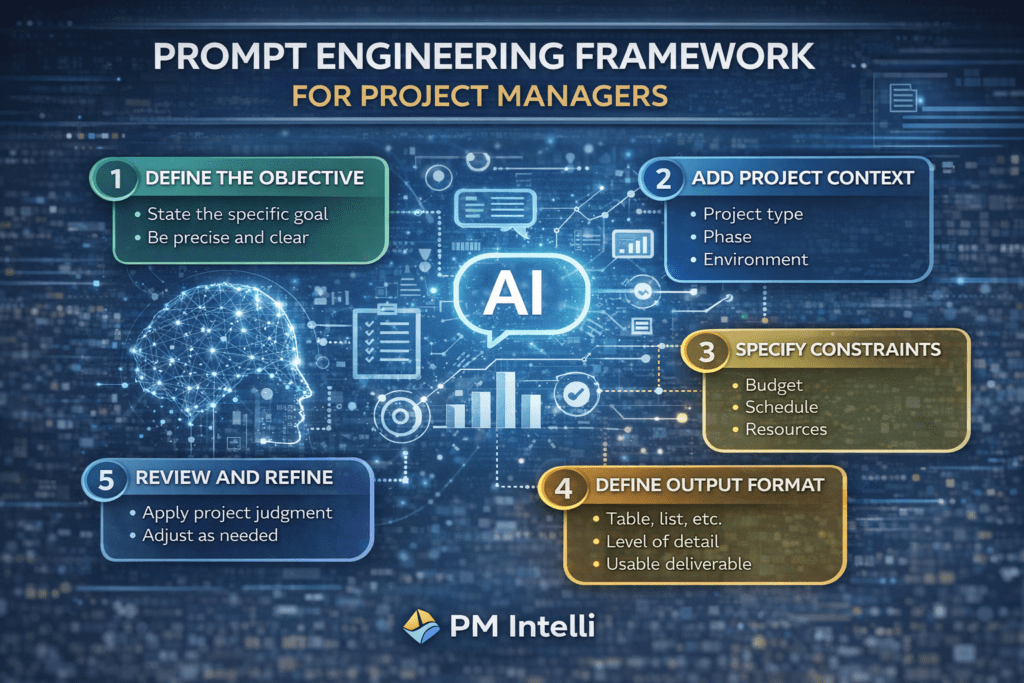
Step 1: Define the Objective Clearly
Begin with a precise goal.
Weak prompt:
Create a project plan.
Strong prompt:
Create a high-level project plan for a 12-month municipal infrastructure project, including major milestones and assumptions.
Step 2: Provide Project Context
Context helps AI understand complexity and priorities. Include:
- Project type
- Current phase
- Regulatory or stakeholder constraints
This is especially important when supporting different phases of the project life cycle.
👉 https://pmintelli.com/the-complete-guide-to-the-project-life-cycle-with-real-examples/
Step 3: State Constraints Explicitly
Constraints guide AI outputs toward practical solutions. Examples include:
- Fixed budgets
- Limited resources
- Safety or regulatory requirements
Step 4: Specify the Output Format
AI delivers better results when expectations are clear.
Examples:
- Tables for risk registers
- Bullet points for action items
- Dashboards for cost tracking
Step 5: Review and Refine
AI outputs should always be reviewed and adjusted using professional judgment. Prompt engineering supports decision-making—it does not replace accountability.
Real-World Applications of Prompt Engineering
Engineering Projects: Risk Identification
For large engineering or infrastructure projects, AI can help identify early-stage risks when guided by structured prompts.
Example use:
- Define scope, duration, and constraints
- Request categorized risks with mitigation strategies
👉 https://pmintelli.com/developing-a-project-risk-register-using-ai/
PMO Reporting and Governance
PMOs benefit from standardized prompts that generate consistent status reports and summaries across multiple projects.
This improves governance while reducing administrative effort.
👉 https://pmintelli.com/what-is-a-pmo-roles-types-and-benefits-explained/
Cost Management and Budget Dashboards
Prompt engineering enables AI to assist with:
- Cost trend explanations
- Forecast narratives
- Dashboard KPI definitions
These outputs support cost control without bypassing controls.
👉 https://pmintelli.com/how-to-create-a-project-budget-dashboard-step-by-step-guide-for-project-managers/
Common Prompt Engineering Mistakes to Avoid
Even experienced project managers can misuse AI if prompts are poorly designed. Common mistakes include:
- Asking vague questions
- Ignoring constraints
- Accepting outputs without validation
- Treating AI as a decision-maker
Prompt engineering helps reduce these risks by enforcing structure and clarity.
Practical Prompt Engineering Tips for Project Managers
- Treat AI like a junior analyst
- Include scope, constraints, and assumptions
- Request outputs aligned with PM deliverables
- Save effective prompts for reuse
- Apply project controls thinking to every prompt
For ready-to-use examples, see:
👉 https://pmintelli.com/beyond-chatgpt-essential-ai-prompts-every-project-manager-should-master/
Strategic Value of Prompt Engineering for PMs
Prompt engineering is quickly becoming a baseline competency for project managers.
Professionals who master it:
- Work more efficiently
- Communicate more clearly
- Improve decision quality
- Lead AI-supported teams responsibly
As AI adoption grows, the ability to guide it effectively will distinguish high-performing PMs.
Conclusion: Prompt Engineering Is About Control, Not Technology
Prompt engineering for project managers is not about mastering AI tools—it is about maintaining control.
The same principles that define good project management—clarity, structure, and accountability—also define effective prompt engineering. Project managers who adopt this skill will be better positioned to lead projects where AI plays an increasing support role.