
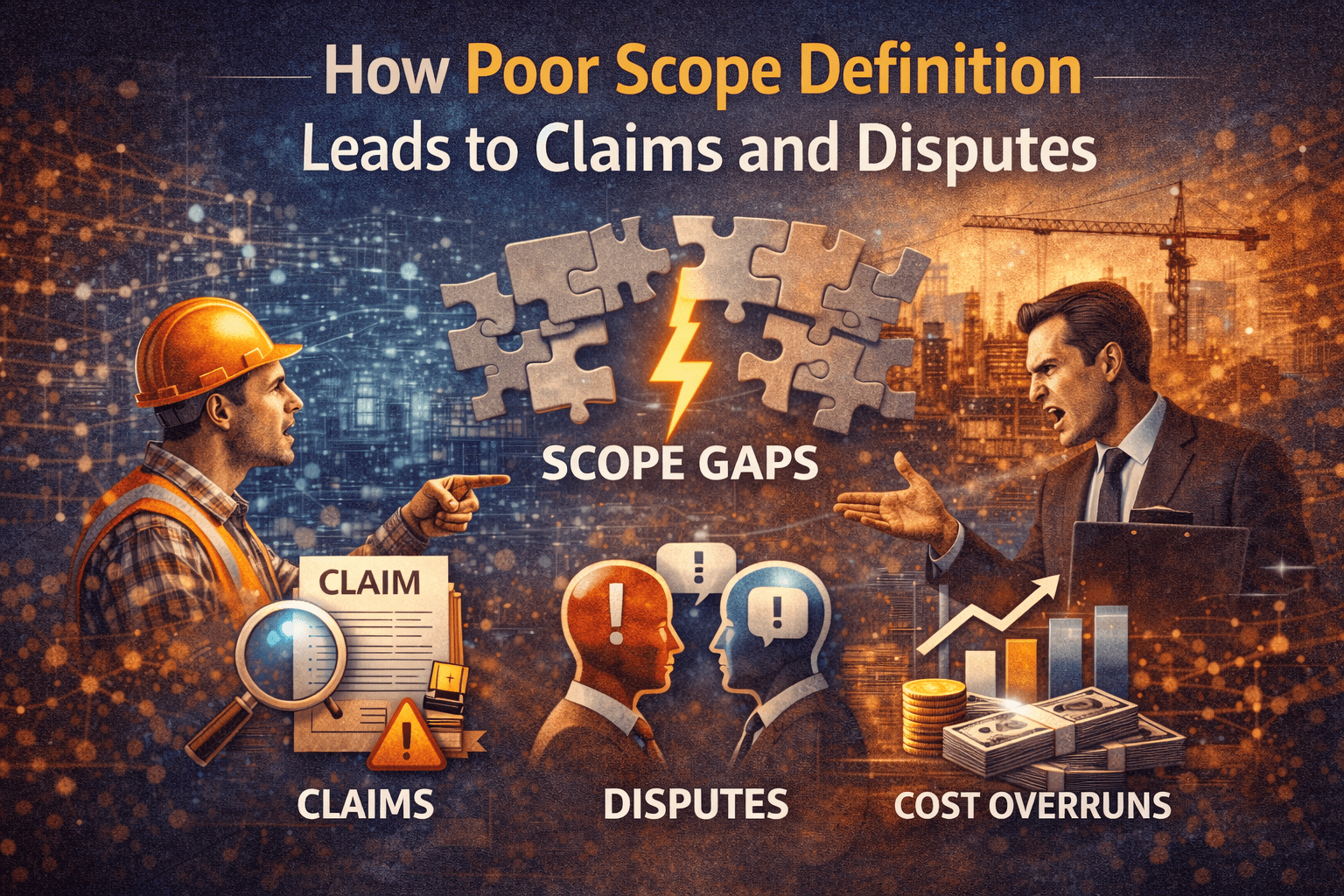
Why Poor Scope Definition Matters More Than You Think
Poor scope definition is one of the most common—and most expensive—failures in project delivery.
Across engineering, construction, infrastructure, and IT projects, unclear scope creates confusion long before it creates claims. However, when cost growth, delays, or quality issues appear, that confusion turns into disputes.
For project managers and project controls professionals, understanding how poor scope definition triggers claims is not optional. It is a core risk management skill. When scope is vague, incomplete, or internally inconsistent, every downstream control—schedule, cost, change management, and risk—becomes fragile.
This article explains how poor scope definition leads to claims and disputes, step by step, using practical project examples and professional best practices.
What Is Scope Definition in Practical Terms?
Scope definition describes what is included, excluded, and assumed in a project.
It establishes boundaries, responsibilities, and performance expectations.
A well-defined scope answers three basic questions:
- What work is required?
- Who is responsible for delivering it?
- Under what conditions is the work considered complete?
Poor scope definition does not mean “no scope.” Instead, it usually means scope exists but is fragmented, ambiguous, or contradictory across documents.
How Poor Scope Definition Creates Claim Conditions
Claims rarely originate from a single mistake. Instead, they develop through a chain reaction that starts early and escalates over time.
Step 1: Ambiguity Creates Multiple Interpretations
When scope language is unclear, each party interprets it differently:
- Owners assume tasks are included
- Contractors assume tasks are excluded
- Designers assume clarification will come later
These interpretations coexist until the work reaches execution.
Step 2: Execution Exposes the Gaps
Once construction or delivery begins, unresolved scope gaps become visible:
- Missing quantities
- Undefined interfaces
- Unclear performance criteria
- Conflicting drawings and specifications
At this point, someone must absorb the effort—or stop the work.
Step 3: Informal Direction Replaces Formal Control
Field staff often resolve scope gaps informally to keep progress moving:
- Verbal instructions
- Sketches issued without approval
- Assumptions made under schedule pressure
These actions create work without contractual alignment.
Step 4: Cost and Schedule Impacts Accumulate
Unplanned scope consumes:
- Labor hours
- Equipment time
- Materials
- Float
Without formal change authorization, costs grow while entitlement remains unresolved.
Step 5: Claims Become the Only Recovery Mechanism
When project closeout approaches, contractors seek recovery through:
- Change order disputes
- Delay claims
- Impact cost claims
At this stage, positions harden and relationships deteriorate.
Common Types of Poor Scope Definition
Incomplete Scope Descriptions
These occur when key elements are missing entirely:
- Temporary works
- Testing and commissioning
- Permits and approvals
- Demolition or relocation activities
Vague Language
Words like “as required,” “as necessary,” or “typical” invite interpretation rather than clarity.
Conflicting Contract Documents
Examples include:
- Drawings showing work not described in specifications
- Specifications requiring performance not shown on drawings
- General notes contradicting detail sheets
Undefined Interfaces
Interface gaps are especially common on complex projects:
- Civil vs. utility work
- Systems integration
- Contractor vs. owner-furnished equipment
Real-World Example: Infrastructure Project Scope Failure
On a municipal roadway project, the scope included drainage upgrades but did not define:
- Limits of pavement restoration
- Responsibility for existing utility conflicts
- Temporary traffic control adjustments during utility work
During construction:
- Utility conflicts required redesign
- Pavement restoration exceeded assumed limits
- Traffic control costs doubled
The owner viewed these as included.
The contractor viewed them as extra.
The result: a multi-million-dollar claim rooted entirely in poor scope definition.
Why Poor Scope Definition Leads to Disputes Instead of Change Orders
In theory, scope gaps should result in clean change orders. In practice, they often do not.
Reasons Include:
- Lack of contemporaneous documentation
- Delayed identification of scope gaps
- Fear of slowing progress
- Pressure to “figure it out later”
When issues are not formally addressed early, entitlement becomes harder to prove.
Role of Project Controls in Preventing Scope-Based Claims
Project controls professionals are often the first to see scope problems—if they know what to look for.
Key Warning Signs
- Schedule activities that lack clear deliverables
- Cost accounts without defined quantities
- Frequent field questions about responsibility
- Change requests with unclear origins
Project controls should flag these signals immediately.
Scope Definition vs. Scope Management
Poor scope definition is a planning failure.
Poor scope management is an execution failure.
Both lead to claims, but definition issues are harder to fix later.
| Aspect | Scope Definition | Scope Management |
| Timing | Early project phase | Throughout execution |
| Control | Contractual | Procedural |
| Risk | High entitlement risk | High cost risk |
Common Mistakes That Lead to Claims
Relying on “Industry Standard” Assumptions
What is standard to one party may not be standard to another.
Copying Scope from Past Projects
Every project has unique constraints, interfaces, and risks.
Treating Scope Review as a Checklist Exercise
Scope review requires critical thinking, not box-checking.
Ignoring Constructability Feedback
Field teams often see scope gaps before claims teams do.
Practical Tips to Prevent Scope-Based Claims
Before Contract Award
- Perform interdisciplinary scope reviews
- Reconcile drawings and specifications
- Identify interface responsibilities explicitly
- Document exclusions clearly
During Execution
- Track scope clarifications formally
- Log assumptions as potential changes
- Align cost codes to scope elements
- Update the baseline when scope changes
At the PMO Level
- Standardize scope definition templates
- Train teams on scope risk identification
- Require scope validation workshops
For deeper fundamentals, see
Project Control Fundamentals – PMIntelli article
How AI Can Help Identify Scope Risk Early
AI tools can assist by:
- Comparing contract documents for inconsistencies
- Flagging ambiguous language
- Identifying scope gaps across revisions
- Highlighting high-risk assumptions
Used correctly, AI supports—not replaces—professional judgment.
Related reading:
AI Prompts for Project Managers – PMIntelli article
Claims Are a Symptom, Not the Root Cause
Claims are often treated as legal or contractual problems.
In reality, they are usually planning and controls failures.
Poor scope definition creates uncertainty.
Uncertainty creates assumptions.
Assumptions create conflict.
Once that cycle begins, claims become inevitable.
Strategic Takeaway for Project Managers
If you want to reduce claims and disputes, focus less on defending entitlement and more on preventing ambiguity.
Strong scope definition:
- Protects relationships
- Stabilizes cost and schedule
- Reduces administrative burden
- Improves project outcomes
Claims prevention starts long before construction begins.
